Tuesday, October 30, 2012

Makhlouta, a comforting rice and lentil soup from Lebanon

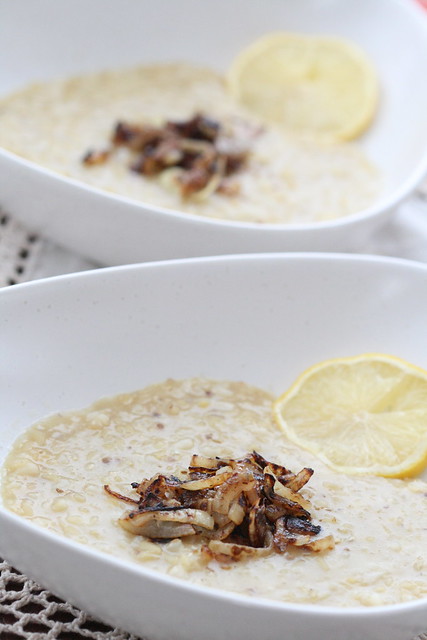
Makhlouta - Lebanese rice and lentil soup / Liibanoni riisi-läätsesupp

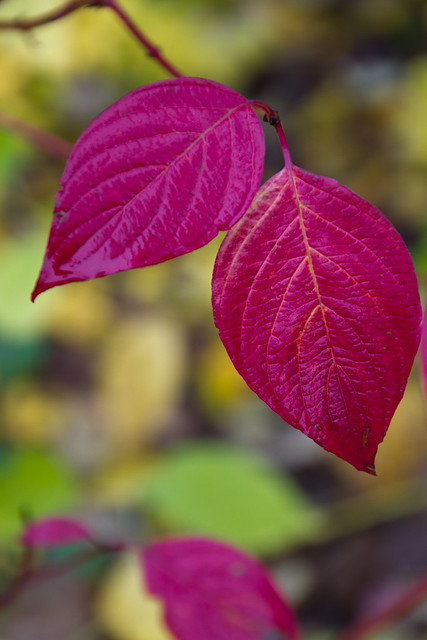
Remember those pictures from our garden, taken just ten days ago? Well, just a week later our garden looked - and is still looking - very different, as the snow came surprisingly early this year, and that first snow is still here.

Kibuvits

Which means it's time to enjoy autumnal hearty flavours from now on. And here's a neat recipe to start with - a Lebanese soup makhlouta. What impresses me most about this is that it hardly contains anything, yet is most satisfying and flavoursome :)The recipe is slightly adapted from Claudia Roden's wonderful Arabesque: A Taste of Morocco, Turkey, and Lebanon, published in 2006. According to Taste of Beirut food blog, makhlouta means 'mixture' in Lebanese Arabic and it's a soupy stew that contains variour legumes and beans such as lentils, kidney beans, white beans, chickpeas, bulgur wheat. Claudia Roden's version is pretty minimalist, containing just rice and lentils, but I often prefere minimalist versions anyway, so I'm happy with this recipe.

Makhlouta - Lebanese rice and lentil soup
(Liibanoni riisi-läätsesupp)
Serves 6 to 8
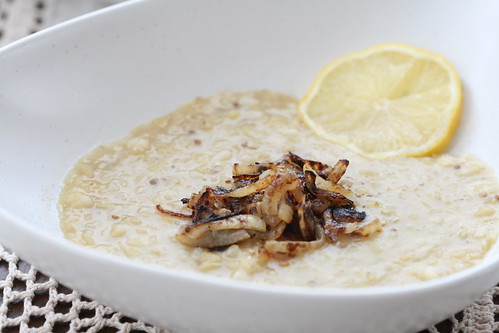
 Makhlouta - Lebanese rice and lentil soup / Liibanoni läätse-riisisupp

2 large onions
3 Tbsp olive oil
2 litres vegetable stock
200 g red 'Egyptian' lentils
100 g risotto or porridge rice, rinsed and drained
2 tsp coriander seeds
salt and black pepper

To serve:
1 tsp cumin seeds, crushed
1-2 lemons, cut into sectors

First make the crispy onion topping. Peel and halve the onions, cut into thin slices.
Heat the oil in a heavy saucepan, add the onions and fry gently until the onions are softened and translucent. Now increase the heat and fry until the onions are golden brown and caramelised. Transfer onto a kitchen paper to crispen.

For the soup, bring the water into a boil. Add the lentils and rice. Season with pepper and add the crushed coriander seeds. Bring into a low simmer, cover and simmer for 35-45 minutes, until both rice and lentils are completely soft and the soup nice and creamy. Taste for seasoning  - add salt, if necessary.

To serve, scoop the soup into warm soup bowls, sprinkle with crushed cumin seeds and garnish with crispy onion rings. Place lemon slices or sectors on the table, so everyone can sprinkle some lemon juice on top of their soup.

More makhlouta recipes out there:
Taste of Beirut
Mama's Lebanese Kitchen
Ya Salam Cooking
The Gutsy Gourmet
The Well-Seasoned Cook


Thursday, October 25, 2012

Finnish mince and cabbage gratin

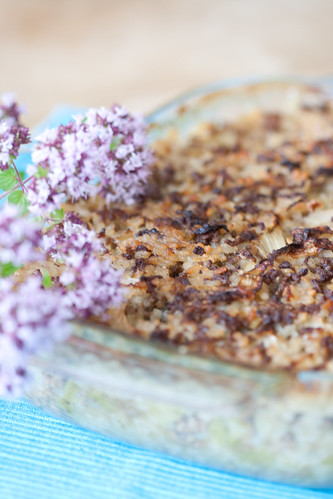
Finnish mince and cabbage dish / Soome kapsa-hakklihavorm

You've already got the recipe for the Estonian cabbage and mince stew (recommended!), here's a Finnish version that's similar, yet totally different. Whereas Estonians like their mince and cabbage as a stew alongside some boiled carrots, the Finns throw in some rice (and syrup or honey - they've got a sweeter tooth!), layer it into a oven dish and bake it slowly until done.

Both are lovely. You could even make a large batch of the Estonian one, and use any leftovers for the Finnish version on the next day :)

The traditional condiment is lingonberry jam (you'll find a jar in your nearest IKEA store), but sour cream works just as well.

Finnish mince and cabbage gratin
(Kapsa-hakklihavorm riisiga)
Serves 6

150 ml short-grain "porridge" rice, uncooked
400 ml water
0.5 tsp salt

about 1 kg white cabbage, finely shredded
1 onion
400 g beef mince
1 tsp salt
0.25 tsp black pepper
1 tsp dried oregano or marjoram
1-2 Tbsp sugar syrup or honey (or use cornsyrup, maple syrup or even agave nectar)
400 ml beef stock

Place rice, salt and water into a saucepan, bring into a boil. Reduce the heat and simmer gently until the rice has absorbed the water. Remove from the heat and put aside.
Chop the onion. Put beef mince and onion into a large and heavy frying pan and fry until slightly browned. Season with salt, pepper and marjoram, then add to the rice.
Add the cabbage to the frying pan, season with a bit of salt and heat, stirring regularly, until the cabbage is slightly coloured and "collapsed". Season with syrup, then combine with the rice and the fried minced beef.
Pour into a medium-sized oven casserole dish, pour beef stock on top.
Bake in a preheated 200 C oven for one hour to one hour and 15 minutes. Use your judgement and cover the dish with a piece of foil at the end, if necessary.

Monday, October 22, 2012

Some pictures from Nami-Nami garden, October 2012

My dear K. took some pictures of our beautiful garden last weekend. The gardening season is more or less over for this year - we picked our last tomatoes and aubergines/eggplants a fortnight ago, this weekend we harvested the last of beets, carrots and potatoes, as well as Jerusalem artichokes (the latter could stay in the ground until the Spring, but we wanted them out from a certain raised bed).

Despite the cold nights and heavy rains, the garden still has some amazing colours on display.

Cornus alba "Sibirica" aka red bark dogwood or red twig dogwood:
 IMG_2824.jpg

Quercus rubra aka northern red oak or champion oak:IMG_2862.jpg

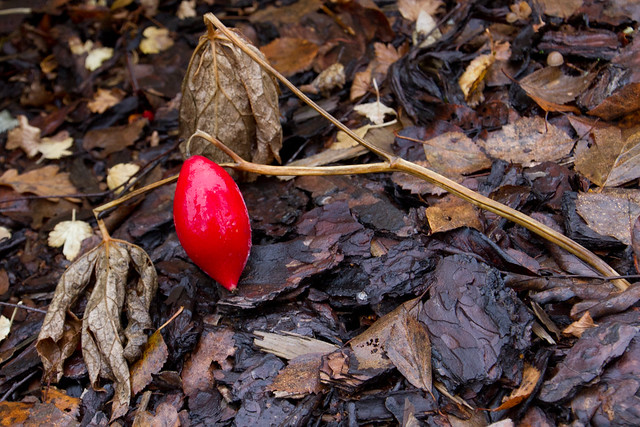
The bright red and ripe fruit of Podophyllum emodi aka Himalayan mayapple or Indian may apple:
IMG_2854.jpg

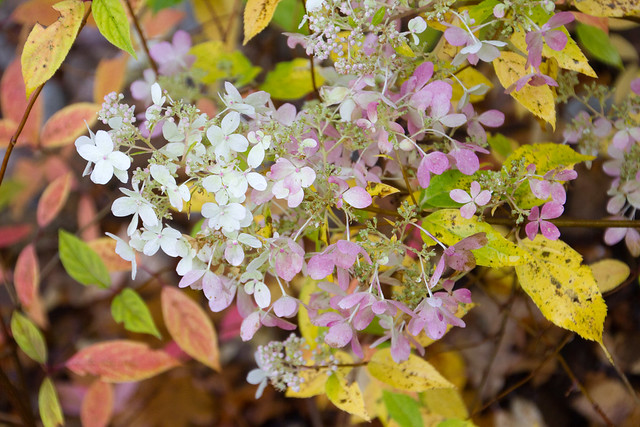
Hydrangea paniculata 'Grandiflora' aka panicled hydrangea:
IMG_2856.jpg

The autumn look of Ligularia stenocephala aka leopard plant:
IMG_2821.jpg

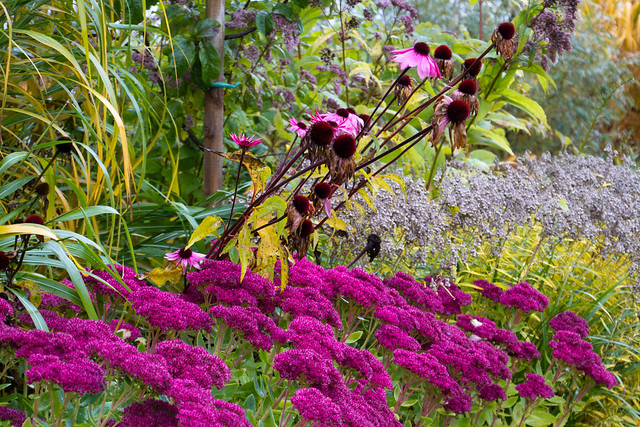
Hylotelephium spectabile (Sedum spectabile) aka showy stonecrop or ice plant in its full glory, Echinacea purpurea aka Eastern purple coneflower or purple coneflowe is finally loosing its beautiful colour:
IMG_2817.jpg

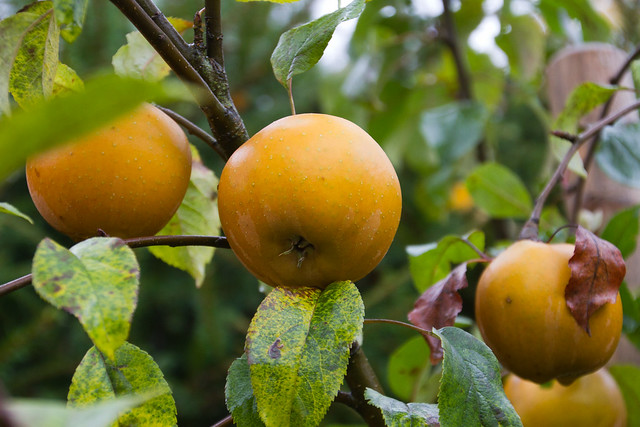
One of my favourite apples back in Scotland was Egremont Russet - perhaps because it's very dissimilar to all the popular apple varieties in Estonia. The russet apple is often described as having a sweet and dry "nutty" flavour, and I agree. When establishing our garden 4 years ago, we ordered two Egremont Russet plants from  England to complement some of our local varieties. Although we got 2 beautiful ripe apples last year, then this year we've been blessed with almost twenty large and perfect russet-coloured dessert apples:
IMG_2807.jpg

Egremont Russet
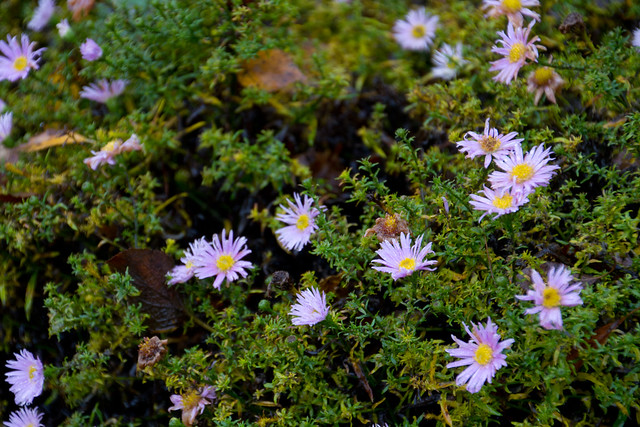
Aster novae-angliae aka aster "New England" is still looking pretty:
IMG_2816.jpg

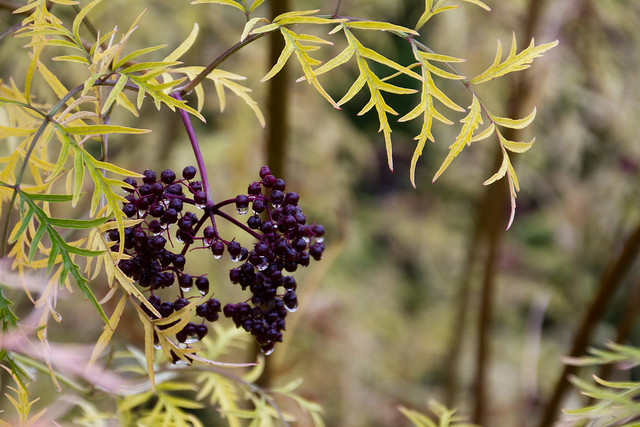
Sambucus nigra or black elder (lace black elder), variety 'Dissectum', has really been thriving in our garden. Earlier this year I used the blossoms to flavour raspberry jam and make several bottles of cordial for the forthcoming winter. Now the berries are ripe and I hope to make some black elderberry jam next weekend:
IMG_2803.jpg

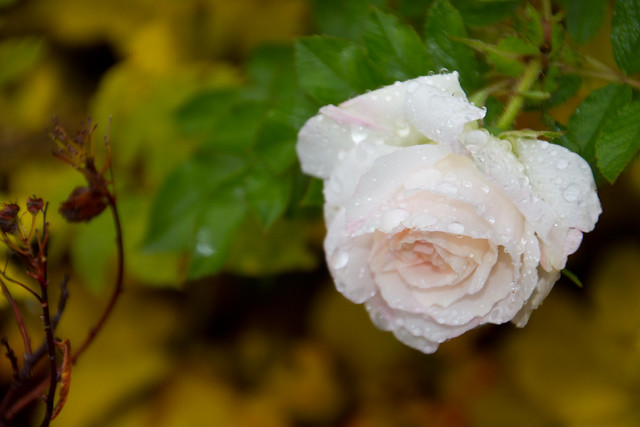
And last, but not least - our beautiful Rosa rugosa aka rugosa rose "Ritausma" has began to blossom again, for the third time this season, if I'm not mistaken:
IMG_2796.jpg

Here's the garden update from May 2012, and here's the garden update in Estonian.

Sunday, October 14, 2012

My recipes in Home & Garden (Kodu & Aed), October 2012

Kodu & Aed, oktoober 2012 (minu esimene toimetatud köögirubriik / I'm their new food editor)

This is the cover of the October issue of one of the best-selling home magazines in Estonia, Kodu and Aed (Home and Garden) and it has my name on the cover page :)

"How come?", you wonder.

In early September I got a phone call from their editor-in-chief, Ms Veigel, asking if I'd be interested in being the editor of the food section. The phone call was totally unexpected and came out of the blue - but as I am unable to return to my academic post at the University just now, I decided to say yes. It all went very quickly then - turned out they wanted me to be in charge of the October issue already and I had about a fortnight to come up with the menu and do the photoshoot. With the help of Juta Kübarsepp, the photographer, we ended up with the following "Pille Petersoo sügismarjamenüü" aka my autumn berries menu. The concept behind the menu was that while Estonians are very good in forageing for wild forest berries (cranberries, blueberries, bilberries, cloudberries, lingonberries and such like), they often overlook the berries in our own garden. Hence I focused on black aronia aka chokeberries (a popular and very beautiful hedge plant, the berries are mainly used for making cordial), sea-buckthorn berries (the super-berry of 1990s and 2000s over here) and rowanberries (the berries of rowan or mountain ash; see also and article in The Guardian).  All three are pretty abundant, especially if you live in a small garden town or on the countryside, yet the vitamin-rich and antioxydant-rich fruit of those trees/bushes are too often left for birds to eat (while trendy urbanites spend a fortune on exotic super-berries like acai, goji, golden inca etc).

Here's the menu, photos by Juta Kübarsepp. 

Gravadlax with sea-buckthorn juice and berries: Õrnsoolatud forelli- või lõhefilee astelpajuga / Gravadlax with sea-buckthorn juice and berries

My autumn berry menu began with lightly salted salmon filet (rainbow trout would be excellent, too), that had been seasoned with salt, sugar, pepper and concentrated sea-buckthorn juice. After 24 hours in the fridge, the fish was thinly sliced and garnished with whole sea-buckthorn berries.

Beef or venison "olives" with rowanberry gravy, accompanied with carrot ragout:
Liharullid pihlakakastmega ning porgandiraguu / Beef "olives" with rowanberry gravy, carrot ragout
The sliced beef or venison is topped with sliced carrot, onion and some rowanberries, then rolled up, fried in the mixture of butter and oil, and then simmered in liquid until done.  The carrot ragout is a simple mix of sliced carrots, onions, oil, water, rosemary and seasonings. Earlier versions of both recipes have been featured here on Nami-Nami about five years ago (see here).

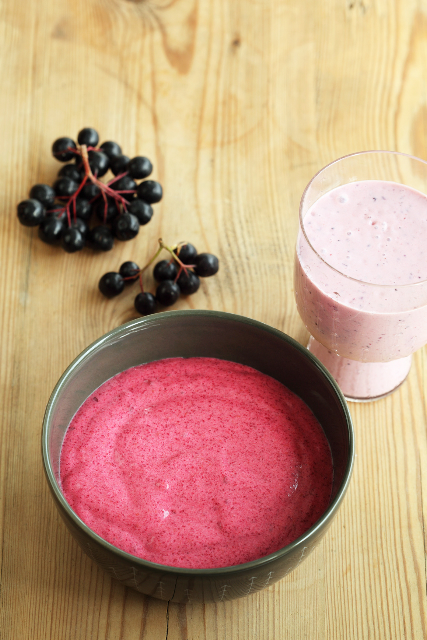
Black aronia smoothie and whipped semolina pudding with apples and black aronia berries:
Aroonia-õunamannavaht & arooniasmuuti / Black aronia smoothie and black aronia and apple pudding

The smoothie is a mix of banana, a handful of black aronia berries, a spoonful of kama or oat bran or oats, a cup of kefir or plain yogurt, sweetened with honey or maple syrup. The whipped semolina pudding (mannavaht) is made with water, apples, black aronia berries, sugar and (wholemeal or spelt) semolina/cream of wheat.

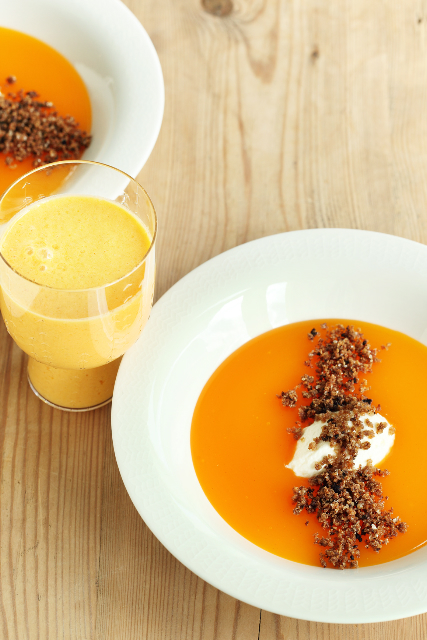
Sea-buckthorn smoothie and sea-buckthorn kissel with crispy rye bread crumbs:
Astelpajusmuuti & kissell krõbeda rukkipuruga / Sea-buckthorn smoothie and sea-buckthorn kissel with crispy rye bread crumbs
The smoothie is a mix of banana, regular or oat milk, (frozen) sea-buckthorn berries or undiluted juice, sweetened with honey or maple syrup. The fruit soup (kissel) contains water, sugar, pureéd sea-buckthorn berries and potato starch/flour (cornflour would do), served with curd cheese mouse and garnished with crispy rye bread crumbs.

How do you like the menu? Are you familiar with any of the berries and if yes, then how do you tend to use them in the kitchen.

We shot the November issue last week and are shooting the December one in a few days, so there's a lot of cooking and writing going on at our house just now.

Thursday, October 11, 2012

Braised Chinese leaves (Peking cabbage) in chicken stock

Chinese cabbage braised in chicken stock / Kanaleemes hautatud Hiina kapsas

What do you usually do with a Peking cabbage/Chinese leaves/Chinese celery cabbage/Napa cabbage (Brassica rapa subsp. pekinensis)?

In Estonia you'll most likely to encounter it chopped into small dice or thin ribbons and mixed with chopped peppers, tomatoes, cucumbers, perhaps some feta cheese, and served as a side salad. Not particularly interesting, but cheap and filling.

I hosted/instructed couple of Chinese cookery events earlier this year, and while preparing for the events, I spent hours browsing my favourite Chinese cookbooks, looking for recipes and inspiration. Fuchsia Dunlop and Ken Hom are my favourites for inspiration (currently in love with Dunlop's most recent book, Every Grain of Rice,  the US version is due in February), but Yan-kit So's Classic Chinese Cookbook, as well as Sasha Gong & Scott Seligman's The Cultural Revolution Cookbook provided a number of excellent dishes for the final menu.

One of the dishes that I included in the final menu, was this humble braised Chinese cabbage, served hot. This particular recipe is from Ken Hom's wonderfully approachable tome, Complete Chinese Cookbook (hardcover, published in August 2011), with tiniest of modifications (you'll find the original recipe for Braised Beijing (Peking) Cabbage in Cream Sauce on p 264); there are rather similar recipes for braised Chinese leaves in Sasha Gong's book (p 21), and in Yan-kit's book (p 205)).

Chinese cabbage braised in chicken stock / Kanaleemes hautatud Hiina kapsas

I was rather sceptical to start with - I had never had these leaves in a hot dish before (and don't care much for the raw version myself). However, this dish was a true revelation - the leaves become almost silky after braising, and the final dish was much bigger that the sum of its parts. As we were enjoying our meal at the end of the 2-hour cooking marathon, most of the participants were expressing their surprise regarding how much they enjoyed this dish, having not had very high expectations about cooking and eating a hot dish using Chinese leaves (and that happened three times, actually, as I hosted three Chinese cooking sessions, all sold out, and all having 15 participants).

Note the dish is gluten-free, and also vegetarian, if you use plain water instead of Chinese chicken stock. Not as flavoursome, but still tasty. 

NB! There are few more Chinese recipes here on Nami-Nami.

Braised Peking cabbage in chicken stock
(Hautatud Hiina kapsas leeme sees)
Serves four to six

Chinese cabbage braised in chicken stock / Kanaleemes hautatud Hiina kapsas

500 g Chinese leaves
1 Tbsp groundnut oil
3 large garlic cloves, peeled and thinly sliced
300 ml chicken stock (ideally Chinese-style chicken stock)* or water
1 tsp salt
0.5 tsp ground white pepper

To thicken:
2 tsp cornflour + 2 Tbsp water (optional)

Cut the Chinese leaves into 5 cm (2 inch) wide strips.
Heat the wok. Add oil and heat until hot and slightly smokey. Add the garlic, stir-fry for 15 seconds.
Add the cabbage leaves, stir-fry for 2 minutes.
Add the stock or water to the wok, season with salt and pepper. 
Reduce heat, cover the pan and simmer on a low heat for 15 minutes, until the cabbage leaves are softened.
Using a slotted spoon, remove the cabbage leaves from the pan and place into a serving dish.
Reduce the remaining liquid by half. Add the cornflour water, heat through to thicken*.
Pour the thickened stock over the cabbage leaves and serve at once.

* To be really honest, I've usually skipped the final thickening phase with cornflour and simply reduced the liquid.

Thank you, Marju, for helping me style this simple dish for the photo shoot.

Sunday, October 07, 2012

Oven-baked toffee apples (from the recipe archives)

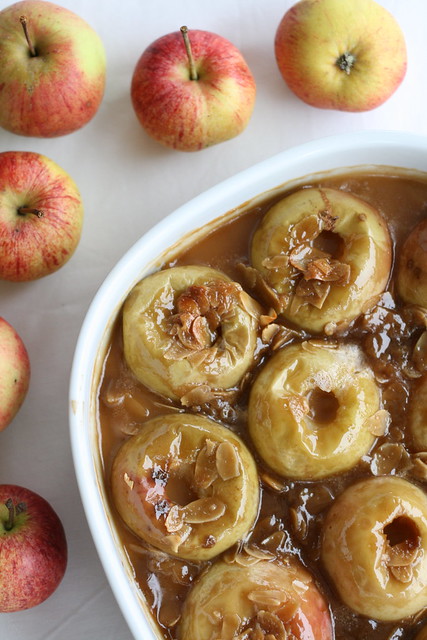
Baked apples with almond slices and toffee sauce / Ahjuõunad iirise-mandlikattega
September 2010

This recipe was originally posted in September 2008, but it's still a big favourite with our friends and family, so I decided to showcase this again. It's a wonderful twist on the traditional oven-baked apples, that should appeal to everybody with a sweet tooth.

Oven-baked Toffee Apples
(Ahjus küpsetatud õunad mandli-iirisekattega)
Serves 4 to 6

September 2008

4 to 6 large firm apples

Toffee-almond topping:
50 g almond slices
50 g unsalted butter
200 ml soft brown sugar
200 ml whipping or double cream
1 Tbsp potato starch or cornflour

To serve:
vanilla ice cream

Peel the apples (NB! this is optional, see comment below*), halve and core them. Fit them snugly into a buttered oven-dish, cut-side down.

Mix brown sugar and potato flour/cornflour in a small saucepan. Add butter, almond slices, and fresh cream. Bring slowly into the boil, stirring regularly. Spoon the toffee mixture onto the apples.

Bake in the middle of a pre-heated 200 C / 400 F oven for 20-30 minutes (cooking time depends on the apples), until apples are cooked and toffee topping has thickened. KEEP YOUR EYES ON THE PUDDING and take care not to burn the toffee sauce!!!

Cool a little and serve with ice cream or soft whipped cream.

* In general, I tend not to peel apples from my mum's or grandma's garden, or apples from a reputable organic source. However, peeling apples beforehand does make for neater presentation and easier eating afterwards.

 
This recipe was also included in my first cookbook, Nami-Nami kokaraamat ("Nami-Nami Cookbook"), published in Estonian in December 2010.