Wednesday, January 28, 2015

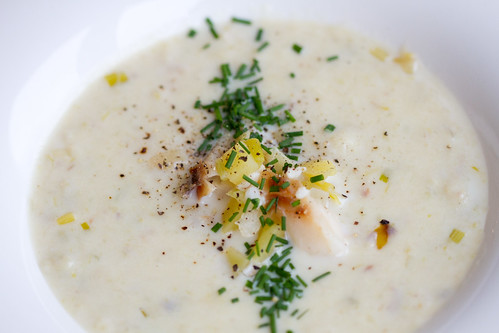
Cullen Skink, a Scottish smoked haddock and potato soup (gluten-free)


IMG_3073.jpg

Few days ago the Scots - and friends of Scotland - celebrated yet another anniversary of the birth of Robert Burns, hosting or attending a Burns Supper. Any self-respecting Burns Supper begins with a proper Scottish soup. I've shared a recipe for Cock-a-leekie before, other options are Scotch broth and Cullen Skink.  Now it's time to share my recipe for the smoked haddock and potato soup - think of it as a Scotch chowder :)

The soup is from the North-East of Scotland, from the fishing town of Cullen. Originally it's a comfort food, cheap and easy fare, and it's still popular in and around Cullen. Yet somehow that humble soup has tranformed into a fancy fare to be enjoyed at various festive Scottish occasions.

Scots know their smoked fish. Arbroath Smokie is a pair of salted haddocks, hot-smoked in a humid smoking chamber. Finnan Haddie, the traditional fish used for making Cullen Skink, is gutted and cleaned haddock that's been dry-salted and then smoked in a cool smoking chamber for 8-9 hours. If Finnan Haddie is hard to find where you live - that's probably most of the world apart from the British Isles - (and avoid the bright yellow dyed stuff, it discolours the soup), then any other nice smoked white fish would do. I used smoked cod, a user of my Estonian Nami-Nami site said that the soup worked well with smoked herring.


Cullen Skink
(Šoti suitsukalasupp)
Serves 6 as a starter, 3 as a main dish
IMG_3083.jpg


500 g smoked haddock (ideally Finnan Haddie)
500 ml (2 cups) of water
butter for frying
1 yellow onion, chopped
1 large leek, cleaned and sliced
2-4 floury potatoes, peeled and cut into chunks
500 ml (2 cups) whole milk
1 bay leaf
salt and freshly ground black pepper
fresh chives, finely minced

Place the fish into a pan, add the bay leaf and cold water. Gently bring into a boil, then simmer for about a minute or two. Remove the fish from the pan, transfer onto a plate and leave to cool. Keep the fish stock!

In another pot melt the butter gently. Add onion and leek, cover and sauté gently for a about 10 minutes. Stir every now and then, do not brown! Season with salt and pepper. Add potato pieces to the onion and leek, give it a stir. Add 500 ml/2 cups of fish stock, bring into a boil and simmer until the potato is cooked.

At the same time remove the fish from the bones carefully, flake into smaller pieces (discard the fish skin and bones). Using a slotted spoon, take couple of spoonfuls of the potato-leek mixture from the soup and put aside. Discard the bay leaf. Add the milk, bring gently into a boil. Add about half of the smoked fish. Mash the remaining soup or pureé using the hand-held/immersion blender. Season with salt and pepper.

To serve, place a large spoonful or two of potato-leek-smoked fish mixture into the middle of each soup bowl, then ladle the liquid soup neatly into the bowls as well. Garnish with chives and serve.

Tuesday, December 30, 2014

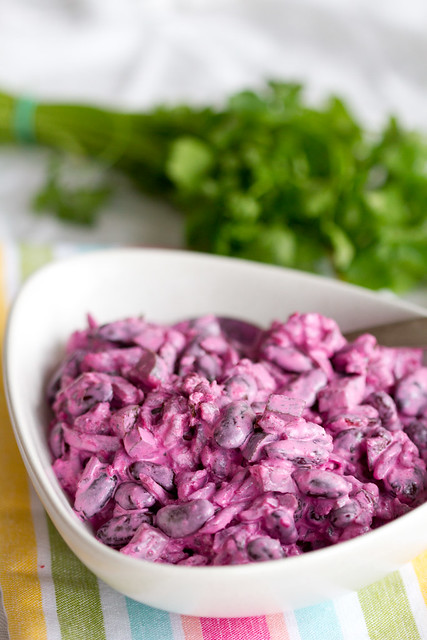
Recipe for a Latvian Beet and Bean Salad (Pupiņu un Biešu Salāti)

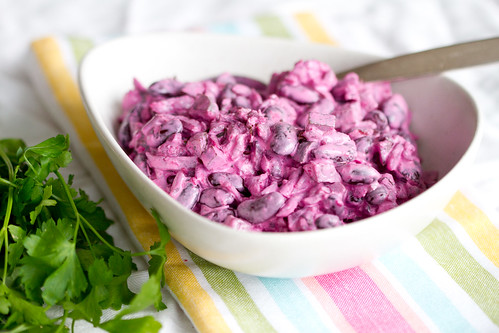
Läti peedi-oasalat. Latvian beet and kidney bean salad.  Pupiņi un Biešu Salāti. Rūjienas salāti.

A few years ago Saveur, the American food magazine, featured some Latvian recipes (Latvians, remember, are our Southern neighbours). Among them was a recipe for beet and bean salad, Pupiņu un Biešu Salāti, that caught my attention. I love beetroot, and cook and eat various beetroot salads quite frequently. Some of my favourite beet salad recipes have been featured here on Nami-Nami as well over the last 9+ years, like the Russian vinaigrette salad, beet and potato salad, layered vegetable salad with smoked salmon, to name just a few.

Given my love of beets and the simplicity of the salad, it was only the matter of time I made this salad. We loved it, a lot, although the salad is probably more Russian than Latvian in its origins (any Latvian readers wanna comment on this?). It has also proved to be highly popular with my Estonian readers (like the ones on Nami-Nami's Facebook page), and who knows, perhaps you'll be positively surprised as well :)

Just a handful of ingredients, but surprisingly lot of flavour. Gluten-free as well.

Latvian Beet and Bean Salad 
(Peedi-oasalat)
Adapted from Saveur.com
Serves six to eight

Läti peedi-oasalat. Latvian beet and kidney bean salad.  Pupiņi un Biešu Salāti. Rūjienas salāti.

200 g sour cream (20%)
100 g mayonnaise
400-500 g cooked beetroot*
2 cans of kidney beans (about 400 g/12 oz each), rinsed and drained
4 pickles, chopped
salt and pepper
fresh parsley or chives, finely chopped

* You can use boiled, steamed or roasted beet to make this salad. I use coarsely shredded boiled beetroot. 

In a large bowl, whisk the sour cream and mayonnaise until combined, then season with salt and pepper. Add the beet, beans and pickles, folding them into the sour cream and mayonnaise dressing. Season again, then transfer the salad into the serving dish and sprinkle with herbs.

Friday, December 12, 2014

Layered Vegetable Salad with Smoked Salmon

(From the Nami-Nami recipe archives.)

Layered smoked salmon salad / Suitsulõhega kasukas

"Kasukas" - "fur coat" - is a name for a layered vegetable salad that is very popular here in Estonia, especially during the cold and dark season. The salad has chopped cured herring as the bottom layer, topped with layers of grated or chopped beets, carrots, potatoes and other vegetables and "glued together" with thin layers of mayonnaise. The recipe - or rather an alternative way to serve the popular "rosolje" salad - came to Estonia from Russia in the second half of last century. In Russia "fur coat" aka "shuba" is still one of the most popular salads on the festive table (here's a lovely English-language blog post about the traditional "cured herring under fur coat"), and the un-layered "rosolli" is also a must on Finnish Christmas tables). Whereas I love beets, I dislike cured herring, so I tend to skip that salad on buffet tables. When making this at home, I'd usually make a double portion and divide the salad between two glass bowls - one with herring and the other without. Until I came across a version using smoked salmon in Natasha's Kitchen blog. That was about a year and a half ago, and since then I've made this salad over and over again and converted many kasukas-haters into kasukas-lovers.

Traditionally this salad is made and served in a big glass bowl that proudly shows off all the layers, and then it's spooned into serving plates (rather like a trifle). For a neater presentation, you may want to use individual glass bowls instead (see top photo). A note to my Estonian readers - I like making this with külmsuitsulõhe aka cold-smoked salmon (Pepe Kala makes a wonderful one!), rather than with kuumsuitsulõhe aka hot-smoked salmon.

Suitsulõhega kasukas

Layered Smoked Salmon and Vegetable Salad
(Suitsulõhega kasukas)
Serves about 6 to 8

Kasukas suitsulõhega

200 g smoked salmon
400 g potatoes
1 small onion, peeled and finely chopped
200 g cooked beetroot (roasted, steamed or boiled)
250 g carrots
about 300-400 g good-quality mayonnaise
2 eggs

Boil (unpeeled!) carrots and potatoes until soft, but not mushy. Drain, cool a little, then peel.
Hard-boil the eggs, then cool and peel.

To compose the salad:
1. Cut the salmon into small pieces and scatter evenly at the bottom of a 2-litre (approximately 2-quart) glass bowl.
2. Grate the potatoes coarsely, scatter over the salmon.
3. Scatter chopped onion over the potato layer.
4. Gently spread about half of the mayonnaise over the onion layer.
5. Grate the beetroot coarsely, scatter over the mayonnaise layer.
6. Grate the carrots coarsely, scatter over the beetroot layer.
7. Spread rest of the mayonnaise over the beetroot layer.
8. Finely grate the eggs, scatter over the mayonnaise layer.

NB! As the mayonnaise is seasoned already, there is no need to season any of the layers with salt and pepper!

Cover the bowl with clingfilm and put into the fridge for a few hours for the flavours to combine (and the beetroot colour to stain the other layers :)) The salad can be happily made on a previous day as well, as it keeps rather well.

This recipe was also included in my latest cookbook, Jõulud kodus ("Christmas at Home"), published in Estonian in November 2011.