What is kama?Kama is one of the oldest dishes in Estonian kitchen. People either love it or hate it. Non-Estonians are usually extremely suspicious of it, at least if they're not from Eastern or Northern Europe. But it's popular amongst Estonians, especially in the summer.
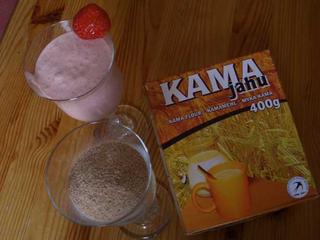
So what is it? Basically it's a mixture of various roasted and ground grains that are usually just mixed with sour or curdled milk or kefir or such like. I used to translate it as a 'flour drink' when I was younger, which obviously didn't win it any more friends. The product packaging says: "Kama flour" healthy and natural product made of Estonian crops. A meal from kama flour will provide you with a healthier diet option. Kama flour is a product rich in fibres and minerals* and a valuable source of B group vitamins. Use kama flour with fermented milk products, it will double the healthy impact.'
Making kamaTo make kama, one needs to boil the grains separately in a slightly salted water and then dry in the sun/dry place. The grains are then roasted in the oven, and then ground and mixed. The most common kama in Estonia is a mixture of peas, rye, barley and wheat. It's not unique to Estonia though - in Finland they have a similar product, called
talkkuna or
mutti, depending on the region. The Setus in South-East Estonia and the Finns of Häme region in Finland like oat kama, Karelians prefer barley kama. Finnish talkkuna is usually a mixture of roasted and ground barley or oat, with an occasional addition of peas.
Eating kamaThe simplest - and most traditional - way of serving kama is mixing it with curdled or buttermilk. Depending on the amount of kama you end up with a
'külm kört' that can be drunk or with thicker
'kamakäkk' that can be formed into small balls and eaten with hands. If you don't like the idea of curdled milk, then you can mix kama flour with fresh milk and season it with salt and some sugar. Mixing kama flour with sour cream and seasoning with sugar results in another tasty option.
On the picture above I mixed some yogurt, sugar, fresh strawberries and kama in a blender, which resulted into a really yummy, refreshing and filling summer drink. I like the way you can taste something 'grainy' in the mixture. If left to stand for a while, the kama flour thickens considerably and the result is more suitable for eating with a spoon than drinking.
For a slightly modern and more 'internationally agreeable' version, I've mixed kama flour with mascarpone cheese, nuts, some cream liqueur (a la Bailey's) and sugar and rolled into small balls that you put into fridge for a while before serving. (Recipe
here)
Kama flour can be used in baking and for making various desserts (I will surely blog about some desserts in the future). There's even a breakfast cereal - kamapallid or 'kama balls' in Estonia know made out of kama flour.
Kamatahvel or kama 'chocolate'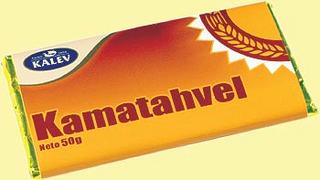 Source: AS Kalev
You can even find kama in
'chocolate' bars - and this product is unique to Estonia. Namely during the Soviet era in 1970s, the price of cocoa beans increased and these became almost unavailable in Soviet Union. The main confectionery factory in Estonia,
Kalev, had a witty worker who tried replacing cocoa flour with kama flour. The result was obviously not a chocolate, but it was nevertheless delicious and became very popular in Estonia. I remember buying it as a school kid - it was a lot cheaper than some of the other chocolate bars available. In early 1990s the product was discontinued, as shop shelves in Estonia were flooded with
Fazer chocolates from Finland, Marabou chocolates from Sweden and every other chocolate from around the world one can imagine. Capitalism was in full bloom and no-one thought that such a humble product as kama chocolate would have any commercial appeal. However, in 2001 the 'chocolate' was reintroduced. The wrapping paper looked exactly the same, apart from the disappearance of the word 'chocolate' (aargh, the joys of EU regulations;) - now it is marketed as
kamatahvel. There was no advertisement campaign whatsoever. But the nostalgia can be a powerful marketing tool - and within months the newly introduced kamatahvel was one of the top-selling 'chocolates' in the market.
Interested?If you're curious to try kama, then drop me a line - I'm happy to send you some. Kama is sold in 400 g packets. I can also send you some kama 'chocolate'. I'm a patriotic blogger, you see:)
* Just FYI:
nutritional values for the most common kama flour sold in Estonia (produced by AS Cibus) per 100 grams:
Energy 341 kcal, Proteins 15.6 g, Carbs 63.6 grams (of which sugars 1.0 gram), Fats 2.7 grams (of which saturated fatty acids are 0.4 grams), Fibres 14.1 grams, Sodium 0.04 grams, Vitamin B1 - 0.51 mg, Niacin 3.0 mg, Pantothen acid 1.5 mg, Phosphorus 340 mg, Magnesium 115 mg, Iron 8 mg
Update: 22.3.2006 - Manne of Tummyrumble took up my offer and has written about what he thinks of the kamatahvel here.