Showing posts with label Cuisine: Arabic/Middle Eastern. Show all posts

Wednesday, October 09, 2013

Roasted pumpkin soup with almonds and spicy dukkah oil a la Silvena Rowe

IMG_8296.jpg

From the recipe archives, originally posted in October 2011. Totally worth making!!! 
PS Check the comments section - Silvena Rowe herself left a comment - how cool is that!?

I spotted this soup recipe in Silvena Rowe's beautiful Orient Express: Fast food from the eastern Mediterranean, one of my recent cookbook acquisitions. I've been making various pumpkin soups and certainly wasn't looking for a new soup recipe, but this one caught my eye because of almonds. There are almonds both inside the soup and in the dukkah-mixture (Not sure what dukkah is? You can read more about it here). We cooked four recipes from Silvena's book last Sunday (see the menu below, scribbled on our newly painted kitchen wall), and the soup was very well received. The almonds add a thickness and a lovely texture to the soup, the dark red pomegranate seeds are a true eye candy, and the dukkah oil is a wonderful flavour enhancer. I more or less followed the recipe, though I used a bit more pumpkin and less chicken stock, and used some coriander/cilantro for garnish.

IMG_8284.jpg

You can either use any orange-fleshed winter squash here - butternut squash or a Hokkaido pumpkin (potimarron in French). Well, you could use any winter squash, but orange-fleshed one looks prettiest :)

More pumpkin soup recipes @ Nami-Nami:
Pumpkin soup with nutmeg
Pumpkin soup with thyme
Estonian pumpkin and semolina soup

Roasted pumpkin/butternut squash soup with dukkah
(Röstitud kõrvitsa supp mandlite ja vürtsiõliga)
Serves six

IMG_8291.jpg

For the dukkah oil:
50 g while almonds
1 Tbsp coriander seeds
0.5 Tbsp cumin seeds
0.25 Tbsp fennel seeds
5-6 Tbsp olive oil

For the soup:
1.2 kg orange-fleshed pumpkin or squash
8 fresh sage leaves, chopped
2 onions, peeled and quartered
6 garlic cloves, peeled
4 Tbsp olive oil
750 ml chicken stock (3 cups)
100 g ground almonds
sea salt and freshly ground black pepper

To serve:
pomegranate seeds
fresh coriander/cilantro leaves

Preheat the oven to 180 C/350 F.

Peel the pumpkin, remove the seeds and cut the flesh into 2-3 cm (1 inch) chunks. Place onto a large roasting tray alongside the onion quarters, garlic cloves and chopped sage leaves. Season to taste with salt and pepper, drizzle with olive oil:

IMG_8271.jpg

Cook the vegetables in the preheated oven for 30-40 minutes, until the pumpkin is soft. Remove from the oven and cool.

Make the dukkah oil while the pumpkin is roasting. Place the spices and almonds onto a small dry frying pan and cook over a moderate heat until fragrant and slightly golden (keep an eye on them, as the spices burn easily!):

IMG_8277.jpg

Using a pestle and mortar (or a small food processor), bruise the spices and almonds until you've got a coarsely ground mixture. Add the oil, put aside.

When the vegetables are cooked, place them into a food processor or a blender. Blend to a purée, adding a little of the vegetable stock if necessary. Return the pumpkin purée into the saucepan, add the rest of the stock. Bring into a slow boil, then simmer for 15-20 minutes, until the soup is smooth and slightly thickened. Stir in the almonds, season to taste.

To serve, ladle the soup into warmed bowls. Spoon some dukkah oil on top, sprinkle with pomegranate seeds and garnish with some cilantro/coriander.

IMG_8289.jpg

Tuesday, October 30, 2012

Makhlouta, a comforting rice and lentil soup from Lebanon

Makhlouta - Lebanese rice and lentil soup / Liibanoni riisi-läätsesupp

Remember those pictures from our garden, taken just ten days ago? Well, just a week later our garden looked - and is still looking - very different, as the snow came surprisingly early this year, and that first snow is still here.

Kibuvits

Which means it's time to enjoy autumnal hearty flavours from now on. And here's a neat recipe to start with - a Lebanese soup makhlouta. What impresses me most about this is that it hardly contains anything, yet is most satisfying and flavoursome :)The recipe is slightly adapted from Claudia Roden's wonderful Arabesque: A Taste of Morocco, Turkey, and Lebanon, published in 2006. According to Taste of Beirut food blog, makhlouta means 'mixture' in Lebanese Arabic and it's a soupy stew that contains variour legumes and beans such as lentils, kidney beans, white beans, chickpeas, bulgur wheat. Claudia Roden's version is pretty minimalist, containing just rice and lentils, but I often prefere minimalist versions anyway, so I'm happy with this recipe.

Makhlouta - Lebanese rice and lentil soup
(Liibanoni riisi-läätsesupp)
Serves 6 to 8

 Makhlouta - Lebanese rice and lentil soup / Liibanoni läätse-riisisupp

2 large onions
3 Tbsp olive oil
2 litres vegetable stock
200 g red 'Egyptian' lentils
100 g risotto or porridge rice, rinsed and drained
2 tsp coriander seeds
salt and black pepper

To serve:
1 tsp cumin seeds, crushed
1-2 lemons, cut into sectors

First make the crispy onion topping. Peel and halve the onions, cut into thin slices.
Heat the oil in a heavy saucepan, add the onions and fry gently until the onions are softened and translucent. Now increase the heat and fry until the onions are golden brown and caramelised. Transfer onto a kitchen paper to crispen.

For the soup, bring the water into a boil. Add the lentils and rice. Season with pepper and add the crushed coriander seeds. Bring into a low simmer, cover and simmer for 35-45 minutes, until both rice and lentils are completely soft and the soup nice and creamy. Taste for seasoning  - add salt, if necessary.

To serve, scoop the soup into warm soup bowls, sprinkle with crushed cumin seeds and garnish with crispy onion rings. Place lemon slices or sectors on the table, so everyone can sprinkle some lemon juice on top of their soup.

More makhlouta recipes out there:
Taste of Beirut
Mama's Lebanese Kitchen
Ya Salam Cooking
The Gutsy Gourmet
The Well-Seasoned Cook


Tuesday, September 18, 2012

A recipe for Shakshuka (shakshouka), or eggs nested in spicy tomato sauce

Shakshuka / Shakshouka
You'll find the recipe for this wonderfully simple and flavoursome basic shakshouka at the end of this post. The colourful selection of hot peppers and tiny tomatoes is from our greenhouse.  


I went to Israel back in June (see disclaimer at the end of this post), and fell in love with shakshuka (also spelled as shakshouka). Shakshuka is a northern African dish, originally from Tunesia or Algeria (depends who you ask from) that has become extremely popular in Israel over the last decades. We were told on several occasion that this is one of the two dishes that every Israeli man knows how to cook (I cannot recall what was the other one. Anyone?). I'm sure Israeli women are pretty good in making this dish as well, but yes, it's mainly men who boast who can make and eat the most fragrant and spicy shakshuka for breakfast :)

As with many traditional dishes, there are as many recipes around as there are cooks.  The hugely popular Yotam Ottolenghi has a version in his second bestselling book, Plenty, using onions and plenty of bell peppers and you can see him making his version of shakshuka in this video recipe on Guardian's website. The guru of Jewish food, Claudia Roden, includes a recipe for shakshouka in her epic The Book of Jewish Food. She notes that  

"This name us used for all kinds of dishes involving fried vegetables with eggs broken on top. A variety of vegetables, from potatoes and broad beans to artichoke hearts and courgettes, are used in Tunesia, where the dish originated, but it is the version with onions, peppers and tomatoes that has been adopted in Israel as a popular evening meal".

Claudia Roden also includes two variations in her book - one with spicy merquez sausage, the other with white Bulgarian cheese.  In another excellent book, Tamarind and Saffron, Claudia Roden provides two recipes, one with the merquez sausage, the other one with peppers and garlic instead of onions, which also happens to be my Allium of choice for this recipe.

Janna Gur - a popular and well-known Israeli food writer whom we had a pleasure of meeting twice during our trip to Israel (she's standing on the far left on this photo) - has included a recipe and several variations of shakshuka in her beautiful The Book of New Israeli Food: A Culinary Journey. Janna claims that there are just three mandatory ingredients - tomatoes, hot sauce and eggs, and her basic recipe includes garlic, fresh and canned tomatoes, seasonings and eggs (note: NO peppers!). She also includes varieties with onions and peppers, with spicy merquez or small cocktail sausages, "the Israeli Army shakshuka" with canned corn, baked beans and sausages, as well as the mild tomatoless shakshuka with spinach and feta.

Last, but not least, there's a recipe for shakshuka in Rebbetzin G. H. Halpern's rather humorously written Confessions of a Kitchen Rebbetzin, using plenty of bell peppers (green, yellow and red), garlic cloves, eggs and spices. Rebbetzin goes as far as claiming that shakshouka is probably the dish Israelis enjoy eating most:

"What Israelis really dig is Shakshuka - a well seasoned North African dish of eggs in hot tomato sauce. The best and nicest (and most barbaric) way to eat it is straight from the pan, no utensils needed, by dipping thick chunks of simple bread."

Here are some of the shakshukas we  enjoyed during our trip to Israel*. First off, the large Shakshuka at restaurant Cordelia (Chef Nir Zook), Old Jaffa, Israel. Challah bread (on the background) is perfect for scooping up the spicy tomato and egg dish:
 Shakshouka for breakfast @ Cordelia (chef Nir Zook), Jaffa, Israel

Here's a "single portion" shakshuka at Manta Ray, Jaffa, Israel - about to be devoured by the colourful Ms Marmite Lover. Note the thin layers of grilled cheese on top of the shakshuka - wonderful, if not traditional, addition. Another fellow traveller, David Lebovitz, mentions shakshuka in his extensive post about Israeli breakfast.
 Shakshouka for breakfast at Manta Ray, Jaffa

As the eggs play such an important role in this dish, it's best to use the freshest organic/free-range eggs you can afford. Luckily, our backyard chicken keep us well stocked with eggs at the moment and of course, I used eggs from our own chicken. Here are our Orpington chickens, Buffy and Fluffy, earlier this year. They're excellent layers:
Buffy & Fluffy (Orpingtons)

My recipe below is pretty basic - just garlic, tomatoes, seasonings and eggs. Although you can use fresh tomatoes during the summer time, I'll include canned tomatoes in the recipe - the fresh tomato season is coming quickly to an end here in Estonia, and you wouldn't want to use the flavourless winter supermarket tomatoes here. You'll find links to fancier and more elaborate versions below. Somehow I prefer this dish to be very basic.

As hinted above, you need a good bread - no pita bread (that's for eating hummus!), but a nice challah or a bloomer or a crusty country bread to scoop up all the shakshuka from the pan!

A simple shakshuka recipe 
(Shakshuka ehk teravas tomatikastmes küpsetatud munad)
Serves one

1 Tbsp oil
1 large garlic clove, crushed
200 g chopped tomatoes
a generous pinch of chilli flakes or a scant teaspoon of harissa
a pinch of ground cumin
a pinch of ground caraway seeds
salt and freshly ground black pepper
2 eggs

Heat oil in a small frying pan over medium heat. Add garlic and fry gently, until garlic is golden.
Add the chopped tomatoes and the seasonings, stir, cover and let simmer for 10-15 minutes, until the tomato sauce is well flavoured and slightly thickened. Taste for seasonings - add more chilli or other spices, if necessary.
Using a spoon, make two dents into the tomato sauce and break an egg into each one. Sprinkle some salt on top and heat for another 5-6 minutes, until the egg white is thickened and the egg yolk is half-cooked (if you prefer your egg yolk fully cooked, cover the pan or transfer it under a hot grill for a few minutes.

Other foodbloggers writing about shakshouka (in English): 
Kitchen Parade (September 2012; Alanna hosted me generously - and fed me, of course - in June 2008. Do check out her blog, if you're not yet familiar with it)
The Wednesday Chef (September 2006)
Smitten Kitchen (April 2010; Deb crumbles feta cheese on top of her shakshouka)
The Bojon Gourmet (October 2011)
The Leftover Queen (May 2012)
The Shiksha in the Kitchen  (July 2010)
A Sweet Spoonful (March 2012, incl. fennel!)
Cook Republic (May 2011)

Other foodbloggers writing about shakshouka (in Estonian):
Ise tehtud. Hästi tehtud. (August 2011)

 * Disclaimer: I spent six days in Israel in late June/early July as a guest of a non-profit social start-up Kinetis, more specifically their Vibe Israel programme. This particular trip hosted five international food bloggers and writers, introducing them to the multifaceted and pluralist Israeli culture and cuisine. 

See other posts about my trip to Israel.

Monday, June 04, 2012

Persian scrambled eggs with dill (panir bereshteh)

Persian scrambled eggs with feta and dill / Pärsia munahüüve fetajuustuga

After "discovering" this wonderful Persian beetroot and yogurt borani recipe, I was hungry for more Persian recipes. Browsing the FoodBlogSearch results and using Google gave me plenty of ideas for diversifying my family's diet during the coming weeks. One dish that really caught my eye was "Persian feta omelette" that's apparently a real hit at byblos le petit café - a favourite Persian brunch location in Montreal, Canada. As we have a ready supply off fresh eggs from our four chickens, I'm always willing to try new egg recipes, and this feta omelette fit the bill nicely.

Fluffy (Orpington)
Fluffy, one of our two Orpingtons, on a walk 

I didn't have an exact recipe, instead I took inspiration from here and there (see some links at the bottom of this post). I call it Persian scrambled eggs with feta as opposed to Persian feta omelette, as, well, this is how I make scrambled eggs and not an omelette :) By blitzing the eggs with feta cheese first guarantees you have a uniform feta-egg mixture, and every bite you take tastes of the lovely feta cheese, as well as the farm-fresh eggs.

Serve with a selection of flat and soft white breads, or on top of - or between - toasted sliced bread.

Persian scrambled eggs with feta cheese
Serves two to three

Persian scrambled eggs with feta and dill / Pärsia munahüüve fetajuustuga

4 large eggs
200 g soft feta cheese
freshly ground white or black pepper
a pinch of oregano or marjoram

fresh dill, to garnish

Place the eggs and the feta into the beaker of your hand-held/immersion blender and blitz until combined. Season with pepper and a pinch of oregano or marjoram.
Lightly oil a heavy-bottomed omelet pan.
Pour the egg mixture into the cold pan and place the pan onto a hob over a medium-low heat. Heat gently and slowly, stirring with a wooden spatula or spoon, until the eggs are scrambled, yet soft and creamy.
Remove the pan from the heat, transfer the eggs into a serving dish. Garnish with chopped dill and serve at once.  

More about Persian feta omelette/omelet: 
Cooking and Cooking (recipe for Panir Bereshteh)
Julie's "Eating Project" blog (see photo no 5)
She Said (same recipe/photo in the Australian Herald Sun)
Cheese contest @ Canadian Living

Tuesday, May 29, 2012

Beetroot borani recipe (borani chogondar)

Peedi-borani / Beetroot borani / Beet borani

Any regular reader of Nami-Nami has noticed the respectable number of beetroot recipes on this blog. My friend Alanna of A Veggie Venture blog even calls me "Beet Princess" (she reserved the title of Beet Queen to herself, and indeed, her list of beetroot recipes is pretty impressive, too :)

Here's my latest discovery among beetroot recipes. I was browsing Sam and Sam Clark's latest book, MORO EAST, and this Persian dish caught my eye. Borani is a general term for yogurt-based vegetable "salads" and dips in Persian cuisine. We really enjoyed this, eating it with simple oven-baked potato wedges on our sunny patio. It'd work well on a meze/mezze board with some toasted flatbread, or alongside some grilled or fried fish, oven-roasted lamb or even grilled chicken. It's extremely versatile, as you can imagine.

I will surely be making this borani chogondar again over the summer (I loved the colour!!!), perhaps alongside the spinach version (borani esfanaaj) and the aubergine/eggplant version (borani bademjan).

Make it at least a few hours in advance, so the flavours can develop.


If you're a fellow beet lover, you may want to check out the Beautiful Beet Recipes Pinterest board, where you'll find 100+ great pins leading you to some wonderful foodbloggers' recipes. If you'd love to contribute to that board, then just leave your Pinterest handle in the comments and I'll send you an invite!


Beet Borani
(Peedi-borani)
Serves 6 to 8 
Based on Sam & Sam Clark's recipe, with some modifications

Peedi-borani / Beetroot borani / Beet borani

500 g young beets
400 g thick/strained Greek/Turkish/Persian yoghurt
1 large garlic clove (crush to a paste with a generous pinch of salt)
a pinch of sugar
a small bunch of fresh dill, finely chopped
sea salt and freshly ground black pepper
a splash of wine vinegar or lemon juice, to taste

To garnish:
100 g feta cheese, crumbled
a small handful of walnuts, chopped
a sprinkling of nigella seeds (also known as black Kalonji onion seeds)
a few dill fronds

Scrub the beets, but don't peel them. Place into a boiling water and simmer for 1-1,5 hours, until cooked. Drain and cool and peel, then cut into chunks and place into a food processor.
(Note that you can also roast the beets, or, in a hurry, use boiled un-vinegared beets).
Process the beets, then add the yogurt, crushed garlic and a pinch of sugar, process again until smooth.
Add  the chopped dill, then season to taste with salt, pepper and vinegar/lemon juice.
Transfer onto a serving bowl, cover with clingfilm and put into the fridge for a few hours so the flavours can mingle.
When ready to serve, garnish with crumbled feta, chopped walnuts and some dill fronds. Sprinkle black nigella seeds on top.

 Peedi-borani / Beetroot borani / Beet borani

See other beetroot borani recipes: 
Smoke and Umami
Café Leilee
The Salty Pear
Liz Z  (Liz uses mint to flavour her borani)
Chef Yusuf

Wednesday, February 09, 2011

Chickpea and tomato soup with Moroccan spices

Moroccan chickpea soup / Maroko kikerhernesupp

Here's a delicious chickpea/grabanzo soup recipe adapted from this book by the lovely Irish chef, Rachel Allen. It's quick, flavoursome, vegan and gluten-free (unless you serve it with crispy bacon or some herb croutons) and easy to make. It's been a while since I made it - seeing one of the few Estonian male foodbloggers making this the other day (check out the video!) - brought it back to our table. Our daughter loved it, K. loved it, and I loved it - so it's definitely a keeper. Hope you enjoy it, too!

I used canned chickpeas - dried ones are much harder to come by here in Estonia. If you prefer using dried chickpeas, then take 150 grams of pulses, soak them overnight in cold water and then boil in unsalted water for about half an hour.

Moroccan chickpea and tomato soup
(Maroko kikerhernesupp)
Serves four

Moroccan chickpea soup / Maroko kikerhernesupp

2 Tbsp olive oil
1 large onion, peeled and chopped
2 celery sticks, chopped
salt and freshly ground black pepper
2 tsp cumin seeds, slightly crushed
400 g can of chopped tomatoes
a generous pinch of sugar
400 g can of chickpeas, rinsed and drained
600-750 ml vegetable or chicken broth
juice of half a lemon
2 Tbsp fresh cilantro/coriander or parsley

Heat the olive oil in a saucepan. Add the onion and celery sticks, season with salt and pepper. Cover the saucepan with a lid and sauté over low heat for about 10 minutes, until the onion and celery are soft, stirring every now and then (do not burn!)
Add the cumin seeds, fry for another minute to release the aromas.
Add the tomatoes, sugar, chickpeas and hot stock. Simmer on low heat for 5-10 minutes.
Season with lemon juice, stir in the chopped herbs and taste for seasoning. Serve.

Friday, July 30, 2010

My favourite quick dish of the summer: Harissa-spiked houmous

Harissa hummus

If there is one dish that I've been making over and over again (apart from fried chantarelle mushrooms in various disguises), it's this quick and spicy version of houmous, the Middle-Eastern chickpea/garbanzo dish. I love the traditional houmous to bits, but sometimes it's nice to play around with your favourites a bit. I've had my fling with a beetroot houmus, and I've been eyeing a roasted pepper houmous recipe for a while now. But first, I need to get tired of this harissa-spiked houmus recipe, and this hasn't happened yet. (If you've got a favourite 'way with houmus', then I'd love to hear about it!)

I use Belazu's Rose Harissa, but any other favourite would work just as well. Suitable for vegetarians, vegans, celiacs as well, so a very handy recipe to have :)

Harissa-spiked houmous
(Hummus harissaga)
Adapted from BBC Good Food, June 2009 (see original recipe)
Serves 4 to 6

Harissa hummus

400 g can of chickpeas/garbanzos
2 Tbsp extra virgin olive oil
couple of spoonfuls of water
1 large garlic clove, chopped
about half a lemon, juiced
1 scant Tbsp harissa paste
1 Tbsp tomato pureé / tomato paste
salt, to taste

coriander/cilantro or parsley for garnishing (optional)

Drain the chickpeas and place to the food processor with the rest of the ingredients. Blend until you've got a smooth paste (or slightly coarse, if that's how you prefer your houmous). Taste for seasoning - if you wish, add some more harissa or lemon juice or salt.
Excellent with toated pita bread, or on a slice of toast, or spread on crispy crostini or as a dipping sauce with some crudités.

Hummus with harissa / Harissaga hummus

Sunday, June 06, 2010

Ottolenghi's roasted aubergine with saffron yoghurt

Roasted aubergine with saffron yogurt / Röstitud pommu e. baklažaan safranijogurtigalant

Ottolenghi's new book, Plenty, is just out, and I've already bookmarked several recipes from the book that I'm keen to try. Meanwhile, I'm still in love with their first book, Ottolenghi: The Cookbook. I've blogged about their bright and beautiful cucumber and poppy seed salad already (and I've made it twice). I've tried their orange florentine cookies twice. But there's a dish I've made thrice at home, as well as twice at a Middle Eastern cooking club session I hosted few months ago. That's their fabulous recipe for roasted aubergine (eggplant) with saffron yogurt. I cannot imagine anyone not liking this salad (well, perhaps if you hate aubergine/eggplant and saffron :)) - it's bright and colourful, with contrasting textures and bold, interesting flavours. I've followed the recipe pretty much to the letter, apart from roasting the aubergine slices on a hot griddle instead of the oven, and slicing them into rounds as opposed to wedges. Highly recommended (if you like aubergines and saffron, that is :))

See also Meeta's beautiful version of this recipe. Her beautiful and detailed posting almost discouraged me to blog about the salad, but then it's my favourite dish, too :)

Roasted aubergine with saffron yoghurt
(Röstitud pommud safranijogurtiga )
Serves four

Roasted aubergine with saffron yogurt / Röstitud pommu e. baklažaan safranijogurtiga

2 medium-sized aubergines
olive oil for brushing
2 Tbsp pine nuts, toasted
a large handful of pomegranate seeds
a large handful of basil leaves
sea salt flakes and freshly ground black pepper

Saffron yogurt:
a small pinch of saffron strands
3 Tbsp hot water
200 g thick Greek yogurt
1 garlic clove, finely crushed
3 Tbsp lemon juice
3 Tbsp extra virgin olive oil
sea salt flakes

Start by making the sauce. Place the saffron strands into glass, pour over the hot water and let infuse for 5 minutes. Pour the infusion into a bowl containing the yoghurt, crushed garlic, lemon juice, olive oil and some salt. Whisk well to get a smooth, golden sauce. Taste for seasoning and chill until ready to use (Can be made up to 3 days in advance).
Cut the aubergines/eggplants into 1 cm slices (cross-wise). Brush both sides with oil, sprinkle with salt and pepper. Grill on a very hot griddle pan until soft and golden brown, then flip over and fry the other side until golden brown as well. (Alternatively - and originally - roast for 20-30 minutes in a 220 C oven). (This can also be done up to 3 days in advance. Keep the roasted aubergine slices in the fridge, but bring to room temperature before serving).
To serve - layer the roasted aubergine slices onto a serving dish, slices slightly overlapping. Drizzle with saffron yogurt, sprinkle with toasted pine nuts, torn basil leaves and pomegranate seeds.

Tuesday, June 02, 2009

Warm Gingered Carrot Salad with Feta Cheese

Warm ginger and carrot salad with feta cheese / Ingveriporgandid fetajuustuga

Updated and revised, with a new photograph. Originally posted on November 24, 2005

We don't eat meat every day in our household. We're not vegetarians, but meatless days definitely outnumber the meaty ones. Here's a typical dish we would have as an evening meal - a large portion of sauteéd, yet still slightly crunchy carrots, seasoned with mustard seeds and lots of ginger and topped with feta cheese just before serving. Served with some crusty Italian or French bread, and you're set for a wholesome and light meal. It would also work well on a buffet table, as the carrot salad tastes nice when lukewarm.

See other vegetarian carrot recipes @ Nami-Nami:
Oil-marinated carrots with rosemary and orange
Alanna's carrots with African spices, my way
Kalyn's Roasted Carrots and Mushrooms with Thyme and Parsley
Alanna's Cumin Carrot Chips
Estonian grandmother's Carrot Ragout
Warm Moroccan Carrot Salad

Warm Ginger and Carrot Salad with Feta Cheese
(Soe porgandisalat fetaga)
Serves 4 as a side dish or 2 as a main meal

Warm gingered carrot salad with feta cheese / Soe ingveri-porgandisalat fetajuustuga

500 grams of organic carrots, thickly sliced
1 onion or 3 shallots, peeled and sliced
1 heaped tsp mustard seeds
2 Tbsp butter
100 ml /almost 1/2 cup/ water
2-3 tsp finely grated fresh ginger
1 tsp sea salt
2-3 Tbsp fresh parsley or basil or chives
100-150 grams crumbled for cubed eta cheese
freshly ground black pepper, to taste

Peel the carrots and slice thickly. Peel and slice the onions finely.
Heat butter on a heavy frying pan over a medium heat, add mustard seeds and fry for a minute, until the mustard seeds start 'popping'.
Add carrots and sauté for about 5 minutes, stirring occasionally.
Reduce heat a little, add the onion slices and continue sautéeing for another 5 minutes, until onion starts to turn opaque.
Add the water and cook, until the water has evaporated and the carrots are al dente.
Season with ginger, salt and herbs, cook for another minute and then remove from the heat.
Transfer onto a warmed serving dish, scatter feta cheese on top and season with some freshly ground black pepper.

Warm gingered carrot salad with feta cheese / Soe ingveri-porgandisalat fetajuustuga

Monday, May 25, 2009

Spicy Chicken Couscous with Rose Harissa

Chicken couscous with Belazu rose harissa / Maitsev kanakuskuss harissaga

Here's a lovely, and rather fiery, chicken couscous that I made on several occasions earlier this year. The chicken is first marinated in a yogurt-harissa mixture, then gently cooked in the same marinade, before mixed with couscous and some additional ingredients. It's got plenty of taste, good texture and it's definitely not dry - a problem I find with so many couscous dishes and couscous salads.

I used Belazu's Rose Harissa - a rather expensive, but very tasty British harissa paste available in deli shops. But I'm sure your regular harissa would work, too.

Spicy Chicken Cous-Cous with Rose Harissa
(Maitsev kanakuskuss harissaga)
Serves 6

500 g chicken breast or thigh fillets
200 g plain yogurt
1 heaped tsp Rose Harissa paste

CousCous:
300 ml water
1 Tbsp olive oil
1 tsp salt
250 g medium-grain couscous
2-3 Tbsp butter

In addition:
250 g cherry tomatoes
handful of spring onions (white and light green parts only)
handful of fresh coriander/cilantro

Cut the chicken pieces into small strips (about an inch long and 1 cm wide). Fold harissa into the yogurt, then throw in the chicken pieces, stirring, so all chicken pieces are covered with marinade. Cover and place in the fridge for an hour.

Prepare the couscous. Heat the water, salt and oil in a saucepan. Remove from the heat and whisk in the couscous. Cover the saucepan and leave for 2-3 minutes. Return to the heat, add the butter and heat for 2-3 minutes, stirring, until the butter is melted. Remove from the heat and keep covered.

Take a small frying pan, add a splash of oil, rinsed cherry tomatoes and season with salt and pepper. Sauté for 2-3 minutes, until the cherry tomatoes are hot. Add to the prepared couscous and cover again. /No need to stir at this point/.

Take a large frying pan and dip in the chicken strips with the marinade. Heat over a moderate heat for 7-8 minutes, until chicken pieces are cooked through and the marinade hot. Pour over the couscous.

Stir the whole lot gently with a large spoon, then scatter chopped spring onions and coriander leaves on top.

Serve.

Monday, October 13, 2008

Quail Eggs with Dukkah


Have you heard of dukkah before? I had, but hadn't actually eaten any until this June, when in Bloomington, US, I had a chance to try a lovely pistachio dukkah made by Cindy Bradley, a local food blogger. Basically, it's an Egyptian dry mixture of chopped nuts (mainly hazelnuts), seeds (coriander, cumin, sesame) and possibly some other spices. It's a popular street food, where fresh wheat bread is dipped first into olive oil and then into the dukkah-mixture. But it can also be sprinkled on salads to give some crunch (say, instead of toasted pinenuts). Apparently it can be used for breading fish and meat when cooking. Quite a few bloggers have already featured dukkah on their blogs - Heidi adds black peppercorns for some heat, Jaden adds chilli pepper for an extra kick, Rosa combines almonds and hazelnuts, and my dear friend Ximena cheats a little :)

The recipe below is very lightly adapted from the British food magazine Olive (January 2007), and makes a small bowl of very simple dukkah. Feel free to play around with spices.

Quail Eggs with Dukkah
(Vutimunad dukkah-seguga)
Serves six to eight

24 quail eggs

Dukkah-mixture:
50 grams hazelnuts
1 Tbsp cumin seeds
1 Tbsp coriander seeds
25 grams white sesame seeds

To serve:
Maldon sea salt flakes

First you need to blanch the hazelnuts*. Put them on a dry frying pan and roast for 3-4 minutes over a moderate heat, until they're aromatic and slightly browned. Then place on a clean kitchen towel and rub with the towel, until the brown skins come loose. Chop the nuts as rather finely (best done with a knife, as there's a danger of processing the nuts into a paste, when using a food processor).
Place coriander seeds, sesame seeds and cumin seeds on a dry frying pan and toast also for 2-3 minutes, until the seeds start to brown and smell fragrant. Cool, then mix with the toasted and chopped nuts.
Tip into a serving bowl and put aside.
Cook the quail eggs in simmering water for 3 minutes. Drain and run under cold water for a few minutes.
Serve with the dukkah and Maldon sea salt flakes. Each person peels their own eggs, then dips them into salt flakes and the dukkah mixture.

* If you can get blanched hazelnuts (I can't here in Estonia), then simply toast them for a few minutes and then chop finely.

Other recipes using QUAIL EGGS at Nami-Nami:
Small "mushrooms" of quail eggs and cherry tomatoes
Rye bread canapés with wild mushroom 'Caviar' and soft-boiled quail eggs
Soft-boiled quail eggs with dill and lightly salted whitefish roe
Spicy fried quail eggs

Monday, May 26, 2008

Persian Lamb and Rhubarb Stew


I love rhubarb. I've just checked my Flickr photostream and it seems that I've made no less than seven rhubarb cakes, six different rhubarb puddings, one type of jam and one drink during the last few weeks alone. But I was determined to try something savoury as well, so I combined this BBC Good Food recipe and this Delicious magazine recipe (they're remarkably similar, aren't they?), and made this Persian lamb stew.

Not sure this is my favourite new way of serving lamb, but it's definitely a nice and different recipe for using rhubarb. Frying of the herbs in butter is essential for the success of this recipe, as the flavour and aroma of fried parsley and mint is rather special, so no skipping of that part!

Persian Lamb and Rhubarb Stew
(Pärsia lambahautis rabarbriga)
Serves 4 to 5

75 g butter, divided
1 Tbsp sunflower or rapeseed oil
2 large onions, halved and sliced
750 g lamb, chopped into cubes (I used the leg)
2 tsp ground coriander seeds
1 litre vegetable stock
salt
freshly ground black pepper
sugar or honey, to taste
20 g fresh parsley, chopped
3 Tbsp fresh mint, chopped
400 g rhubarb, cut into 1 inch lengths

Melt 25 g of butter in a heavy-based saucepan on a low-moderate heat. Add onions and saute for 10 minutes, until golden and softened. Put the onion aside.
Increase the heat to high and add the oil. Add about half of the cubed lamb and brown all over (about 5 minutes). Put the browned meat aside and brown the rest of the lamb.
Return all the meat and the onions to the saucepan, add coriander. Add enough hot stock to cover. Reduce the heat, cover the saucepan and simmer on a low heat for about an hour.
Season with salt and pepper.
Melt 25 g of butter in a small saucepan, add the chopped fresh herbs and fry, stirring frequently, for 5 minutes. Add the fried herbs to the meat and simmer for another 30 minutes.
Melt the rest of the butter and add chopped rhubarb. Saute for 3-5 minutes, until rhubarb is soft, but not mushy. (If the rhubarb is very sour, add about a tablespoonful or two of sugar or honey). Stir the rhubarb into the stew.
Taste for seasoning and serve with rice or couscous.

Similar posts:
Persian lamb stew with rhubarb and mint by Ariana @ And Here We Are ...
Persian lamb with rhubarb and chelow @ Australian Gourmet Traveller
Persian rhubarb stew by Azita @ Turmeric and Saffron
Persian lamb and rhubarb stew by Dani @ The Kitchen Playground
Persian lamb and rhubarb stew by Laszlo @ Chef de Paprika

Monday, March 10, 2008

Something Spicy: Red Lentil Soup

This is my entry to the latest round of Waiter, there is something in my ... , this time hosted by lovely Jeanne of Cook Sister!, who has chosen pulses as the theme.

Although I've got plenty of Estonian recipes (as well as beetroot recipes:) in store for you, I decided to post something altogether spicier today - a red lentil soup. It's based on a recipe for Spicy Egyptian Lentil Soup in lovely Claudia Roden's "Tamarind and Saffron", but I tinkered with the recipe and the serving suggestions a bit, and really loved the result. It was on our table last Saturday, when couple of friends came over for a Scrabble night, and all four of us went for second helpings.

Spicy, exotic (well, for us:), heart-warming, delicious, comforting.

Spicy Red Lentil Soup
(Vürtsikas läätsesupp)
Serves 4-6


3 Tbsp olive oil
1 large onion, finely chopped
3 garlic cloves, finely chopped
2 tsp cumin seeds, slightly crushed
1.5-2 tsp coriander seeds, slighly crushed
1 tsp red chilli flakes
400 g chopped tomatoes or passata
400 g red lentils, rinsed
2 medium carrots, coarsely grated
2 litres chicken stock
salt
freshly ground black pepper
juice of half a lemon

To serve:
fresh coriander/cilantro leaves, finely chopped
plain yogurt/sour cream

Heat the oil in a large saucepan, add onion and fry gently for 7-8 minutes, until onion softens.
Add the garlic, crushed cumin and coriander seeds (I use my pestle & mortar), chilli flakes. Give it a stir and fry for another minute.
Add the tomatoes, red lentils, grated carrot and hot chicken stock. Bring to the boil, reduce the heat and simmer, half-covered, for 30-45 minutes, until lentils begin to break up.
Season with lemon juice, salt and pepper. Dilute with hot water, if necessary.

Serve with a dollop of coriander cream (mix coriander and cream/yogurt).*

* Claudia Roden suggested serving her soup with fried crispy shallots. But I had a lovely Egyptial lentil soup with coriander cream in a new deli-café near university here, so I 'stole' that serving idea instead.

Wednesday, October 24, 2007

Alanna's spicy carrot side dish recipe

[From the recipe archives. Originally posted on January 7, 2007. Updated with a new photo in October 2007]

I love foodblogging. Just when you're trying to come up with plans for dinner (not that it's a problem with all my cookbooks and food magazines and ever-expanding dishes-to-do-list, but still) , a recipe 'jumps' at you from a friendly foodblog while you're browsing your Bloglines alerts. That's exactly what happened to me yesterday lunch-time with Alanna's recipe for carrots with African spices. Funnily enough, it's not the first time carrot recipes 'come to me' from Alanna - she also reminded me of Kalyn's roasted carrots with mushrooms that has become one of my favourite carrot dishes..

I stocked up on carrots on the way home, and just half an hour after getting to our casa, K. and I enjoyed a wonderful meal you can see below. I used lime juice and fresh parsley, and added a spoonful of honey to the carrots for extra sweetness and a hint of glaze. Wonderfully fragrant and delicious! No leftovers whatsoever..

Alanna's carrots with African spices, my way
(Vürtsikad porgandid)
Very slightly adapted from Alanna's wonderful blog A Veggie Venture.
Serves 2 as a vegetarian main dish, more as a side dish.


1 Tbsp olive oil
4 cloves garlic, finely chopped
2 tsp Hungarian sweet paprika powder
1 tsp cumin seeds, slightly crushed
1 tsp coriander seeds, slightly crushed
300 ml water
500 grams carrots, peeled and cut into chunks
1 Tbsp lime juice
1 Tbsp honey
salt to taste
a handful of fresh parsley or coriander/cilantro, chopped

Heat the olive oil in a large saucepan, add the spices and garlic, stir for about a minute, until the spices are all aromatic.
Add the water and bring to the boil.
Add the carrots, season with salt and lime juice. Simmer gently for about 20 minutes (I like my carrots al dente - you may want to simmer them longer, like Alanna does), adding a spoonful of honey half-ways.
Once the carrots are your preferred consistency, then season, sprinkle with fresh parsley and serve, spooning any remaining liquid on top (the boiling water has been infused with spices, honey and carrot juices - you don't want to waste that!)

Other carrot dishes at Nami-nami:
Kalyn's roasted carrots with mushrooms (April 2006)
Moroccan carrot salad (December 2005)
Gingered carrots with feta cheese (November 2005)
Carrots with rosemary & orange (August 2005)

Wednesday, January 24, 2007

Small Lebanese lamb 'pizzas' with pomegranate molasses and pomegranate seeds

Here's a recipe for some small lamb 'pizzas' that were on the table during yet another housewarming/welcome party back in December, alongside (though not necessarily simultaneously) with salmon & cream cheese canapés, grilled beetroot & suluguni cheese canapés (basically a non-rye bread no-goat cheese version of my contribution to the (in)famous Cheese Sandwich Day; Suluguni cheese was left over from hatchapuri), puff pastry sausage rolls with sesame seeds, small puff pastry & mushroom tartlettes, Molly's chocolate & nut blocks and raspberry marshmallows, among other things. These were really interesting - the pomegranate molasses adds a certain sweetness and depthness to the topping, and pomegranate seeds really make the dish sparkle. And believe me - cinnamon is the perfect pairing to the minced lamb..

The recipe is from one of the books by Sam & Sam Clark - the restaurateur couple I met in Edinburgh last March. It's a second dish from them on my blog in about a month or so - I also tried their chicpea salad with pomegranate seeds and saffron recently. Considering that I've bookmarked many other recipes, then the Clarks are probably going to make an appearance again soon:)

Small lamb 'pizzas' with pomegranate molasses & seeds
(Väikesed lambalihapirukad)
Adapted from Sam & Sam Clark's Casa Moro (p. 42, Flatbread with lamb, pine nuts & pomegranates)
Yields ca 40 small 'pizzas'


(On the top left corner you can see small salmon canapés that I first served on my birthday back in April; on the top right, small puff pastry sausage rolls with sesame seeds; at the centre at the far back, a bowl of wasabi peas)

The dough:
a batch of your favourite pizza dough or some other yeasted bread dough, using about 300 ml of liquid (I used half of the dough for my tiny mushroom pies)

The topping:
500 grams of lean lamb meat, ground
2 Tbsp olive oil
1 onion, finely chopped
2 cloves garlic, finely chopped
1 tsp ground cinnamon
4 Tbsp pomegranate molasses
50 ml water
sea salt
freshly ground black pepper
peanuts

To garnish:
chopped fresh parsley
seeds from one large pomegranate

Prepare the yeast dough and let it rise according to your favourite recipe (or use half a batch of dough from here)

For the filling, grind the meat (I used the special food grinder attachment of the KitchenAid).
Heat the olive oil on a frying pan, add salt and onions and fry gently for about 7-8 minutes. Add the garlic, fry for another 3-4 minutes, until transluscent.
Add the minced lamb and cinnamon to the frying pan, increase the heat a little, and fry, stirring regularly, until the meat is browned.
Season with salt and pepper, add the pomegranate molasses and water and simmer, until water has evaporated. Remove from the heat.

When you are ready to start baking, then roll the dough thinly (ca 4 mm) on a slightly floured worktop. Cut out small circles ca 5-6 cm in diametre (I used a smallish drinking glass for that). Place them on a parchment-paper covered baking sheet.
Place a scant spoonful of lamb filling on each dough disc, pressing down gently. Sprinkle with pine nuts.
Bake at 230C for 10 minutes or until they're cooked and golden on edges.
Transfer to a metal rack to cool, then sprinkle with pomegranate seeds and lots of chopped parsley to serve.

Thursday, January 18, 2007

Copycat: Dagmar's spicy meatballs

I told you there's another copycat post on the way when writing about Alanna's wonderfully fragrant carrots with African spices. Well, Dagmar posted a recipe for spicy chicken meatballs in early January that caught my eye. It must have been the use of sumac in the meat mixture (apart from the tempting photo, that is). I've had a packet of sumac for the best part of the last year, and apart from sprinkling it on top of rice every now and then I haven't really used it. Now was my chance!

Sumac, for those of you who don't know, is the dried and crushed fruit of the sumac tree (Rhus coriaria L.) that grows wild in Sicily, Western Asia, and parts of Arabia and Central Asia. The dried fruit have a beautiful dark red colour, and taste slightly sweet and sour. Sumac is widely used in Turkish and Iranian cuisine, where it is used to season rice, meat dishes, döner kebabs, and salads. It's always added at the end of cooking process, as heating sumac dulls the flavour. In addition to being used as a seasoning, the red sumac flakes also make a beautiful garnish. It's also an essential ingredient in the za'tar spice mixture popular in Jordan. Think of it as dried lemon juice - you add just a generous squeeze (sorry, a sprinkle) to enliven the dish.

You can read more about sumac here (Gernot Katzer's Spice Pages).

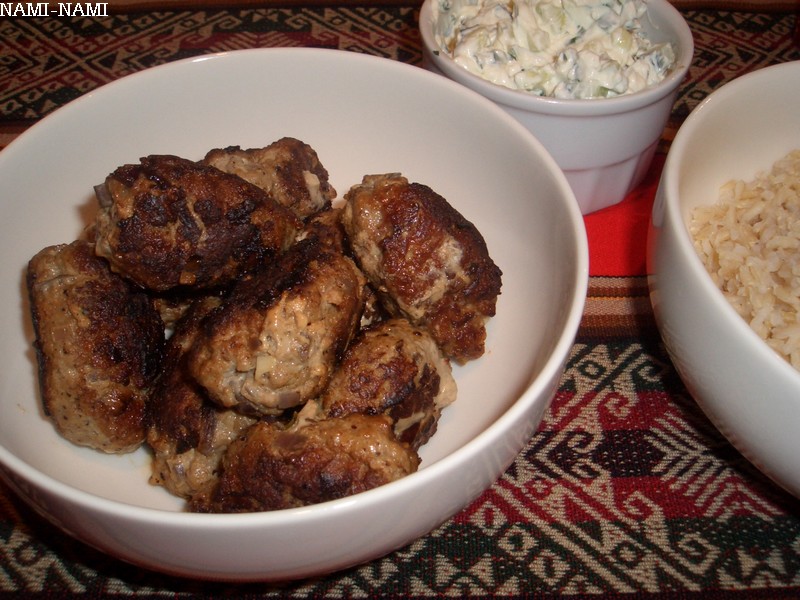
Anyway - back to Dagmar's spicy meatballs. I've added some breadcrumbs to the mixture, as there's a man with a very big appetite in the house and this makes the meatballs go further without really compromising the taste. I've also enlarged the quantities a little to suit the local shopping habits (minced meat is sold in 500 gram packets). Dagmar used chicken mince, but as poultry mince is not really available here and chicken fillets are expensive (for mincing purposes), I used the more economical minced lean beef (first time) and minced beef & pork (when K. requested these again few days later). The recipe worked really well both times. The mixture of spices is wonderful - the warmth of coriander and cumin, the kick of Cayenne and the sharpness of sumac complement each other brilliantly.

When I made Estonian cabbage rolls the other day (seasonings: salt, pepper, a bit of dill), K. asked if I could spice them up a' la these meatballs:) Do try them, they're good!

Dagmar's spicy meatballs, my way
(Vürtsikad hakklihapallid)
Serves 4


500 grams mince (lean steak mince or a mixture of pork & beef)
1 small onion, finely chopped
1 garlic clove, finely chopped
1 egg
5 Tbsp dried breadcrumbs
1 egg
1 tsp dried ground sumac
1 tsp cumin seeds, finely crushed
1 tsp coriander seeds, finely crushed
1 tsp ground Cayenne pepper
sea salt
freshly ground black pepper

oil for frying

Combine all ingredients in a bowl. Shape into 12 large 'sausages' or smaller patties (best done with slightly wet or oily hands to avoid sticking).
Shallow-fry in oil for 10 minutes, turning, until the meatballs are browned all over.
Serve with rice and feta-cucumber 'salad' (above) or with Alanna's wonderful carrots (below).

Friday, December 08, 2006

Warm and spicy fried quail eggs, from 780 years ago

You know how you sometimes read a book and see a recipe that captivates you, yet looks only half tempting? That what happened to me when I flipped through the pages of recently acquired book and spotted a recipe for Baid Mutajjan, or fried hard-boiled eggs with cumin. I like eggs, and I do like the listed spices (cinnamon, coriander, cumin), but somehow spice-fried chicken eggs sounded less than perfect. I guess I just cannot imagine biting into a full boiled egg, seasoned or not, fried or not, elsewhere than at a breakfast table. And then I want my boiled egg plain, with just a dot of butter and a sprinkle of sea salt. No cinnamon, cumin nor coriander in sight. But then, I thought, as a little light started flashing in the back of my head, this recipe would work so much better with tiny quail eggs, wouldn't it!?

It did. A perfect little quail egg mouthful doused in warm and subtle spices would make a wonderful addition to a drinks party. I'm sure children would welcome new spices when served like this. And we simply nibbled them while waiting for our main course to be done..

By the way - if this source is to believed, then this is a truly old recipe indeed. A very similar recipe for Baid Mutajjan is to be found in Muhammad bin hasad al-Baghdadi's 1226 cookbook al-Kitab al-Tabīh ('The Book of Dishes') . If my math is correct, then that's 780 years ago!!!

Spicy fried quail eggs
(Vürtsikad vutimunad)
Adapted from Ghillie Basan's The Middle Eastern Kitchen


12 quail eggs*
1 Tbsp oil
1 tsp cumin seeds
1 tsp coriander seeds
0.5 tsp ground cinnamon
Maldon sea salt

Bring a small saucepan of water to the boil. Add quail eggs, boil for no more than 2 minutes, drain and quickly rinse under cold water. Peel the eggs carefully.
Grind cumin and coriander seeds in a pestle and mortar (or use an old electric coffee grinder), mix in cinnamon.
Heat the oil in a small frying pan, add the spices and stir for a few seconds to release the aromas.
Add peeled eggs, stir gently, until the eggs are covered with a spicy oil.
Serve warm, sprinkle with salt flakes.

* Feel free to use only 10 eggs. It's just that quail eggs come in packets of 12 in Estonia :)

Wednesday, December 06, 2006

Moro's chickpeas with pomegranate seeds

I had another housewarming party last week, this time for my university girlfriends. There were 14 adults and 3 kids in the house on a Friday night, and we treated them to a buffet style table (known as rootsi laud or 'Swedish table' here). There were some stuffed Turkish-style aubergines, stuffed peppers with Suluguni cheese (i.e. the same cheese I used for making hatchapuri), and this chickpea salad with home-made pomegranate molasses (recipe below). Additionally, K. made creme brulees for everyone, which were wonderful (though I must admit I felt somewhat intimidated the butane torch he used, as it was definitely not intended for kitchen use!) As a result, we had 15 egg whites left over, half of which I turned into lime meringues, whereas K. used the other half to make some raspberry-flavoured marshmallows (he used the Polish raspberry syrup I got from Dagmar in July). It was a lovely party indeed.

Here's the recipe for chickpeas with pomegranate seeds and molasses, adapted from my signed copy of Sam & Sam Clark's Casa Moro. Apparently it makes a lovely side dish to fish.

Chickpea salad with pomegranate molasses
(Kikerherned granaatõunasiirupiga)


250 grams dried chickpeas*, or 450 grames canned chickpeas, rinsed
4 Tbsp olive oil
3 garlic cloves, thinly sliced
3 Tbsp pomegranate molasses**
200 ml boiling water
about 1 scant tsp safron threads, mixed with a little of the hot water
a generous handful of fresh coriander, chopped***
1 large pomegranate, seeds only
sea salt
black pepper

If using dried chickpeas, then soak and boil them first (read below*). If using canned, just drain them.
Heat oil in a large saucepan on a moderate heat. Add garlic and fry gently (do not burn!). Add the drained chickpeas, pomegranate molasses**, water and safron-infused water. Simmer for 10 minutes, until the liquid has evaporated.
Add coriander/parsley, season with salt and pepper.
Transfer into a serving bowl, scatter pomegranate seeds on top.

* I used dried chickpeas, which I first soaked overnight in lots of cold water, with a couple of teaspoonfuls of baking soda thrown in (cannot remember where I read it, but apparently it helps them to soften). I then boiled them, first on a high heat, then reducing the heat, for about 90 minutes in plenty of fresh water, skimming off any foam that appeared on the top.
** I slowly boiled 1 litre of pomegranate juice for 30 minutes, until I was left with just over 100 ml of thick pomegranate molasses. A bottle of very good pomegranate juice (no added sugar!) from Azerbaijan costs just under £1.50 at the market here, which is a lot cheaper as the small plastic bottles that were available in the UK.
*** I couldn't find coriander - apparently it's not in season (asking for it at different stalls selling herbs at the market caused lots of amused looks) - so I used flat-leaf parsley instead.

Tuesday, October 10, 2006

A Turkish delight: Hanedan in Edinburgh


Gürsel Bahar, the chef & proprietor of Hanedan, July 2006

Hanedan opened in June 2004, yet it was imprinted in my head even before that. You see, it was exactly on my route from home to my regular breakfast-coffee place, Peckhams on South Clark Street, so I was passing it pretty much daily. Also, as I shared a flat with a Turkish girl at the time, a sign announcing "A Turkish restaurant opening soon" simply caught my eye. Quite soon afterwards, I realised that the chef enjoyed his morning coffee at Peckhams on a regular basis, too, and we began exchanging hellos and engaging in small talk. I found out that Gürsel had lived & worked in London for 16 years, where he worked 9 years with Sir Terence Conran at his Quaglino's Restaurant in St James. But as his wife was Scottish, it was inevitable that they'd move back to her homeland at one point.

Few months after befriending the chef over my breakfast coffee, I decided to pay his new eaterie a visit. I liked the food, and alongside with my other local restaurant, the Jamaican Coyaba, it quickly became my regular haunt. It was there that I took my parents, sister and nephew to celebrate my graduation last summer. I've had numerous meals there since, most recently last Saturday with my friends Michael & Emma. Hanedan has a lovely and inviting atmosphere, being obviously popular both with local Southsiders, as well as others, and it's always a pleasure to go back.

The first few times I opted for the mixed meze starter, lalezar (£6.75 per person), consisting of humuz (pureed chickpeas with sesame oil and lemon juice), herkez bayildi (roast aubergine, onion, tomato sauce and herbs), barbunya pilaki (olive oil braised red kidney beans), ispanakli yogurt (strained yogurt and spinach with garlic, served with a delicious pinch of sumac on top), firin kofte (oven baked mincd meat balls) and yaprak dolma (stuffed wine leaves). But the chef was 'complaining' that I'm not giving his other, 'proper' dishes a chance, so some time last autumn I 'upgraded' and began ordering mezes as well as main courses. I've never had to regret that, as the food has always been delicious, flavoursome and filling, and the service efficient and friendly (which cannot be said about another well-established Turkish restaurant in town, which I've stopped visiting since a rather unpleasant encounter in August).

If I am allowed to grumble just a little, then it's the limited choice of mains for vegetarians - Biberli makarna (pasta, red pepper sauce & feta cheese, £6.90) and Sebzeli musakka (vegetable moussaka, £7.90). And it would be also nice for his regular customers if he'd occasionally change his two-course menu offer (£7.95). That said, however, there are plenty of vegetarian meze dishes to choose from, with ispanakli yogurt (£2.90), herkes bayildi (£ 3.20) and helim izgara (perfectly grilled haloumi cheese, £3.60) being my favourites. And the main dishes are reasonably priced, too. His kuzu shish (a substantial portion of marinated grilled lamb on skewer, £7.90) simply melts in your mouth - I've never had meat so moist and tender before. Apparently the 'secret' to this dish is 'gentle massage' (though the Chef has now shared his recipe for the rub mixture with me:) My other favourites are tavuk guvech (sauteed chicken with onion, mushroom and tomato, £7.50, on the left), and tavuk shish (marinated grilled chicken on skewer, £7.75).

There are some Turkish wines on the wine list, and Efes Pilsen is available. And their baklava (filo pastry with mixed nuts & honey syrup, £2.90) is mouthwatering, light and rich at the same time. Highly recommended, whether you're sipping Turkish apple tea or a strong Turkish coffee which is served in cheerful tiny cups. Or, if you're up for it, some raki. Or why not both...

I'll miss this place. But then I do have the secret recipes for some of Gürsel's dishes in my pocket now:)

Some useful Turkish phrases from their menu:
Bu aksham olmaz - Not tonight.
Bisiklet pompani alabilirmiyim? - May I borrow your bicycle pump?
Gunde bir paket sigara iciyorum - I smoke a packet a day*

Note that booking is pretty much essential during weekends - I've been turned away on many occasions.

Hanedan
41-42 West Preston Street
Edinburgh EH8 9PY
Tel. 0131 667 4242

Lunch 12-3pm, Dinner 5.30pm till late, closed on Monday
website

* Even if you do, don't try to lit your cigaret while in Hanedan. Like all other public drinking & eating venues in Scotland, it's been smoke-free since March 2006. Bliss!