Showing posts with label Recipes: Christmas. Show all posts

Monday, December 19, 2016

Traditional Christmas roast (oven-baked pork shoulder with honey, mustard and rosemary)

From the recipe archives (originally posted in December 2012. Still my favourite Christmas roast). My traditional Christmas roast / Traditsiooniline jõulupraad
Photo by Juta Kübarsepp for the December issue of Kodu ja Aed magazine, 2012 

What's your traditional Christmas roast (assuming you're eating meat)? Turkey? Goose? Duck?

In Estonia it's definitely pork, though roast poultry has become more popular during recent years. I've been flirting with roast goose and actually served duck leg confit on Christmas Eve this year. It was delicious.

However, for years I've been serving pork roast - a pork shoulder (kaelakarbonaad in Estonian) in a mustard-honey-garlic-rosemary marinade, to be more precise. I love that it's a pretty fool-proof recipe, simple to make, with lots of flavour. And - as an added bonus - any leftovers are excellent on top of rye bread on the days after the party, or as part of a salad. So if you're not making it for a big family feast, you can still make the same amount and simply make several meals out of it.

So here you go. Nami-Nami's traditional Christmas roast. On the photo above, it's accompanied by black pudding ('blood sausages') - another traditional Christmas dish.

Wish you all a lovely festive season!!!

Traditional Christmas roast
(Ahjupraad karbonaadist)
Serves about 10

2 kg boneless pork shoulder (Boston butt)
3-4 Tbsp honey
3-4 Tbsp Dijon mustard or Estonian Põltsamaa mustard
2-3 fresh rosemary sprigs (leaves only)
3 large garlic cloves
2 tsp sea salt

Finely chop garlic cloves and rosemary leaves, then mix with honey and mustard until combined.
Season the meat generously with salt, then spread the mustard-honey mixture all over the pork shoulder and massage into the meat.
Place the pork shoulder into a large ovenproof dish, cover with foil and place into a fridge or cold larder for 1-2 days.
Bring back to the room temperature about an hour before you plan to cook the meat.
If you have a meat thermometer, then stick it into the thickest part of the meat (you can do this through the kitchen foil).
Roast the meat in a pre-heated 160 C / 320 F oven for about 2,5 hours or until the meat thermometer has reached 82-85 C/ 180-185 F.
If you plan to serve gravy with your meat, then pour a cup of hot water into the baking tray half-way through the cooking. 
When the meat is cooked, remove the foil, season the meat once more lightly with salt and then bake for another 10-15 minutes at about 200-220 C/ 390-425 F, just to brown the meat  a little.

Remove the roast pork from the oven, cover again with a kitchen foil and leave to rest for 20-30 minutes before carving into thin slices.

This recipe was also included in my latest cookbook, Jõulud kodus ("Christmas at Home"), published in Estonian in November 2011. 
I also included the recipe in the December 2012 issue of Kodu & Aed magazine. 

Friday, December 12, 2014

Layered Vegetable Salad with Smoked Salmon

(From the Nami-Nami recipe archives.)

Layered smoked salmon salad / Suitsulõhega kasukas

"Kasukas" - "fur coat" - is a name for a layered vegetable salad that is very popular here in Estonia, especially during the cold and dark season. The salad has chopped cured herring as the bottom layer, topped with layers of grated or chopped beets, carrots, potatoes and other vegetables and "glued together" with thin layers of mayonnaise. The recipe - or rather an alternative way to serve the popular "rosolje" salad - came to Estonia from Russia in the second half of last century. In Russia "fur coat" aka "shuba" is still one of the most popular salads on the festive table (here's a lovely English-language blog post about the traditional "cured herring under fur coat"), and the un-layered "rosolli" is also a must on Finnish Christmas tables). Whereas I love beets, I dislike cured herring, so I tend to skip that salad on buffet tables. When making this at home, I'd usually make a double portion and divide the salad between two glass bowls - one with herring and the other without. Until I came across a version using smoked salmon in Natasha's Kitchen blog. That was about a year and a half ago, and since then I've made this salad over and over again and converted many kasukas-haters into kasukas-lovers.

Traditionally this salad is made and served in a big glass bowl that proudly shows off all the layers, and then it's spooned into serving plates (rather like a trifle). For a neater presentation, you may want to use individual glass bowls instead (see top photo). A note to my Estonian readers - I like making this with külmsuitsulõhe aka cold-smoked salmon (Pepe Kala makes a wonderful one!), rather than with kuumsuitsulõhe aka hot-smoked salmon.

Suitsulõhega kasukas

Layered Smoked Salmon and Vegetable Salad
(Suitsulõhega kasukas)
Serves about 6 to 8

Kasukas suitsulõhega

200 g smoked salmon
400 g potatoes
1 small onion, peeled and finely chopped
200 g cooked beetroot (roasted, steamed or boiled)
250 g carrots
about 300-400 g good-quality mayonnaise
2 eggs

Boil (unpeeled!) carrots and potatoes until soft, but not mushy. Drain, cool a little, then peel.
Hard-boil the eggs, then cool and peel.

To compose the salad:
1. Cut the salmon into small pieces and scatter evenly at the bottom of a 2-litre (approximately 2-quart) glass bowl.
2. Grate the potatoes coarsely, scatter over the salmon.
3. Scatter chopped onion over the potato layer.
4. Gently spread about half of the mayonnaise over the onion layer.
5. Grate the beetroot coarsely, scatter over the mayonnaise layer.
6. Grate the carrots coarsely, scatter over the beetroot layer.
7. Spread rest of the mayonnaise over the beetroot layer.
8. Finely grate the eggs, scatter over the mayonnaise layer.

NB! As the mayonnaise is seasoned already, there is no need to season any of the layers with salt and pepper!

Cover the bowl with clingfilm and put into the fridge for a few hours for the flavours to combine (and the beetroot colour to stain the other layers :)) The salad can be happily made on a previous day as well, as it keeps rather well.

This recipe was also included in my latest cookbook, Jõulud kodus ("Christmas at Home"), published in Estonian in November 2011.

Tuesday, December 09, 2014

Holiday baking: Carrot cake cookies recipe

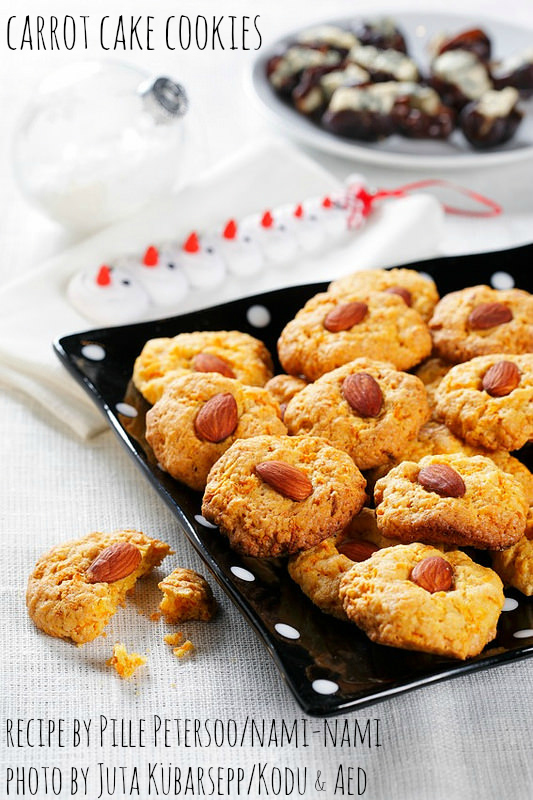
Carrot Cake Cookies. Porgandiküpsised.

Time to start preparing for the Christmas holidays and I offer you a lovely cookie recipe! Although we'll be mostly eating piparkoogid aka gingerbread cookies here in Estonia, these slightly chewy carrot cake cookies would do just as well.

For over two years now I've been contributing recipes for one of the biggest home and gardening magazines here in Estonia, Kodu ja Aed (that translates "Home and Garden"). Since spring we've been focusing on a specific vegetable both on the gardening pages and in the food section. Carrot happened to be the vegetable of the month in December. December, of course, being the Christmas month, so I was trying to think of recipes that would feel right at the Christmas table as well. I think these cookies fit the bill brilliantly. They are easy to make, go brilliantly with a glass of glögg or mulled wine, they're "healthy" as containing a vegetable (carrot is also providing both texture and flavour), and they are egg-free, making them also suitable for some special diets. Most of all, they have a pretty colour and they taste great. As an added bonus, the kids loved them - something to think about when you've got 3 small ones running around the house!

So when you're planning your next glögg party, think of adding these carrot cake cookies to the menu!

You'll find all of Nami-Nami's Christmas recipes here and a selection of cookie recipes here.

TIP! You could make these cookie more festive by adding a scant teaspoon of mixed spices, gingerbread spice or pumpkin pie spice - all of these would work.

TIP! If you forgot to take your butter out of the fridge in advance, then simply grate the cold butter into your mixing bowl. Instant softened butter! 

Carrot cake cookies
(Porgandiküpsised)

200 g butter, at room temperature (7 oz)
150 g caster sugar (2/3 cups)
200 g carrots, finely shredded (2 medium carrots)
300 g all-purpose flour (2 cups)
1 tsp vanilla sugar or extract
1 tsp baking powder
a pinch of salt
whole almonds

Pre-heat the oven to 200C/400F. Line a baking sheet with a parchment paper.

Cream the butter and sugar in a mixing bowl, either using a wooden spoon or the paddle attachment of your standing mixer. Add the carrots, then the dry ingredients (flour, vanilla sugar, baking powder, salt). Mix the dough until combined, then take small chestnut-sized chunks of the dough and form into small balls.

Place the balls onto the baking sheet, flattening them with your palm. Press a whole almond onto each cookie.

Bake for 15 minutes or until the cookies are golden brown.  Remove from the oven, leave for a few minutes before transferring the carrot cookies onto a metal rack to cool completely.

More carrot cookie recipes:
Carrot oatmeal cookies by Heidi @ 101 Cookbooks
Chocolate chip carrot cookies by Jeanine @ Love & Lemons
Gingered carrot cake cookies by Michelle @ Brown-Eyed Baker
Porgandiküpsised by Marit @ Magusad fotod (recipe in Estonian)
Porgandiküpsised by Kaare @ Koopatibi (recipe in Estonian)
Porkkanakeksit @ Kotiliesi (recipe in Finnish)

Saturday, September 20, 2014

ApfelSTROHdel - a hot apple toddy with Austrian Stroh rum

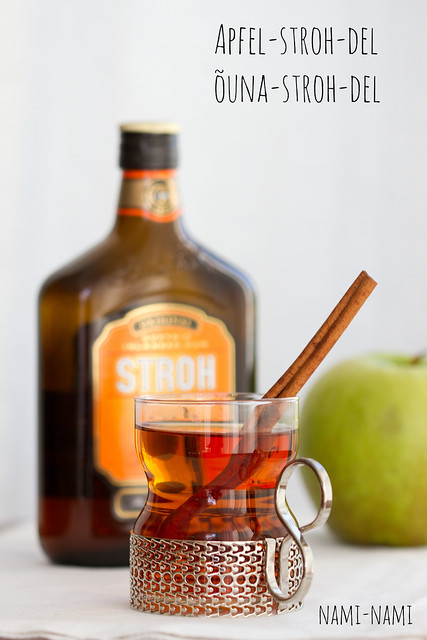
ApfelSTROHdel. ÕunaSTROHdel.

I've been testing various recipes using the spiced Austrian rum, Stroh, and this autumn/winter drink was quite popular. The ApfelSTROHdel recipe is adapted from the Stroh's website (see here), and it's a witty play of words - think of the famous Viennese apple strudel or Apfelstrudel.  I've still got some Stroh left, I'll be making this again and again. The nights are getting darker and cooler here, and this is a nice recipe to have on a cold and rainy autumn night :)

ApfelSTROHdel
(ÕunaSTROHdel)
Serves 2

400 ml apple juice (you can use apple cider or unfiltered apple juice)
2 cinnamon sticks
2 tsp dark brown sugar (or more, to taste)
60 ml Stroh rum (I used Stroh 40)

Heat the apple juice, cinnamon sticks and sugar gently in a small bowl, stirring, until the sugar has dissolved. Do not boil!
Remove from the heat, let cool for a moment. Stir in the Stroh, pour into glasses and garnish with a thin apple slice (optional).

Enjoy, preferably in front of a flickering fireplace.

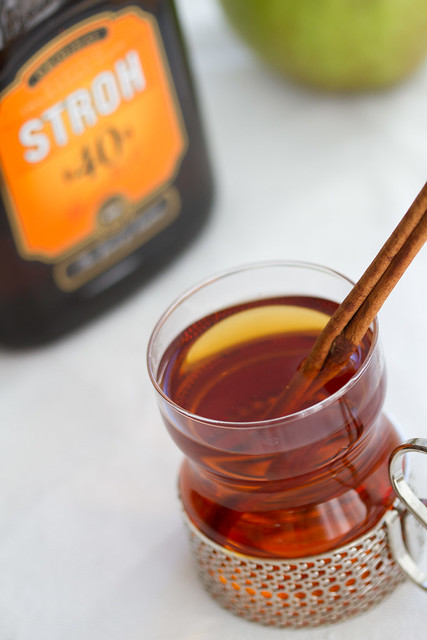
ApfelSTROHdel. ÕunaSTROHdel.

Disclosure: This is not a sponsored post as such, but I have received remuneration for sharing this recipe with my Estonian readers on my Estonian-language site.

Wednesday, January 08, 2014

To keep you warm in those cold days: mulled apple juice (hot cider)

Mulled apple juice. Kuum õunajook.
Photo by Juta Kübarsepp for the January 2014 issue of Kodu ja Aed magazine (I made the drink and modelled for the photo :))

Do you love mulled wine or glögg or vin chaud or Glühwein? I do. However, once Christmas is behind us, I don't fancy red wine based mulled drinks - they simply feel too, well, Christmassy. However, this mulled apple drink is perfect for winter, and a great alternative to your regular mulled wine. And should you plan a winter walk and a small picnic, you can make a batch and put into your favourite thermos bottle!

I use cinnamon and ginger, and sometimes add star anise - feel free to play with different spices. My version is non-alcoholic, but feel free to add some calvados or rum or cognac to it ;)

Mulled apple glögg (non-alcholic)

(Alkoholivaba õunaglögi)
 Serves 6

Omenaglögi. Mulled apple drink. Vürtsidega õunaglögi, alkoholivaba.
Photo by Pille Petersoo for Nami-Nami

1 litre of good apple juice, homemade or bought
1 cinnamon stick
thumb-sized piece of ginger root
1-2 star anise (optional)
soft brown sugar or honey (optional)

Gently heat the apple juice in a saucepan. Add the cinnamon stick and peeled ginger (no need to chop, though of course you can do that), as well as the star anise. Cover and let infuse for about 15 minutes on a very low heat.

Pour through a sieve and serve in heat-tolerant glasses or mugs, sweeten with brown sugar or honey, if you wish.

Thursday, December 26, 2013

Our Christmas meal, 2013

Hope you all had a lovely Christmas, dear friends and readers! We had the pleasure of cooking for and hosting our respective families on Christmas Eve (that's when we, Estonians, have the main Christmas meal and distribute gifts). I was in charge of the menu and cooking - and I thought it's a good idea to share the menu on my blog as well. I decided to have a rather light and minimalist first course. Here's what it looked like:

IMG_7803.jpg

Good black Estonian bread, some white toast and a selection of cured fish. Starting from the left, there are spiced Baltic sprats that I wrote about in the previous post (see here), but this time served simply with sliced red onion:

IMG_7805.jpg

Then there's salt-cured whitefish from my favourite fishmonger, PepeKala OÜ. Whitefish slices are to be eaten with buttered toast:
IMG_7806.jpg

Finally, locally grown and jellied catfish (African sharptooth catfish, to be more precise, angersäga in Estonian, Clarias gariepinus in Latin). This one came out of the jar as well :)

IMG_7807.jpg

For those who prefer meat, I did serve some cold-smoked turkey slices:
IMG_7804.jpg

Serving a selection of cured fish for starters is a rather Nordic thing to do, but you'd find many more dishes on a traditional Estonian Christmas table (some rosolje salad or perhaps the layered vegetable salad). But we kept it rather minimalist this year and it worked for us.

The main course was much more traditional. There was pork - but not my usual Christmas roast,  the ever-delicious oven-baked pork shoulder with honey, mustard and rosemary. I did experiment with pork belly and fennel seeds - and rather successfully - the meat was extremely succulent and melt-in-your-mouth, and gobbled up quickly.

IMG_7815.jpg

Here's a close-up of the pork:IMG_7810.jpg

The cabbage was my classic õllekapsas aka sauerkraut braised in beer (the beer was A le Coq's porter):

IMG_7809.jpg

There were simple boiled potatoes, and a duo of roasted veggies - carrots and parsnips, lightly drizzled with maple syrup:

IMG_7813.jpg

The duo of roasted vegetables was accompanied by a trio of black pudding:  IMG_7821.jpg

For condiments, there were two relishes from a small Estonian producer, Treppoja. Pumpkin and horseradish (the yellow one) and chilli and lingonberry (the red one): IMG_7818.jpg

Neither one was bad, but my mother-in-law's apple and lingonberry jam came out tops (I've got a recipe here, but she uses more lingonberries and less apples): IMG_7819.jpg


The star of the evening, as usual, was the dessert. I was planning to do the popular Danish Christmas dessert risalamande or fluffy rice pudding with almonds and a warm cherry compote. But then our little family went to Denmark for a small holiday in early December, and my dear Danish host-mum Kirsten served us a wonderful æbletrifli - a layered trifle of æblegrød, whipped cream and custard, as well as crunchy Italian almond cookies. It was simple, delicious and really festive, so that ended up finishing our Christmas feast of 2013.

 Danish apple trifle "æbletrifli". Taani kausitort õuntega.

We didn't drink much - some beers, and some small glasses of the Swedish Blossa glögg from 2012 and 2013, juice and water for the kids..

What did you do for Christmas?

See all Nami-Nami's Christmas recipe here.
Estonian World writes about Estonian Christmas traditions here.

Friday, December 20, 2013

Holiday cooking: browned sautéed cabbage


Photo by Juta Kübarsepp for Nami-Nami

Christmas is just around the corner and I'm busy coordinating various festive dinners and other occasions. Good times, and I always feel a bit sad when all the feasts are finally over. Well, there will be another Christmas in just a year, of course :)

One of the staples on Estonian Christmas table is sauerkraut, and I've got a lovely version here on my blog, sauerkraut braised in dark beer. However, not all people have access to Estonian-style sauerkraut (fresh and unpasteurised, containing just cabbage and salt and perhaps some caraway seeds), or perhaps they cannot stomach the fermented version. Here's where this recipe comes to rescue - a fresh cabbage that's been sautéed and browned in butter, dark syrup and some stock. This has a slightly milder flavour compared to the traditional sauerkraut, but it's just as lovely as a side dish alongside the traditional pork roast that I always serve on Christmas eve. It also works brilliantly with oven-baked salmon or other fish, so it's quite versatile.

Here's the recipe. If you use vegetable broth, then the dish is also suitable for vegetarians. For a vegan version you'll need to choose vegetable stock and oil instead of butter. It's also suitable for a gluten-free diet, as long as you'll use proper vegetable or chicken broth.

Browned sautéed cabbage
(Pruunistatud kapsas)
Serves 6 to 8

1 head of white cabbage
2 Tbsp butter
2 Tbsp dark (corn) syrup (I used this)
about a cup of hot vegetable or chicken broth
salt, to taste

Cut the cabbage into wedges, then into thin ribbons.
Heat butter in a large saucepan, add the cabbage, a sprinkling of salt and fry for a few minutes over a moderate heat. Add the dark syrup and the stock, give it a stir. Cover and simmer over a low heat for about an hour, until the cabbage is tender and nicely golden brown. Season to taste with salt.

Can be successfully re-heated, so feel free to make this in advance.

--------

Thank you, Kalyn of Kalyn's Kitchen for featuring this recipe on BlogHer in January 2014.

Sunday, December 15, 2013

Holiday baking: Sliced Almond Christmas Cookies

French gingerbread / Christmas cookies / Piparkoogid / Viilupiparkoogid
From the recipe archives!

It's the time to bake various Christmas cookies again. While I'll certainly be making and baking and decorating a batch of these favourite Estonian piparkoogid ("pepper cakes"), then this year I have another recipe in mind as well. These sliced Christmas cookies with almonds found their way into my heart in the midst of the summer heatwave, as I was choosing and testing recipes for my Christmas cookbook. I had seen a recipe for "French gingebread cookies" in a Swedish food magazine that I liked, and that reminded me of Jules Destrooper's wonderful almond thins that I used to love. After some tweaking here and there (less sugar and less cloves, more almonds), I ended up with this great recipe.

I usually divide the dough into four equal portions and roll and wrap them individually. Then I bake one and place three in the freezer - I can then bake fresh and aromatic Christmas cookies whenever I feel like :)

Almond Gingerbread Cookies
(Viilupiparkoogid)
Makes a lot - about 4 large sheets

viilupiparkoogidNAMI

250 g butter
200 g caster sugar
140 g light baking syrup (about 100 ml)
420 g plain flour (700 ml)
1 Tbsp ground cinnamon
0.5 Tbsp ground cloves
0.5 Tbsp baking soda
100 g sliced almonds

Melt the butter in a saucepan. Add sugar and syrup, stir until combined. Remove from the heat and let cool completely.
Combine flour, cinnamon, cloves, baking soda and almonds in a bowl, then fold into the cool butter-sugar-syrup mixture. Stir until combined.
Divide the cookie dough into four equal parts, then form each one into a cylinder/sausage, about 4 cm in diameter. Wrap in clingfilm or baking paper and place into the fridge to rest. (Ideally for 24 hours).

To bake the cookies, cut each "sausage" into 3-4 mm (1/8th inch) slices, and place onto a parchment covered cookie sheet.
Bake in the middle of a preheated 200 C oven for 6 to 8 minutes, until golden brown.
Remove from the oven, let rest for a few minutes, then transfer onto a metal rack to cool completely.

French gingerbread / Christmas cookies / Piparkoogid / Viilupiparkoogid

This recipe was also included in my second cookbook, Jõulud kodus ("Christmas at Home"), published in Estonian in November 2011.

Wednesday, December 26, 2012

Puff pastry pinwheels with black pudding and lingonberry jam

Lehttainarullid pohlamoosi ja verivorstiga / Puff pastry pinwheels with black pudding and lingonberry jam
Black pudding (aka blood sausages) with lingonberry jam are one of the staples on Estonian Christmas table and I like using these two elements in other dishes as well. Here's a small pastry that I've been baking for 5 years already. The initial idea isn't mine. Back in November 2008 I took part at a two-day cooking course ("Modern Christmas menu") at one of the vocational training schools here in Tallinn, and we had a brain-storming session with other participants trying to come up with new twists of old favourites. One of the other participants mentioned using black pudding and lingonberries for making small pastries - I cannot remember any longer, if she was talking about something she has made already or something that could be made, neither can I remember if she was talking about the idea in general or making puff pastry pinwheels in particular. In any case, I've been rolling puff pastry sheets with crumbled black pudding and lingonberry jam and some dried marjoram ever since (here's a photo evidence from November 2008, another one from December 2008 and here's one from October 2010).

So if you've got some black pudding and lingonberry jam left over after the Christmas feast, then you can use these two to make some delightful puff pastry pinwheels. And let your guests guess what's inside - most of them seem to think it's raisins ;)

Puff pastry pinwheels with black pudding and lingonberries
(Lehttainarullid verivorsti ja pohlamoosiga)

Lehttainarullid pohlamoosi ja verivorstiga / Puff pastry pinwheels with black pudding and lingonberry jam

puff pastry - either regular or yeasted puff pastry
lingonberry jam
dried marjoram (oregano will do as well)
black pudding

For brushing:
egg, whisked with some water

Roll out the puff pastry into a rectangle about 3-4 mm thick.
Spread with a thin layer of lingonberry jam, then scatter the crumbled black pudding on top. Sprinkle with some dried marjoram.
Roll tightly, starting from the longer end, into a long "sausage". Cut into 2 cm lengths. Place into paper muffin cups and transfer onto a cooking sheet.
Brush with eggwash and bake in a pre-heated 225C/435F for 10-15 minutes, until the pinwheels are nicely golden brown.

Serve either warm or at room temperature.

This recipe was also included in my latest cookbook, Jõulud kodus ("Christmas at Home"), published in Estonian in November 2011. 

Thursday, December 13, 2012

Saffron buns with marzipan and almonds

Saffron & marzipan rolls / Safrani-martsipanisaiad
These were immensely popular with our kids as well. The photo is from December 2011, when our son, Aksel, was 11 months old. Look at those cheeks!

It's Saint Lucia's Day today, the festival of light, which is especially popular in Sweden. Trust me, it's pit dark outside by 4 pm, so we need any extra light we can get here up North, even if it's in the form of candles on top of a lingonberry branch wreath balanced precariously on some little girls head :)) It's common to eat saffron buns - lussekatter - on Lucia's Day - ideally, first thing in the morning with your breakfast coffee or tea, but these are also wonderful in the afternoon, of course.

Lussekatter or Lucia buns are usually shaped like S, but I've opted for the more simple roll and enriched the buns with marzipan filling and slivered almonds. kokblog has an excellent overview of the various lussekatter-shapes, check them out.

Saffron buns with marzipan and almonds
(Tõeliselt mõnusad safranisaiad)
Makes a lot!

 Saffron & marzipan rolls / Safrani-martsipanisaiad
Yeast dough:
500 ml lukewarm milk (2 cups)
a generous pinch of saffron threads*
50 g fresh yeast (or use 2 sachets of instant yeast)
0.5 tsp salt
150 g caster sugar
150 g unsalted butter, softened
200 g cream cheese, softened
1 kg of all-purpose flour

Filling:
100 g unsalted butter, softened
200 g marzipan, grated
3 Tbsp brandy or cognac
a generous pinch of saffron threads

To finish:
egg-wash made with 1 egg and 1 Tbsp water
50 g sliced almonds
sugar pearls

 Saffron & marzipan rolls / Safrani-martsipanisaiad

Heat the milk, pour into a large mixing bowl. Add the saffron and let it infuse and cool for a while. The milk should be 37 C/98 F at the end.
Crumble the yeast into the milk. Add salt, sugar and most of the flour. Then knead in the soft butter and cream cheese and the rest of the flour. Knead until the dough doesn't stick to the bowl any longer. Cover and let rise until doubled in size - you need to do that in a warm and draught-free place.

(Meanwhile, cover the baking sheet with a parchment paper and pre-heat the oven to 220 C/430 F).

Prepare the filling. Grate the marzipan coarsely. Mix saffron strands with the cognac and let infuse for 5-10 minutes. Melt butter in a small saucepan, add the marzipan and then the saffron-infused cognac. Heat gently, stirring, until combined. Remove from the heat.

Gently knead the yeast dough and divide into two. Roll both on a lightly floured surface into a large rectangle, about 5 mm (1/4''). Spread half of the marzipan mixture onto the dough and roll tightly, starting from the longer edge.

Repeat with the other dough.

Cut into 3-4 cm rolls (about 1,5 inches) and place onto a baking sheet. (If you wish, you can let them rise again for 20-30 minutes). Brush with the egg-wash and sprinkle with slivered almonds and pearl sugar.

Bake for 15-20 minutes, until lovely golden brown. Let cool under a clean kitchen towel - this helps them stay soft.

* A note about using saffron. Saffron is water-soluble, not fat-soluble. I am surprised how many recipes ask you to simply add the saffron threads in with the rest of the ingredients (the oil or the flour), without infusing it with the liquid (NOT oil!) beforehand. You can extract so much more flavour and colour by the simple infusion process, and given the price of good-quality saffron, you can use much less of that precious spice and get much more out of it. 

More recipes for lussekatter or Lucia buns:
Nami-Nami, 2011
A Cat in the Kitchen, 2006
Anne's Food, 2007
Joe Pastry, 2012
Eat Drink One Woman, 2009
Good. Food. Stories. 2009
Eat, Live, Run, 2012
pPod's Kitchen, 2010
One Perfect Bite, 2009

More recipes using saffron: 
Saffron buns (lussekatter)
Roasted aubergines/eggplant with saffron yoghurt dressing by Ottolenghi
Saffron carrot cake with cream cheese frosting
Golden saffron pancakes

Monday, December 10, 2012

Mulled sea-buckthorn drink

Mulled sea-buckthorn drink / Kuum astelpajujook
A glass of warming sea-buckthorn drink. If you're unfamiliar with the name "sea-buckthorn", then it's also known as sandthorn, sallowthorn or seaberry, and tyrni in Finnish, Sanddorn in German (as well as Seedorn, Sandbeere, Weidendorn and so on), havtorn in Danish and Swedish, duindoorn in Dutch, Hippophae rhamnoides in Latin, argousier in French.

Are you a fan of Pinterest? I am. I hopped on the Pinterest-bandwagon quite late, but have grown to love it for the ease of identifying and saving various inspirational dishes. It's a great way to spot gorgeous drink and food ideas, and that's where I came across Sandy's sea-buckthorn punch. Sea-buckthorn, the wonderful superberry, has been featured quite often here on Nami-Nami (see below for numerous recipe links), and I try to use it quite regularly in my kitchen as well. This mulled hot drink using a mixture of sea-buckthorn juice, orange juice and black tea, was a great discovery.

Mulled sea-buckthorn drink
(Kuum astelpajujook)
Adapted from Confiture de Vivre
Serves 6 to 8

1 litre of brewed tea (I used Early Grey)
500 ml (2 cups) sea-buckthorn juice
250 ml (1 cup) good-quality orange juice
4 cloves
4 star anise
1 cinnamon stick/bark
5-6 Tbsp soft brown sugar

Optional (for the alcoholic version):
vodka and/or sea-buckthorn liqueur

Mix tea, sea-buckthorn and orange juice, spices and the sugar in a medium-sized saucepan. Bring into a gentre simmer, then leave to infuse for 15-20 minutes on a very low heat.
Remove from the heat, ladle into heatproof glasses and serve.

For an alcoholic version, add 2 cl of vodka and/or sea-buckthorn liqueur per glass.

More sea-buckthorn recipes:
Sea-buckthorn jelly with kama mascarpone mousse @ Nami-Nami
Sea-buckthorn and Amaretto cheesecake @ Nami-Nami
Sea-buckthorn and apple tart @ Nami-Nami
Sea-buckthorn sorbet @ Nami-Nami
Cardamom panna-cotta with sea-buckthorn and apricot compote @ Nami-Nami
Sea-buckthorn juice @ Russian Season
Sea-buckthorn @ Real Epicurean
Gelbe grütze @ Küchenlatein
Coconut cream custard on sanddorn mirror @ Vegalicious Recipes
Sea buckthorn curd with raspberries @ Swedish Food
Sea-buckthorn cheesecake @ Bumpkin Mag
Sea-buckthorn mousse @ Andie's Veggies
Sea-buckthorn kissel with Greek yoghurt @ Suvi sur le vif

    Wednesday, November 28, 2012

    Orange salad with pomegranate seeds, perfect for the festive season

    Orange salad / Apelsinisalat

    Citrus fruit and Christmas go hand in hand, no? Well, in my house they do. I like serving an orange salad during the festive season - either as a starter, like this beetroot and orange salad with ginger yoghurt dressing or this fennel and orange salad with a simple vinaigrette or even this super-simple orange and red onion salad. Or as a dessert, in a form of a simple "Orange Ambrosia, for instance.

    When flipping through the pages of one of my current favourite food magazines, the Swedish-language Lantliv mat & vin, I was immediately drawn to a pretty orange and pomegranate salad. And although Christmas is still a few weeks away, we've had some snow in Estonia already - and it's snowing outside as I'm writing this post - so this salad has been sitting prettily on our table twice during the last week or so. And it'll be definitely making an appearance or two during December.

    It'd make a lovely light dessert, or simply one of the dishes on your festive buffet spread. It's also vegan and gluten-free, so suits all kind of special diets.

    If you're making this in Estonia and are looking for crushed cardamom seeds, then I recommend buying MEIRA cardamom - it's coarsely ground. If you're looking for fine cardamom "dust" (sorry, powder), then Meira is not for you :) Alternatively, buy whole cardamom pods and grind your own. You'll need seeds from about 20 cardamom pods to get about a teaspoon of ground cardamom. 

    Orange salad with pomegranate seeds
    Apelsinisalat granaatõunaseemnetega
    Adapted from Lantliv Mat & Vin, Nr 6/2012 (Apelsinsallad)
    Serves 4, can be easily multiplied

     Orange salad / Apelsinisalat

     4 large sweet oranges
    1 ripe pomegranate
    1 Tbsp (brown) sugar
    1 tsp ground cardamom seeds

    Peel the oranges with a sharp knife, then cut into thin slices, crosswise. Arrange nicely on a large plate.
    Remove the pomegranate seeds and scatter on top of orange slices.
    Mix the ground cardamom with sugar and sprinkle on top of the fruit.
    Serve at once or leave to macerate for an hour or two in a cool place, covered.

    Friday, March 09, 2012

    Gingery oatcakes or oaty gingersnap cookies? You'll decide.

    Ginger-oatcakes / Ingveri-kaerahelbeküpsised

    In theory, a batch of cookies spiked with ground ginger would be most suitable for Christmas, no? I guess so. Somehow, however, I've baked two batches of these simple gingery oatcakes/oaty gingersnap cookies during this week alone, and wouldn't mind baking them again soon. I blame the long and exhausting frosty winter we're having here in Estonia - temperatures have been falling below -10 Celsius again this week. Some delicious cookies help to forget (at least for a brief moment) that all you really-really want by now is some sun and spring and birdsong and, well, end of winter..

    Note that these cookies do not contain any eggs, so they're perfect if you're cooking for someone who's allergic to eggs.

    Oatcakes spiked with ginger
    (Ingveri-kaeraküpsised)
    Inspiration: Finnish Valio
    Makes about 40 cookies

    Ginger-oatcakes / Ingveri-kaerahelbeküpsised

    125 g butter, at room temperature
    100 g caster sugar
    100 g (wholemeal) flour
    100 g old-fashioned rolled oats
    1 tsp baking powder
    1 tsp ground ginger
    3 to 4 Tbsp double/heavy cream

    Cream butter and sugar. Combine dry ingredients in a bowl, then stir into the sugar and butter mixture. Finally add the cream and stir lightly until combined.
    Form the cookie mixture into small balls (about a heaped teaspoonful each) and place them onto a parchment-covered baking sheet, leaving plenty of room between the cookies, as they spread out during baking.
    Bake in a preheated 200 C oven for about 8 minutes, until light golden brown on edges.
    Remove from the oven, leave to cool for a few minutes, then transfer onto a metal rack to dry and go crisp.

    Wednesday, December 28, 2011

    Cardamom panna cotta with apricot and sea-buckthorn sauce

    Cardamom pannacotta with apricot and sea-buckthorn topping / Kardemonine pannacotta aprikoosi-astelpajukompotiga

    Panna cotta is a dessert that I actually make quite often, even if I've only blogged about it once (Vanilla panna cotta with roasted rhubarb, back in June 2008). It's a good classic Italian dessert that can be served with a number of various toppings and seasoned to your liking.

    Here's a rather non-Italian version that is imminently suitable for the festive season. It has a hint of spice in the form of cardamom, and it's much lighter, as some of the cream has been substituted with kefir. Sea-buckthorn berries are one of the new superfoods, and hugely popular and easily available in Estonia. A word of warning - if you taste the panna cotta mixture before you let it set, it may feel too heavy on cardamom. Don't panic, however - the sweet and sour apricot and sea-buckthorn sauce will nicely balance it out.

    I like my panna cotta to be on the wobbly side, as they're supposed to be, and I often serve them in a nice glass. If you want a firmer dessert that will hold its shape even after you've turned it onto a plate, you can use some more gelatine.

    Cardamom panna cotta with apricot and sea-buckthorn sauce
    (Kardemonine kooretarretis aprikoosi-astelpajulisandiga)
    Adapted from the Swedish COOP-website
    Serves 4

    3 gelatine leaves
    200 ml whipping cream
    2 Tbsp caster sugar
    1 tsp ground cardamom
    200 ml kefir

    Topping:
    100 ml (7 Tbsp) smooth apricot jam
    100 ml (7 Tbsp) sea-buckthorn berries

    Seak the gelatine leaves in cold water for 5 minutes.
    Season the cream with ground cardamom, then slowly bring into a boil in a small saucepan. Cook for a few minutes, then remove from the heat and pour in the kefir. Give it a stir.
    Squeeze the soaked gelatine leaves to remove excess water, then stir and melt into the cream and kefir mixture, one at a time.
    Pour the mixture into individual glasses or ramekins and place into a fridge to set for at least 5 hours.
    Before serving, heat the apricot jam gently in a small saucepan. Fold in the sea-buckthorn berries, heat through. Cool a little, then spoon some on top of each panna cotta.

    Saturday, December 24, 2011

    Tuesday, December 13, 2011

    Swedish Saffron Buns (Lussekatter)

    Safranisaiad / Saffron buns / Lucia buns / Lussekatter / Lussebollar

    Saffron buns like this are eaten all over Sweden on St Lucia's day on December 13th. Lucia's buns are rather decadent buns, with lots of sugar, butter and eggs. I've used a recipe containing cream cheese, which makes these especially soft and luxurious. In Sweden, they mark the beginning of the Christmas season, and there are lots of interesting traditions associated with Lucia's Day, including small girls walking around early in the morning, wearing white and carrying burning candles on top of their head ;)

    We left out the burning candles, and enjoyed these buns simply with a cup of coffee :)

    A note about using saffron. Saffron is water-soluble, not fat-soluble. I am surprised how many recipes ask you to simply add the saffron threads in with the rest of the ingredients (the oil or the flour), without infusing it with the liquid (NOT oil!) beforehand. You can extract so much more flavour and colour by the simple infusion process, and given the price of good-quality saffron, you can use much less of that precious spice and get much more out of it. The recipe here is based on a recipe in a Swedish Allt om Mat recipe. As most other recipes, the Swedish one asks you to put milk, melted butter, saffron and cream cheese all together. No wonder they also ask you to use 1.5 grams of saffron. I used just one packet (0.5 g), and the resulting buns had a beautiful, intense saffron flavour and a gorgeous dark yellow colour. If I had used triple the amount of saffron (AND infused it properly to start with), then the buns would have been way over-the-top!

    You can read more about saffron on Lydia's blog The Perfect Pantry and more about these Swedish buns over on Anne's blog.

    Swedish Saffron Buns
    (Luutsinakuklid ehk safranisaiad)
    Makes about 30 generous buns

    500 ml milk
    0.5 grams saffron strands
    50 g fresh yeast
    170 g caster sugar (200 ml)
    1 tsp ground cardamom seeds
    0.5 tsp fine salt
    about 1 kg plain flour
    250 g cream cheese, softened
    150 g unsalted butter, softened
    2 eggs, divided
    raisins or dried cranberries
    pearl sugar (optional)

    Heat milk in a small saucepan until steaming. Remove from the heat, add saffron threads and leave to infuse for 10-15 minutes. You'll need to cool the milk to about 37-38 C. (Or 42 C, if using instant yeast; in that case simply stir the instant yeast into the flour).
    When the milk is lukewarm, then crumble in the yeast and stir, until dissolved.
    Add salt, cardamom, sugar and about half of the flour. Stir until combined, then add the cream cheese, butter, ONE egg (lightly whisked), and then gradually knead in the rest of the flour. The final yeast dough should be soft and supple.
    Cover the bowl with a clean kitchen towel and leave to rise in a warm room for 30-60 minutes, until doubled in size.
    Knead the dough gently and turn onto a lightly floured work surface. Twist small amounts of dough (about the size of a large egg or a tennis ball, depending on whether you're making small or larger buns). Roll each piece of dough into a long "sausage", then twist it from both ends to form a letter S (see the photo above). There are several traditional ways of shaping Lucia buns, but this is the only way I usually do. It's also easy enough shape to understand for my almost-3-year-old kitchen assistant, you see :)
    Place the shaped buns onto a baking sheet that's been covered with a parchment paper. Leave to prove for another 10-15 minutes, then press a raisin or a craisin into each end.
    Brush with an egg wash (= an egg whisked with a spoonful of water) and sprinkle with pearl sugar, if you wish.
    Bake in a pre-heated 220 C oven for 12-15 minutes, until light golden brown.
    Remove from the oven, transfer onto a metal rack to cool a little. If you want softer buns, then cover them with a clean tea towel when they're cooling.

    Saturday, December 10, 2011

    Homemade candy recipes: fruit and nut truffles

    Puuviljakommid (vasakul) / Dried fruit and nut chocolates (on the left)

    There's a candy I remember from my childhood. Our main chocolate factory, Kalev, was (and probably still is) well-known for its chocolate selections or "assortiikarp" as they're known in Estonian. I loved their ganache and praline filled chocolates in those chocolate selections, but my favourite ones were the foil-wrapped large truffles with fruit and nut filling.

    Here's my attempt to recreate these childhood favourites :) You can see the final product on the left on the photo above.

    Fruit and Nut Filled Truffles
    (Puuviljakompvekid)

    Puuviljakommide tegemine

    100 g dried soft figs
    150 g dried soft prunes
    100 g dried cranberries or cherries (or a mixture of both)
    100 g chopped almonds or hazelnuts
    1 Tbsp runny honey or golden syrup or agave nectar
    a pinch of sea salt

    to coat the truffles:
    dark chocolate (tempered, preferably)

    Remove the stem from the dried figs. If using a food processor, place the figs, prunes and dried cranberries or cherries into the food processor and process until you've got a coarsely ground fruit mixture. Add the almonds/nuts, salt and honey/syrup and pulse again once or twice. (You don't want the nuts chopped too finely, as you want the texture later).
         [You can also simply chop the ingredients as finely as possible]
    Place the truffle mixture into the fridge for an hour to cool and harden.
    Roll into small balls (TIP: use a little oil to moisten your hands - the mixture won't stick as much then.)
    Either dip into melted dark chocolate - or, preferably, into tempered dark chocolate (see note below) until completely covered. Decorate with chopped nuts. Keep in a cool place until ready to serve.

    Why and how to temper the chocolate? The Internet - and food blogs - are full of detailed instructions on how to temper chocolate - and why. The latter is easy - unless you temper the chocolate, the chocolate-glazed truffles will lack the shine and the snap, both very desirable elements. "How" is trickier and indeed, tempering can be a hit-and-miss. I've followed this simplified seed-technique for tempering. Place about 2/3 of your chopped up chocolate (or, indeed, chocolate pellets - and NOT compound chocolate!) into a heat-proof bowl and place the bowl on top of a small saucepan, where you've brought about 5 cm/2 inches of water into simmer. Let the chocolate melt slowly, stirring as you go along. Remove from the heat, stick a chocolate thermometer into the bowl. Now add the "seed chocolate" or the chocolate you put aside at the beginning in two or three installments and keep stirring the chocolate and cooling it. Once all the added chocolate pellets have melted, you must continue stirring the chocolate, until it registers 28 C on the thermometer - that will probably take about 15-20 minutes of active stirring, so be patient! You can then gently re-heat the chocolate - either over the waterbath, on top of a hot water bottle or by hovering your hair-drier over the chocolate - until it's about 30-31 C (best temperature for working with chocolate). 

    Friday, December 09, 2011

    If you like Cosmo (and Sex and the City), then you'll love this drink: Cosmopolitan glögg

    Cosmopolitan glögg


    Sex and the City (2008)
    Miranda Hobbes: [at a bar, drinking Cosmopolitans] 
    "Why did we ever stop drinking these?"
    Carrie Bradshaw: "Because everyone else started! "

    Perhaps it's time to start again?

    This delicious and soul-warming winter drink has got its name from the famous Cosmopolitan cocktail. Ok, there's plain vodka and not lemon vodka here, and I haven't used any limes to give the drink an extra zing (though you could, by all means), but the similarities are definitely there. It's officially my favourite mulled drink this year, even if I do go very easy on the vodka most of the time :D

    If you like the classic Cosmopolitan, and enjoyed watching Sex and the City, then this drink is for you :)

    Cosmo Glögg
    (Jõhvikaglögi)
    Serves six
    Adapted from Finnish-language book "Kotilieden jouluaika: Pikkujoulusta loppiaisen" (2006)

    Cosmopolitan glögg

    1 litre good-quality cranberry juice drink
    2 Tbsp glögg mixture*
    100 ml vodka
    50 ml orange liqueur (Triple Sec or Cointreau)

    To serve:
    dried cranberries (aka 'craisins')
    orange twist

    Bring the juice and glögg mixture into a simmer, then remove from the heat and leave to infuse for 20-30 minutes. Add some sugar to taste, if you really wish so.
    Strain and re-heat. Add the spirits and serve in heat-proof glasses.

    * I used Meira's glögimauste, which contains finely chopped dried Sevilla orange peel, ginger, cloves, cinnamon and cardamom. You can use any mulled wine or glögg seasoning mix of your choice, if that's not available. 

    Thursday, December 08, 2011

    Christmas recipes: Swedish meatballs

    Christmas meatballs / Vürtsikad lihapallid

    Serving meatballs at a Christmas table is NOT an Estonian tradition, but it's something I've borrowed from our Swedish neighbours across the sea. They're especially popular with kids (though adults aren't far behind), and as they can be served hot or cold, they're excellent for buffet table. I love them with a generous grating of nutmeg, but you could also use cinnamon, allspice, juniper berries, cumin. Anne of Anne's Food uses white pepper, cinnamon, ginger, cardamom AND allspice, for example.

    This recipe was also included in my latest cookbook, Jõulud kodus ("Christmas at Home"), published in Estonian in November 2011.


    Swedish meatballs
    (Vürtsikad lihapallid)
    Serves four or many more, depending on what else is on the table

    Swedish meatballs / Vürstikad lihapallid

    400 g minced meat
    2 Tbsp finely chopped onion
    1 Tbsp potato starch or cornflour
    1 large egg
    1 tsp salt
    0.5 tsp freshly ground black pepper
    150 ml milk (10 Tbsp)
    a generous grating of nutmeg

    butter, for frying

    Mix all ingredients in a mixing bowl, then form into small meatballs (it's easier to do with wet or oiled hands).

    Now you've got three ways to proceed (my preference goes for the last one):

    1) Melt some butter on a frying pan, brown the meatballs on all sides, then cover the pan with a lid, reduce heat and cook until done.
    2) Melt some butter on a frying pan, brown the meatballs on all sides. Transfer the meatballs onto a small tray and finish cooking them in a pre-heated 200 C/400 F oven.
    3) Brush a baking sheet with some melted butter or oil, spread meatballs evenly on top. Bake in a pre-heated 220 c/450 F oven for about 15 minutes, until cooked inside and lovely dark golden brown outside.

    Serve warm or at room temperature.