Showing posts with label Recipes: Offal. Show all posts

Friday, November 16, 2012

Oxtail ragout with celeriac mash

Veisesaba / Oxtail / Härjasaba / Lehmasaba

Oxtail - isn't it beautiful? I admit that I blatantly nicked the idea for today's post from the wonderful Jeanne in London, who wrote about a 20-hour sous vide oxtail stew in her award-winning blog, Cook Sister! Here's my oxtail story.

Nightview / Öine vaade Albarracinile
Albarracín at night, March 2008

I still remember my first encounter with oxtail - on a plate, I mean. My dear K. and I were travelling in Spain in March 2008, visiting the lovely Ximena of the Lobstersquad fame in Madrid, and visiting some other off-the-beaten-track cities that Ximena and her also very lovely husband J. had suggested. One late afternoon we arrived in the picturesque Albarracín in Aragon (yep, on the lands of the medieval Kingdom of Aragón). After checking into our hotel for the night, we wandered on the streets of Albaraccín, looking for a tiny restaurant called Rincón del Chorro. Somebody somewhere had recommended it, you see. The night was already dark, but we were obviously too early for dinner, as all we found was a locked door. We returned an hour later, to find a small but busy restaurant. The menu wasn't long - I opted for the pickled partridge (a local speciality, I was told), K. ordered the rabo del toro or oxtail.

Rabo de Toro / Oxtail Stew / Härjasabahautis e. veisesabahautis e. lehmasabahautis

Both were brought to the table pretty quickly. While the partridge was lovely, the oxtail was wonderful and although the idea of cooking it myself seemed a wee bit daunting initially, I've become a huge oxtail convert over the years and cook this particular cut of beef regularly.

My favourite oxtail dish takes slightly less time to cook than Jeanne's and as there's definitely no sous-vide machine in my kitchen, it can be cooked in a simple stovetop saucepan. But I guarantee it'll be just as delicious ;) The inspiration for the dish is from a blog written by an Estonian restaurateur, Mme Randrüüt - see here. It's an interpretation of the French classic, mijotée de queue de boeuf et purée de céleri rave or stewed oxtail with celeriac pureé. If you haven't cooked oxtail before, then slowly cooked oxtail has the most wonderful sweet and meaty flavour, which is pretty much universally liked. While we happily gnaw away on the slowly cooked oxtail pieces (there's a link to another oxtail stew recipe here on Nami-Nami at the bottom of this post), it can be intimidating to somebody who's new to oxtail - or if you're wanting to serve oxtail in a slightly more elegant manner. This oxtail ragout is the perfect solution then.

Oxtail / Härjasaba e. veisesaba

In Estonia I usually get my oxtail cut into chunks and packed neatly on a tray. Very convenient, even if it is only sold in one major supermarket and only on certain days, so one has to pre-plan carefully. If you have a friendly butcher at your favourite market, you can obviously order some whenever you need it.

Oxtail ragout with celeriac mash
(Veisesabaraguu)
Serves two to three (can be easily doubled)

Oxtail ragout with celeriac mash / Veisesabaraguu selleripüreega

1 kg oxtail pieces
2-3 Tbsp oil
500 ml (2 cups) boiling water
few fresh parsley sprigs
few fresh thyme sprigs
1 bay leaf
3-4 whole black peppercorns
3-4 whole allspice berries
salt, to taste

Season the oxtail pieces with salt.
Heat oil in a heavy saucepan, sauté the oxtail pieces until dark golden brown on all sides.
Add the water, herbs and seasonings. Bring into a boil, then reduce heat and cover the saucepan. Simmer gently for about 3-4 hours until meat falls off the bones easily.
Remove from the heat, cool. Remove the meat off the bones, discard the bones and return the meat into the stew.

(This can be done a day in advance). 

Skim the excess fat from the top of the stew. Re-heat the stew and simmer gently for another hour or two, until the stew has thickened. Taste for seasoning.

Serve with a celeriac/root celery mash - prepare like your regular potato mash, just use root celery instead.

Looking for more oxtail inspiration? Here are some recipes:

Papardelle with oxtail ragu by Skye Gyngell
Oxtail ragout with papardelle by Sammy and Bella (My Kitchen Rules)
Oxtail braised in dark beer by Nami-Nami
Coda alla vaccinaria by Food Lover's Odyssey
Glazed oxtails by Simply Recipes
Korean braised oxtail by Kitchen Wench
Alsatian oxtail stew by Choosy Beggars

Wednesday, November 09, 2011

Things to do with (Estonian) black pudding aka verikäkk

Someone left a comment on my blog this morning:

Just brought back home from Estonia some Verikäkk and still wondering what to do exactly with it :D Aitäh also from Spain for your blog ;)

I thought I'll help Enlil out and share some of the recipe ideas and photos with him :)

Verikäkk is basically a dense black pudding (also known as blood pudding or blood dumpling). It's a mixture of (usually pig's) blood, flour (rye, barley or wheat), fried onions, lard/bacon and seasonings. Here in Estonia it's sold widely, and it comes in large dumplings, weighing about 450 grams. Traditionally it was made in late Autumn/for Christmas, but is now available throughout the year. I personally don't think of verikäkk as a Christmas product at all (as opposed to verivorst or black sausages), and happily buy it all year round.

Here are some of the ways of consuming black pudding.

Fried black pudding with sour cream:

Fried black pudding / Praetud verikäkk hapukoorega

1 black pudding
lard, butter or oil for frying
250 g sour cream

Cut into thick (about 1 cm) slices, fry in butter until browned and crisp on both sides. Pour the sour cream on top at the end and heat gently. Serve at once.
Pickled pumpkin salad and lingonberry or cranberry jam/sauce work well as condiments.

Fried black pudding:


Fried black pudding / Praetud verikäkk

1 black pudding
lard, butter or oil for frying

Cut into thick (about 1 cm) slices, fry in butter until browned and crisp on both sides. Serve with a dollop of sour cream and/or lingonberry jam. (If you forgot to buy that in Estonia, then head to your nearest IKEA food isle).

Fried black pudding crisps:

Black pudding chips / Veritsipsid

I've already blogged about this, see recipe here.

MÕNED EESTIKEELSED VIITED:
Ülle tore ood verikäkile
UMA MEKK video verikäki tegemisest

Monday, June 13, 2011

Recipe request: buckwheat and beef liver


A Flickr user emailed me this morning, saying that he/she saw this picture and that he/she would love to make it. Instead of translating and typing in the recipe for him/her, I'm blogging about it. It was a delicious dish, and although not necessarily a summer dish, it's definitely lovely and worth making during the colder times. (Incidentally, I had buckwheat for dinner last night, served with a creamy meatball sauce).

Intrigued by buckwheat? There are plenty of buckwheat recipes here @ Nami-Nami. Note that buckwheat is naturally gluten-free, so it's a suitable and tasty grain alternative to all those who need to avoid gluten.

Buckwheat with beef liver
(Tatrahautis veisemaksaga)
Serves four
Slightly adapted version of Kaie Mei's recipe in Oma Maitse (January 2010)

Buckwheat and beef liver / Maksa-tatrahautis

1 large onion, peeled and finely chopped
2 carrots, scraped and chopped finely
oil for frying
250 g buckwheat kasha, rinsed and drained
500 ml (2 cups) vegetable stock
300 g beef liver
salt and freshly ground black pepper

To serve:
fresh herbs
sour cream

First, you may need to toast the buckwheat. The buckwheat we usually use in Estonia is pre-roasted and darkish brown ('kasha', see photo on top), so this can be skip this stage. If you're using the "light" buckwheat groats, then roast them on a dry hot skillet for about 5-6 minutes, until it's nicely toasty and aromatic.

Heat oil on a deep frying pan, add the onion and sauté for a few minutes. Then add the carrots and fry for a few more minutes.
Add the buckwheat groats, stir-fry for a minute.
Add the stock, season with salt. Bring to a boil, then reduce heat and simmer on a low heat for 15-20 minutes, until buckwheat is cooked.
Meanwhile, cut the beef liver into small dice. Season and sear quickly on a hot frying pan for about 4-5 minutes, until browned all over. Add the cooked liver to the buckwheat and sauté for a few more minutes, until the buckwheat and liver and tender.
Serve, sprinkled with herbs and a dollop of sour cream.

Tuesday, February 15, 2011

Lamb's tongue

Rye bread, lamb's tongue, beetroot & horseradish spread
Homemade Estonian rye bread, sliced lamb's tongue and horseradish, beetroot and cream cheese spread.

There may have been a time when I was (at least occasionally) a kind of culinary trendsetter among Estonian foodbloggers, introducing exciting new flavours. Not any more - being stuck at home in a suburb without a car and two little kids means that I am the last one to visit newly opened cafés, I miss all the exciting restaurant review events and am the last one to hear about the best source for exciting ingredients. Take lamb's tongue. There were several local foodbloggers singing praise to this humble delicacy (first Piret, then Tuuli, followed by Zoozi), and I spent days restlessly dreaming about those little tongues. Finally, on Saturday, I demanded a trip to a new (and currently the best) market in town and returned with a whole kilogram of lamb's tongue (it's _very_ cold here and our little son turned 1 month old only today, hence the reluctance to venture out earlier). What a delight (if you like tongue, that is)!

Lamb's tongue / Tallekeel

My dear K. was kind enough to take a nice photo of them (above; apparently inspired by the movie "Saw III" that he saw recently - I cannot comment, as I refused to join him and watch this), and then let me proceed with the dish. Well, preparing lamb's tongue for use in other dishes (like the open sandwich on top and below) is the easiest thing ever. Here's what you do.

Lamb's tongue
(Keedetud tallekeel)

1 kg lamb's tongue (I had 17 pieces)
cold water
1 large onion, halved (no need to peel)
1 large celery stick (break into 3-4 pieces)
2 bay leaves
10 whole black peppercorns
5 whole allspice berries
few parsley sprigs
1 tsp salt

Rinse the tongues under cold water, place into a large saucepan and cover with fresh cold water. Bring it to a slow boil, skimming off any froth that emerges on top.
Then add the onion, celery, bay leaves and seasoning. Reduce heat and let simmer for about 50-60 minutes, until cooked (test with a sharp knife).
Cool a little, then peel the tongues (as the tongues are quite small and there are many of them, it will take a bit of time).
Serve as they are (sliced thinly, on top of an open sandwich) or use to make salads or whatever else you fancy.

Rye bread, lamb's tongue, beetroot & horseradish spread

Have you had lamb's tongue before? And what's your favourite way to prepare/eat it? I'm already looking forward to buying and preparing lamb's tongue again, so any cool suggestions are welcome.

Other foodbloggers writing about lamb's tongue:
Ryan @ Nose to Tail at Home
Florian @ Food Perestroika

Thursday, July 01, 2010

Grilled chicken livers in sherry and honey marinade

Chicken livers in sherry honey marinade / Grillitud kanamaksavardad

When planning the menu for the Midsummer's Eve, I knew I wanted something more unusual in addition to the traditional pork shashlik. I ended up making this simple grilled chicken liver dish, which was much liked by everyone. Such a quick dish to throw together and cook, ideal for those quick (yet leisurely) summertime meals in your backyard.

Serve with a green salad or a watermelon & feta or melon & blue cheese salad.

Grilled chicken livers
(Grillitud kanamaksavardad)
Source: Finnish magazine Apu (14.3.2004)
Serves 4

450-500 g chicken livers

Marinade:
2 garlic cloves, minced
a bunch of fresh parsley, finely chopped
4 Tbsp dry sherry
4 Tbsp olive oil
2 Tbsp runny honey

salt and pepper to season

If you're using frozen chicken livers, then transfer them to the fridge night before.
Drain the defrozen chicken livers carefully. Cut each liver into two large pieces.
Mix all the marinade ingredients in a bowl, add chicken liver. Leave to marinate for about 2-3 hours.
Pierce the chicken livers onto a wooden sticks* and grill over hot coals or under a hot grill for about 5 minutes, turning them every now and then.
Season with salt and pepper and serve.

* Soak the sticks in cold water for at least 30 minutes before - then they won't burn as quickly.

Monday, August 10, 2009

A Story of a Grilled Pig's Heart

Grilled pig's heart / Grillitud seasüda

Last week a kind friend brought us a whole pluck of a wild boar. He had been on a hunting trip to one of the island, that's why. It was late on Wednesday night, and knowing that liver needs to be cooked a.s.a.p, I simmered it with some carrots, onions and seasonings (salt, pepper, bay leaves) until cooked, to be made into a liver paté next day. The heart and the lights* had to wait - I was too tired to do anything with them in the evening.

First thing on Thursday morning, I checked with two food-loving friends if they're up for a wild boar supper on Thursday night. Of course they were. I made the liver paté, using my usual recipe (grind twice, season with salt, pepper, some brandy and soften with plenty of butter). I spent some time trying to pick a suitable recipe for the heart and lights, and eventually settled for a traditional stew. However, when I went to pick up the to other elements of the pluck, I realised that they were off. Obviously the summer heat wave we're currently having here in Estonia had quickened any processes that go on in raw meat, and there was no way I could use these for cooking.

I had about 2 hours before my friends were arriving for a feast of liver, hearts and lungs :) Luckily, our local supermarket has a very reasonable meat counter (as far as pork cuts are conserned, that is), and K. quickly brought me three nice pig's hearts. You see, I had promised so-called alternative cuts for dinner, so I decided to stick to it. A quick search in the web gave me an idea for grilled pig's heart, and I must say I haven't been so positively surprised about a dish for a while. The grilled heart was different, tasty and very meaty. I'd definitely make this again, when I see nice pig's hearts on the counter.

* An euphemism for lungs.

Grilled pig's heart
(Grillitud seasüda)
Serves about 6

Pig's heart in marinade / Viilutatud seasüda marinaadis

2-3 pig's hearts
half a cup of dry red wine
5-6 Tbsp olive oil
half a cup of chopped herbs (parsley and/or basil)
2-3 large garlic cloves, slices
salt
freshly ground black pepper

Trim the hearts of any sinew and gristle, if necessary (we bought prepared ones). Cut into 7-8 mm slices, and put into a bowl.
Add other ingredients and stir to combine. Leave to marinate in room temperature, covered, for about an hour.
Heat a griddle until very hot, then grill the sliced meat on both sides until golden brown and cooked.

Serve with a drizzle of good balsamico (we used Belazu).

Saturday, January 17, 2009

Oxtail braised in dark beer


Have you ever cooked oxtail before? 

Until mid-November, I hadn't. I had eaten it before (for example during our trip to Spain last March-April), but never actually handled uncooked oxtail in my kitchen. Then, back in November, we had a Offal and Alternative Cuts Cook-Off on my Estonian site, and upon K's insistence, I decided to make an oxtail stew. If you get hold of good-quality oxtail (e.g. with lots of juicy soft meat attached), then there's not much you need to do with your oxtail. Basically, I had to decide whether I want to braise mine in beer or wine (I chose dark beer, Saku Jõulupruul) and which vegetables to go for (carrots, celery and turnips were my choice). Once you've made those decisions, you're well on your way to a beautiful dinner with friends.

PS I will be eating some again tonight. K. has just informed us that our friends P&K have invited us for a dinner of oxtail tonight. Mmmmm... :P

Oxtail braised in beer
(Õlles hautatud härjasaba)
Serves 2-3 (generously)

1 kg oxtail, cut into chunks
1 to 2 Tbsp oil
200 ml (just under a cup) of dark beer
500 ml (2 cups) good-quailty beef stock
2 carrots
2 small turnips
2 celery sticks
2 to 3 smaller onions
1 bay leaf
2 thyme branches
1 Tbsp sugar
1 tsp salt
freshly ground black pepper

Heat the oil on a large frying pan, add the oxtail pieces and brown them on all sides on a high heat. Transfer into a large heavy-bottomed oven dish with a lid (f.ex. a Dutch oven).
Pour the beer and stock into the pan, and bring into a boil. Simmer on a low heat for about an hour, skimming any froth and impurities that appear on the surface during the beginning. When no more froth is appearing, then cover the stockpot with a lid.
Peel the carrots and turnips and cut into chunks. Cut the celery sticks into an inch-long pieces, the onions into quarters. Dry-fry all vegetables on a frying pan, until they're lovely golden brown on all sides (this considerably improves the flavour). Add the browned vegetables to the stockpot alongside the spices.
Simmer for another 2-3 hours, until the meat easily falls off the bones.
Season and serve with my caraway-roasted potatoes.

Monday, September 24, 2007

Give offal a chance: Beef liver gravy, Estonian style

The eGullet Society for Culinary Arts and Letters, or eGullet for short, as some of you may know, is a huge online food forum with thousands of members. I've been a member since February 2006, and although my main food-related online presence is certainly here on Nami-nami, I do use eGullet quite frequently. It's a great source of food-related information and inspiration, though the style and format are very different from foodblogging as we know. Every now and then the hosts of the forum ask one of their members to do a week-long foodblog, where an eGulleteer keeps a picture diary about shopping for food, preparing food, and eating food, with various tidbits about life and food in general thrown in. Well, I had a chance to do one of those eG foodblogs last week, which was fun, if a bit exhausting (I hardly had time to spend with this foodblog!) On the first day, one of the readers asked me if I could cook any exotic meat a la caribou and such like. I jokingly replied that we only eat pork, beef, veal, rabbit/hare, wild boar, venison, elk and brown bear* in Estonia, and none of them qualifies as exotic :) So I decided to go with an unusual cut of meat instead, and do something Estonian with it, and that's how I ended up making an Estonian beef liver gravy, maksakaste.

Beef liver gravy, Estonian style
(Maksakaste)
Adapted from Eesti Köök/Estonian Cooking (2003)


500 grams beef liver, cut into thin long strips (1 cm x 4-5 cm)
2 Tbsp plain/all-purpose flour
1 tsp black pepper
2-3 Tbsp oil
1 onion, finely chopped
200 ml cold water
100 ml sour cream
salt
fresh dill

To serve:
boiled potatoes
fresh dill, finely chopped
salted cucumbers, sliced

Mix flour with pepper.
Cut liver into thin strips**, drench in flour/pepper mix.
Heat oil in a frying pan, add liver and onion and brown on low heat.
Add any leftover flour, add cold water and heat, stirring regularly, until the sauce thickens. Simmer for 5-7 minutes.
Add sour cream, stirring regularly, and simmer on a low heat for another 5 minutes.
Season with salt, garnish with dill.
Serve with boiled potatoes and sliced salted cucumbers.

* I am not claiming that I have tried all those various meats, nor that they're all eaten regularly in Estonia.
** Click here to see a photo with step-by-step instructions.

Wednesday, September 19, 2007

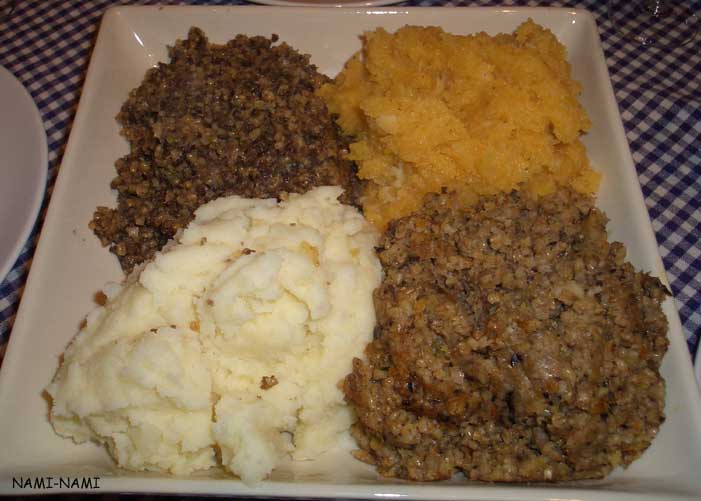
Another way of serving haggis, neeps & tatties


That's exactly how I saw haggis, neeps & tatties served at Peckhams on Nicholson Street in Edinburgh earlier this month (see photo here). I dined there with my friend Melinda on my first night in town, and I simply had to try this at home. Not bad, not bad at all :)

My sauce is a bit different, however - although unconventional, I want my haggis with a caramelised onion gravy.

MacSween of Edinburgh haggis is one food-related thing I miss from Scotland every now and then...

Tuesday, April 11, 2006

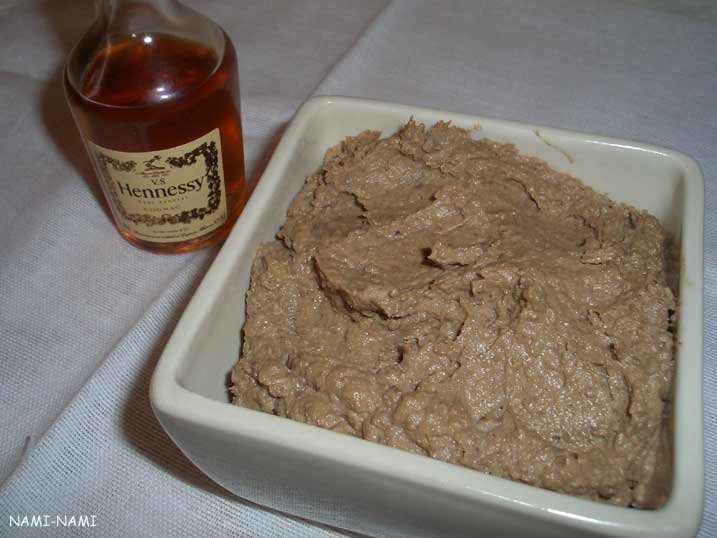
Trip down the memory lane: chicken liver pâté

Chicken liver pate / Kanamaksapasteet

Chicken liver featured pretty often in our kitchen when I was younger. One of my aunties worked in a chicken factory (abattoir?), and was able to smuggle us various cheap chicken bits and pieces during the food-poor and rationed last years of the Soviet era. Some of these chicken parts I hated, some I didn't mind, some I rather liked. Chicken necks will remain my pet hate until I die (my mum used them in soups); chicken wings haven't got enough meat on them, however juicy and flavoursome it is; chicken gizzards and chicken liver - in stews and patés, respectively - I find rather good.

Ever since I saw the recipe and pictures for paté ai fetatini over at Delicious Days few months ago, I've been longing to have some home-made chicken liver pâté again. The opportunity came when I spotted some chicken livers at Edinburgh Farmers' Market. I will try paté ai fetatini recipe soon, but first I had to try my Mum's version..

Chicken liver pâté
(Kanamaksapasteet)

500 grams chicken liver, cleaned
100 grams butter, at room temperature
1 onion, finely chopped
salt
finely crushed black pepper
2-3 Tbsp brandy or cognac
3-4 Tbsp chicken stock

Melt about 25 grams of butter on a frying pan, add the chopped onion and fry gently for 5-10 minutes, until the onion softens a little.
Add the chopped chicken liver and fry on medium heat, turning regularly, for about 5 minutes, until the liver is cooked & no longer pink inside, but is still on the soft side. Let it cool.
If you have an old-fashioned mincer, then mince the fried livers twice (gives a smoother paté). Alternatively, mince the fried livers and onions in a food processor, add soft butter, seasoning and brandy and process until smooth. If the mixture is too dry, then add a bit of chicken stock.

Keeps for a few days in the fridge, covered. To serve, either spread on toast or form into small balls with a warm teaspoon and roll in grated hard cheese - this is a popular way of serving any liver pâté back home.

Now - next time I must ask for some chicken gizzards then..

PS For a slightly fancier take on the chicken liver pâté you can also check out Becks&Posh's recipe for chicken liver crostini, or pictures of it over at Spittoon Extra.

Thursday, January 26, 2006

Celebrating Burns’ Night: Gie her a haggis!

This is my nod to the Scottish national poet Robert Burns, whose 237th birth anniversary was celebrated yesterday all over Scotland and elsewhere in the world. Traditionally copious amounts of haggis, neeps and tatties, as well as whisky, are consumed to celebrate the Bard's life. However, as I was planning to eat in solitude last night (failed miserably, but that's only good:), I was thinking of something a lot lighter and easier to eat. Something that you can eat while watching yet another episode of Desperate Housewives, for instance..


I made potato shortcrust canapés filled with haggis and topped with a rich shallot and whisky gravy. Although it lacks the neeps/turnip element (not my fault, read the note at the bottom), it does combine the haggis, tatties/potatoes and whisky.

I used the same potato shortcrust pastry that I had prepared for my first (and thus far last) Paper Chef entry. The haggis was a mini sized one from MacSween of Edinburgh, of course. And for the gravy I slowly fried some finely chopped shallots, made into a thick gravy, and added a very generous splash of my favourite whisky at the end.

The rest was easy – pop the hot shortcrust cases onto a plate, stuff each with a spoonful of steaming haggis (I bake mine in the oven usually) and top with a tiny dollop of onion whisky gravy.

As it turned out, I didn't eat these on my own after all. I mentioned mini haggis tarts to a friend on the phone, and within minutes she was over at my place with another friend. And we finished them well in advance of Desperate Housewives... The potato cases were perfectly crunchy and worked well with the crumbly-soft haggis and slightly sticky boozy whisky glaze. We all liked these, despite of having had dinner just before...

I wish I could tell you that some of the canapés are with potato shortcrust cases and some with turnip shortcrust cases. Unfortunately, my local Tesco had forgotten that there may be some Scots who fancy eating turnips that night together with their potatoes and haggis. So they had forgotten to order extra. To top this, they had also run out of haggis by 7pm!!! Whoever is ordering the stock for that particular branch, should be fired! Thank god for Peckham's, who had ordered extra haggis, so I could go ahead with my plan after all...

Thursday, January 12, 2006

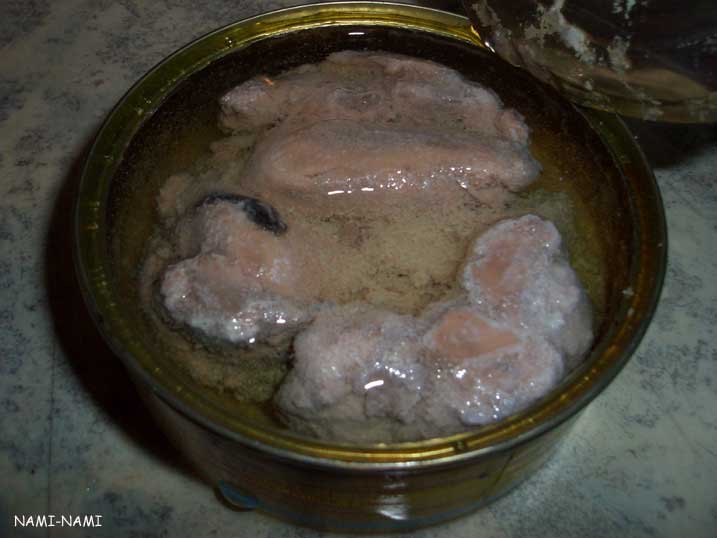
Estonian nibbles: cod liver canapés


Photo updated in December 2008

Cod liver - tursamaks - comes in cans, and it's not very widely available or known these days. It was even less available during the Soviet era, when it was considered a real delicacy. Luckily, my grandmother knew somebody who knew somebody (essential for culinary survival back then) and somehow she managed to get a can or two every now and then. I love it.

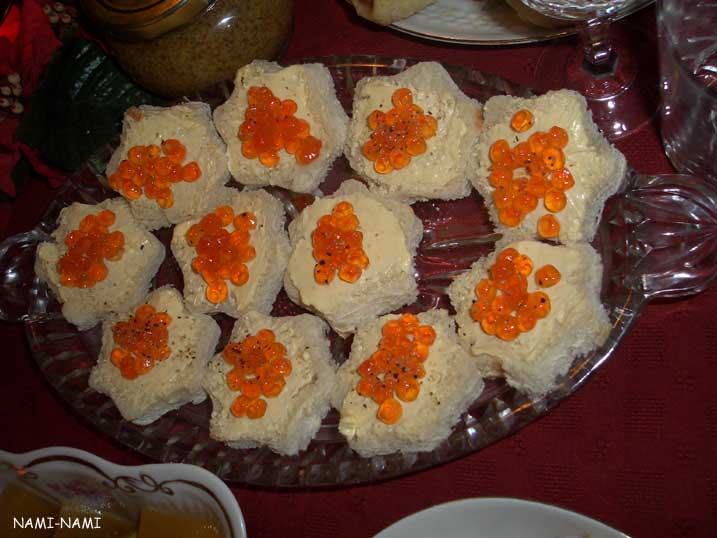
You don't really do much with it. You drain it, mash it with a fork, mix with some chopped onion and pickled cucumber and boiled egg, season with salt and pepper, and moisten with some of the drained oil. You get a very slightly fishy, mushy and creamy concoction that is great for stuffing boiled eggs (in which case you only add chopped egg yolk to the 'salad') or for spreading on toasted bread. That's exactly how cod liver found its way to my family's Christmas dinner this year, as one of the starters, when we were eagerly waiting for the boozy sauerkraut, roasted pork and black pudding to crispen. It also did so last year (click on the Estonian-language link below for a picture from 2004). It is definitely not a typical dish on Estonian Christmas table, but it seems to have its firm place on my family's table, alongside with salmon roe canapés (left) that my parents love but I heartily dislike. Too fishy for my delicate palate:)

Tursamaksasalati retsept

Friday, November 25, 2005

A Scottish supper

As I mentioned in my previous post, I had another Estonian friend visiting and I treated Margit, her colleague and another MacEstonian to a Scottish meal. The Estonian visitors had heard rumours of haggis, the Scottish national dish of lamb bits and other things, so I decided to make some exactly a week ago. My choice of haggis is MacSween of Edinburgh, and I bought both a vegetarian and traditional version. These were served with neeps (alias mashed turnip, seasoned with butter, salt, pepper, and nutmeg) and tatties (potato mash, seasoned with salt, pepper, milk and butter).


We drank my current favourite whisky and Whisky Mac cocktails. For the latter you mix 1.5 oz Scotch whisky and 1 oz green ginger wine. I suspect my ginger wine (not easy to find!) wasn't the green one, as the cocktail was way too sweet compared to the one I usually get served in pubs (which I love).

And for the dessert, I made cranachan again, this time adding mascarpone cheese for the mixture.


Apart from mishaps with the whisky cocktail, the meal was lovely. My visiting friend was surprised that mashed turnip tastes so sweet and nice, and both of them bought some haggis to take home with. And they know where to find a recipe for cranachan..