Monday, February 26, 2007

Waiter, there is something in my ... salmon kulebyaka

For the first round of Waiter, there is something in my ... ! I made Anthony Bourdain's boeuf bourgoingnon. For the second round of this new foodblogging event - in February focusing on pies and hosted by CookSister's Jeanne - I made something from the Russian cuisine: kulebyaka. Kulebyaka should have been on my 2007 list of foodie resolutions, as I had been thinking about making it for months, but somehow it slipped my mind when I wrote the post. But better late than never, and now was my chance to make that festive Russian pie. Kulebyaka is a high and oblong closed pie with different types of fillings. When looking for the perfect recipe, I came across kulebyakas stuffed with fish, mushrooms, meat, cabbage, even apples. Some recipes used puff pastry, some yeast pastry. I realised that it is the shape of the pie (enclosed, high, long) that distinguishes kulebyaka from a pirog (that's simply a 'pie' in Russian). However, to me kulebyaka has always meant - first and foremost - a fancy puff pastry pie filled with salmon and rice. At the end, puff pastry, sliced fresh salmon, rice, dill and dainty quail's eggs were my chosen ingredients. For those of you from the British Isles - think of Beef Wellington, just with salmon and rice instead of beef and mushrooms.

Salmon kulebyaka
(Lõhekulebjaaka)
Serves 6-8


500 grams puff pastry
500 grams salmon or trout fillet, thinly sliced
150 ml rice
12 quail's eggs
fresh dill, chopped
salt
freshly ground black pepper
lemon juice

(egg for brushing, black peppercorns for decorating)

Season the salmon slices with salt, pepper and lemon juice.
Cook the rice in salted water until al dente. Drain and cool.
Boil the quail's eggs in simmering water for 2-3 minutes, then cool quickly under cold running water. Peel and put aside.
Roll out the puff pastry.
Place the smaller pastry sheet on a baking tray. Cover with 1/2 of the rice, then dill and 1/2 of the salmon slices. Place the quail's eggs over the salmon.
Sprinkle with dill, then cover with the rest of the rice, top with salmon slices (see right) and sprinkle any leftover dill on top. Season with salt and pepper and a squeeze or two of lemon juice.
Cover with the larger pastry sheet. Decorate with small cut-out fish figures (optional - I used black peppercorns for eyes:). Make a couple of insertions into the pastry with a sharp knife, so the steam can evaporate during cooking.
Brush with egg.
Bake at 200C for 20-30 minutes, until kulebyaka is golden brown.
Serve hot, either with a good bouillon (traditional way) or a dollop of mayonnaise.

Here's a cross-section of the finished pie - I really liked the way those quail's eggs looked:

Tuesday, February 20, 2007

Perfect buns (re-posting)

Today (February 20, 2007) is vastlapäev or Shrove Tuesday again. All youthful Estonians are sledding down the hills tonight, eating copious amounts of bean or pea soup and maybe even some pig's trotters afterwards, followed by several fluffy cream-filled lenten buns. Not me, however. I'm skiing on the slopes of Italian Alps, checking out the restaurants in Valle d'Aosta and stuffing myself on Italian food. Life is good.

The post below originally appeared on March 1, 2006. I'm re-posting it to 1) mark the folk calendar occasion and 2) convince you to bake these. Believe me, these buns are perfect indeed!


Last night was supposed to be Shrove or Pancake Tuesday, but if you had visited any Nordic foodblogs, you'd realise that it wasn't Pancake Tuesday, but Bun Tuesday. There were buns all over the place. In Finland, Pastanjauhantaa and Axis of AEvil wrote about laskiaspulla. In Sweden, Dagmar, Clivia and Kinna blogged about semlor. And every single Estonian had one vastlakukkel - or two - during yesterday. Most schools would have included them in lunch, and many offices order trayfuls of lenten buns to savour during the day.

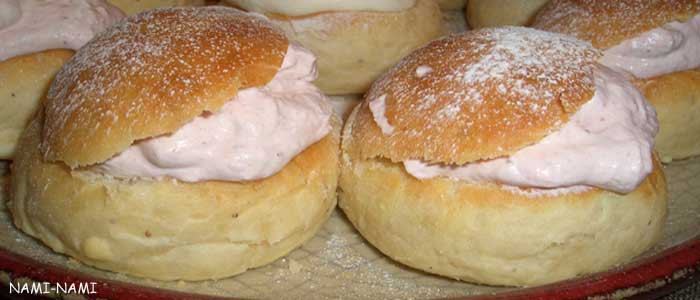
The Swedes have known the semlor-buns since the late 1600s, back home in Estonia it's a more recent treat. The Estonian vastlakukkel, Finnish laskiaispulla, Swedish semla, and Danish fastelavnsbolle are pretty similar. Lenten buns are basically fluffy yeasted caramom-scented buns, where the dough is enriched with eggs and butter. In Estonia, they are served with whipped cream alone. The Swedes include almonds, the Finns either marzipan and/or jam. Some Swedes eat them in a bowl of milk (and then call it hetvägg). Since learning that the Swedish King Adolf Fredrik died in 1771 after eating 14 of these semlor-in-milk (after a subtantial multi-course meal), I'll keep having mine without milk..

Here is a recipe I've used to make my lenten buns for the last few years, adapted from an old Estonian cookbook.

Vastlakuklid: Estonian lenten buns
(Hõrgud vastlakuklid)
Yields about 24

Buns:
500 ml lukewarm milk
50 grams fresh yeast
800 grams plain flour (soft), sifted
3 Tbsp sugar
1 tsp salt
1 tsp ground cardamom seeds
200 grams butter, melted and cooled
2 eggs, whisked

Filling:
500 ml whipping cream (35-38%)
2-3 Tbsp sugar
200 ml lingonberry jam (optional)

Take all the ingredients to the room temperature about an hour before starting.

First make the dough. Crumble the fresh yeast into a bowl and add the lukewarm milk little by little, stirring with a wooden spoon until the yeast has dissolved. Add the sugar and about half of the flour, stir with the spoon. The dough is rather wet at this point, so no need to use your hands.

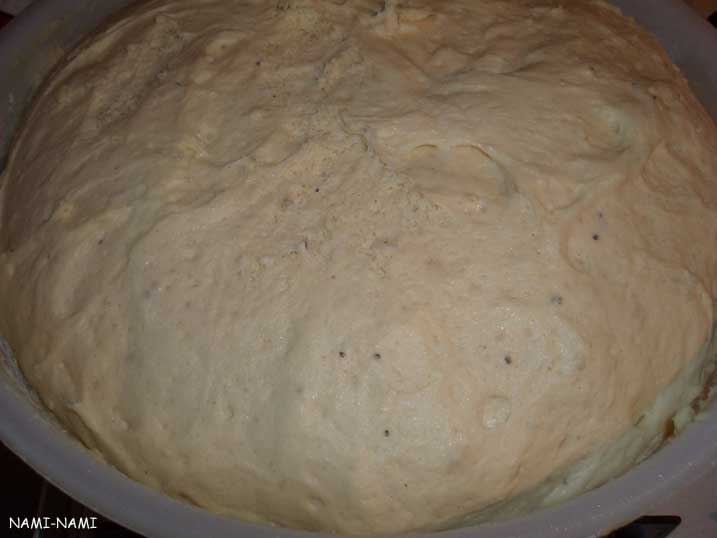
Cover the dough with a clean kitchen towel* and put in a warm place to prove. Make sure there is no draught in the kitchen! Let the dough double in size (about 30-45 minutes, depending on the kitchen conditions). It will look like the picture on the right, with small air bubbles on the surface.

When doubled in size, add the salt, cardamom, melted butter and whisked eggs. Stir in most of the flour and start kneading. You will have to knead the dough for about 10-15 minutes, until it's shiny and elastic and doesn't stick to the bowl anymore.

Now cover again with the kitchen towel and leave to double in size in a warm place. This should take about 45-60 minutes. Knock the dough back and leave to rise again. By this time the dough will look nice and all puffed up, quite dry in consistency.

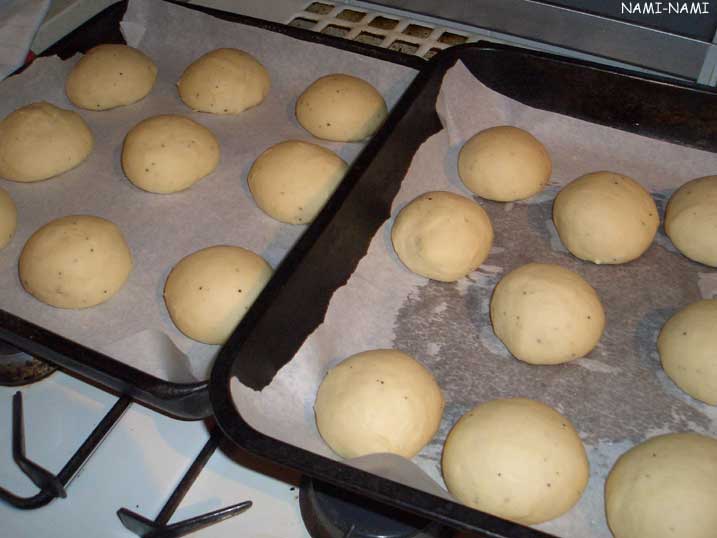
After about half an hour you can start the rolling. Every cook probably has their own trick for making perfect buns. Here's what I do. I twist off a small piece of dough (about the size of a small to medium egg), put it onto a large piece of parchment paper, cupping my hand over the piece of dough. A bit like holding the mouse (the computer mouse, I mean), with fingers touching the working surface as well. Then I start rolling "the mouse" on the table in small, firm circles. After about 10 seconds or so, you should end up with a beautiful and perfectly shaped ball under your cupped hand. Like this:

Transfer to a baking sheet. Let rise again for about 30 minutes.

Brush with milk or whisked egg (both are fine, the latter results in a shinier bun) and bake at 200-225˚C oven for about 15-20 minutes, until you have beautifully golden brown lenten buns.

[Just to recap: you pre-prove the dough, then add the rest of the ingredients and let the dough rise twice. Then you form the buns and let them rise a bit again. Then you bake:)]

Take out of the oven and cover with a kitchen towel to soften the tops. This is essential, as otherwise you'll make a mess when you start eating the cream-filled buns!

Make the filling. Whisk the cream with some sugar. I like to include some lingonberry jam in my cream filling, as this adds a nice tart touch to the otherwise very sweet bun.

Cut a small slice off the bun and fill with some cream. Put the "lid" back on.


Serve. Especially delicious after a night out on a snowy hill.

* It's a good idea to cover the bowl loosely with a cling film first, so if the dough rises very high, you won't end up with a sticky kitchen towel.

Saturday, February 17, 2007

Cooking with friends: a special bottle of burgundy wine, a chantarelle cappuccino, a boeuf bourgoingnon, and a matcha loaf

Here’s how to get hold of that very special bottle of wine that you see at your friends’ place.

A fortnight ago K. and I were invited to have dinner with some good old friends of his, Peter & Kristel. We had a lovely meal, drank some good wine (and pomegranate juice) and watched holiday pictures from South Africa, where the couple had spent the New Year’s Eve. It was my first visit to their place, so I was shown around the house (lots of lovely art, a captivating fish tank). Before we continued with biltong and fig compote, we stood for a while next to the couple’s wine collection.

It was then that K. spotted a precious bottle of Burgundy: Clos de la Roche, Patriarche Père et Fils (Beaune, 1992). K. adores Burgundy, so he came up with a cunning idea.

So it happened that last Sunday, Peter & Kristel turned up at our doorstep with that very bottle of Bourgogne, as K. had managed to convince them that it’s indeed a good idea to drink this wine together. As a good bottle of Burgundy needs a good Burgundy dish, then I made my Boeuf Bourguignon again. We invited another couple, Paavo & Kristina and their little daughter Gretel over, too (yep, the ones who almost ate all my apple cake few months ago:), who contributed a starter. And not just a starter, but a stunning wild chantarelle cappuccino.

Cooking the chantarelles with herbs and cream:


The soup is ready – it does look like a real thing, doesn’t it? We used our new (well, we bought them in November) iittala Origo bowls and Arabia plates:


The incredibly smooth chantarelle cappuccino was garnished with thyme and served with stuffed baked portabello mushrooms - being made on the photo below. As you can see, then little Gretel (aged 5) is a good hand in the kitchen, although only half of the blue cheese ended up on the mushrooms, as Gretel ate the rest of it. Note that we all need some moral support in the kitchen – hence the wine glass on the worktop (for the mother) and the teddy bear (for Gretel):


For the main course, I made Anthony Bourdain’s boeuf bourgoingnon again.

And for the dessert, we had my matcha loaf (third time in less than ten days), this time made by K. and supplemented with some finely chopped almonds. K. also candied some fresh kumquats and piped some Madagascar vanilla flavoured whipped cream on top:


And as for the wine? Well, it was definitely good enough excuse for a lovely night in with old (for K.) and new (for me) friends. It was full of character for sure, even if the other bottle, Bourgogne A. Rodet (Antonin Rodet, 1998) was more to my liking..