Showing posts with label Cuisine: Dutch/Belgian. Show all posts

Friday, October 15, 2010

More apple cakes: Hollandse appeltaart aka Dutch Apple Tart

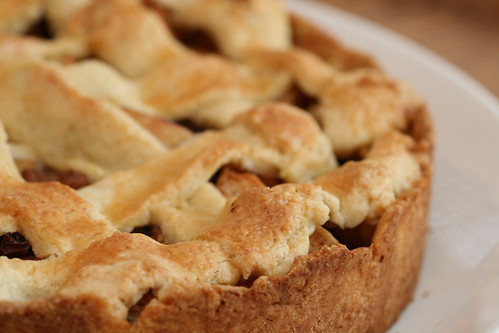
Dutch apple tart / Hollandi õunapirukas

Have you ever been to Amsterdam? If you have, then you surely remember this apple tart that was on offer everywhere - in pubs, in cafés. I definitely remember that, although I'm pretty sure it was called simply appeltaart and not Hollandse appeltaart there :) It's a delicious apple cake with a moist apple-raisin-cinnamon filling that's decorated with a criss-cross pattern of pastry strips. Pretty pretty, I'd say :)

Serve it with a generous dollop of whipped cream, or if you're feeling more glamorous, then some delicious home-made vanilla custard.

Dutch Apple Tart
(Hollandi õunapirukas)
Serves 8

Pastry:
300 g plain flour/all-purpose flour
200 g cold butter
125 g caster sugar
a pinch of salt
1 egg, lightly whisked

Filling:
3 to 4 large cooking apples (Antonovka, Granny Smith)
100 g caster sugar
30 g currants (dark seedless raisins)
30 g golden seedless raisins
1 tsp ground cinnamon
2 Tbsp breadcrumbs

First, make the pastry. Whisk flour, salt and sugar in the bowl of your food processor, add cubed cold butter. Blitz until the mixture is moist and crumbly. Add most of the egg (leave some for brushing), blitz once again. Using your hands, press the pastry together into a flat disk. (Avoid overworking the pastry, as it'll become tough). Wrap into a clingfilm and put to the fridge to relax for about half an hour.

Make the filling. Peel and core the apples, cut into smaller chunks. Rinse and drain the raisins, add to the apple pieces alongside sugar and cinnamon.

Butter a 24 cm springform tin.

Roll 2/3 of the pastry into a about 30 cm circle, use this to line the base and sides of the cake tin. Sprinkle breadcrumbs onto the pastry base, top with apple and raisin mixture.

Roll out the rest of the pastry thinly (about 3 mm), then cut into 1.5 cm strips. Place the pastry strips across the filling, interlacing them. Brush the top with the leftover whisked egg.

Bake in the middle of a preheated 180 C/350 F oven for about 45-50 minutes, until the cake is golden brown.

Cool a little, then transfer onto a serving plate.

Tuesday, May 19, 2009

Julia Child's Waterzooi Recipe - well, almost

Making Waterzooi / Belgia kanahautis Waterzooi

Ruth Van Waerebeek describes this famous Belgian dish in her book Everybody Eats Well in Belgium Cookbook as "a confusion of a soup with a stew, chock-full of herbs and vegetables". Julia Child names this as 'the most interesting recipe she's clipped'. Originally made with fish (perch, preferrably), this dish from the Ghent area of Belgium is now more commonly made with chicken. The chicken is poached alongside julienne of vegetables in a mixture of stock and vermouth, and thickened at the end with heavy rcream and egg yolks. When researching the recipe, I did come across recipes for waterzooi using lemon juice instead of vermouth, but vermouth - as used by Julia Child - sounded so much better :) Eventually I settled for Julia Child's recipe (available here), but adapting it slightly. We thought it was really delicious and rather elegant, and wouldn't look out of place on a slightly more special dinner party.

Now, I wonder what the most famous Belgian of all times, Hercule Poirot, thought of Waterzooi. :D

I used a packet of chicken fillet strips, but sliced chicken fillets or boneless chicken thighs would work as well. You can obviously play around with vegetables, but leeks and carrots are a must here - one for the flavour, the other for the colour.

Belgian Chicken Stew Waterzooi
Serves 4

Making Waterzooi / Belgia kanahautis Waterzooi

3 large carrots
1 large leek (white and tender green part only)
1 medium sized onion
4 celery ribs/sticks
1 tsp dried tarragon
50 g butter (2 Tbsp)
0.5 tsp salt
450-500 g chicken filet strips (1 pound)
250 ml (1 cup) extra dry vermouth (I used Italian Filipeti)
250 ml (1 cup) light chicken or veal broth
100 ml (just under 1/2 cup) heavy/whipping cream
2 large egg yolks
2 tsp cornstarch
salt and freshly ground black pepper
a large handful of finely chopped fresh parsley

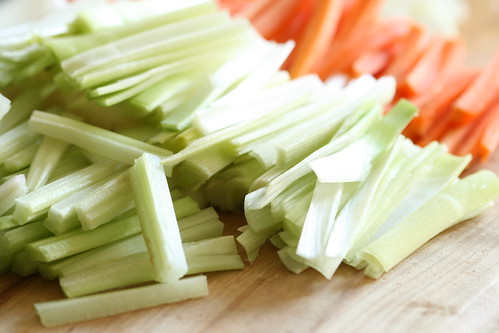
Trim and wash the vegetables. Cut carrots, leek and celery ribs into 4-5 cm (2 inch) julienne matchsticks. Peel and halve the onion, then cut into thin slices.

Making Waterzooi / Belgia kanahautis Waterzooi

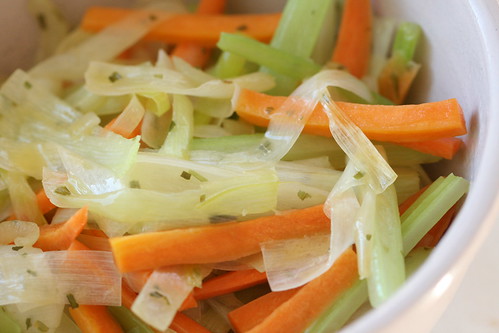
Heat the butter in a heavy casserole dish, add the vegetables, half a teaspoonful of salt and dried tarragon. Sauté for about 5 minutes, without browning! Transfer 2/3 of the vegetables into a bowl.

Making Waterzooi / Belgia kanahautis Waterzooi

Layer the sautéed vegetables and chicken strips into the casserole dish in this order, starting from the bottom: a third of vegetables, half of chicken strips, a third of vegetables, half of chicken strips, a third of vegetables. 

Making Waterzooi / Belgia kanahautis Waterzooi

Pour over the vermouth and chicken or veal broth, so the chicken and vegetables are just covered (you may need a bit more broth). Bring to the boil, then reduce the heat, cover and simmer gently for about 30 minutes, until the vegetables are soft and chicken cooked through. 

Now strain the cooking liquid into a bowl. Whisk egg yolks, cream and cornflour until combined, then add the hot cooking liquid, spoonful at the time in the beginning ('to temper' the egg yolk mixture). Pour the sauce back into the casserole dish over the chicken and vegetables, stir in most of the parsley and heat until the first bubbles appear. Remove immediately (overheating will cause the egg yolks to curdle).

Divide into hot soup bowls and serve with boiled new potatoes, gnocchi, noodles or good French bread. 

Monday, February 27, 2006

Well hung ... and tender: butter braised beef, Dutch style

I had heard about Well Hung & Tender and their award-winning Aberdeen Angus beef from the Scottish Borders before. After all, their steak beat Jamie Oliver's 21 day matured beef at the nationwide "Battle of the Beef Challenge". I had certainly noticed their eye-catching logo during my trips to the Edinburgh Farmers' Market. But the whole idea of cooking beef intimidated me, and I had not actually bought anything from their weekly stall.

Until last Saturday that is. I had spotted a highly praised and simple beef dish over at eGullet that I wanted to try. I had also invited 3 friends for a meal that night, and although you shouldn't really use your guests as Guinea pigs for new recipes, I was feeling quietly confident about the recipe, and the meat.

I told Sarah MacPherson, one half of the Well Hung & Tender team, and personally in charge of the stall last Saturday, about my planned dish. She suggested their best braising steak and gave me some helpful hints for cooking. The average hanging time for retail beef in the US is 19 days, and just 5-10 days in the UK. Well Hung & Tender, on the other hand, hangs their grass-fed and sufficiently "beefed up" Aberdeen Angus carcasses for between four and five weeks. This gives extra time for the enzymes to break down the muscle fibres, resulting in particularly tender and flavoursome meat. More importantly, it also means that this particular meat takes considerably less time to cook than similar cuts that are, well, not so well hung:)

And if you have such a great piece of meat, you don't really want to mess it up or get too fussy about it.

Butter braised beef - 'draadjesvlees/sudderlapjes'
(Imehõrk veiseliha)
Source: Butter braised beef, Dutch style by Chufi at eGullet
Serves 4


~ 500 grams of good quality braising beef
Maldon sea salt
crushed black peppercorns
75 grams butter
boiling water
2 bay leaves
2-3 cloves

Cut the meat into the same amount of pieces as you have diners. Season with salt and pepper.
Heat the butter in a wide, heavy-bottomed saucepan.
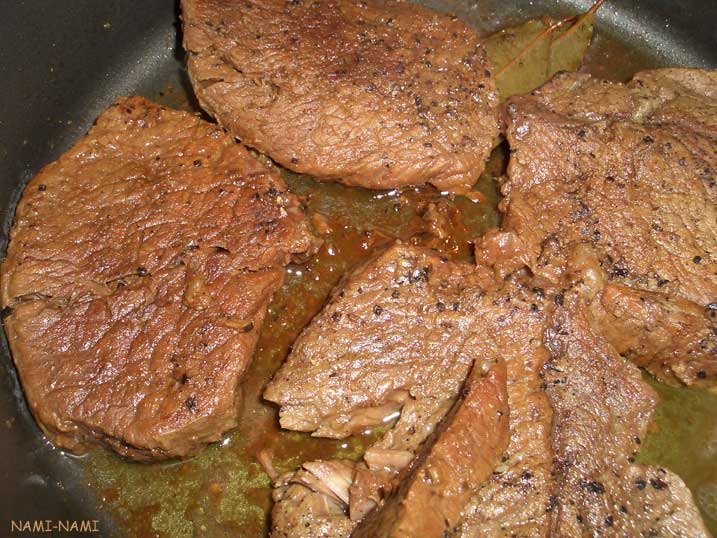
Add the meat in one layer, brown on both sides on a gentle heat. Be gentle.
Pour over the water, just enough to cover the meat.

And now I have to quote Chufi, the eGulleteer, as she puts it very nicely:

"Now add 2 bayleaves and 2 cloves. And here comes the most difficult part.. (for me at least..) don't add anything else. Not a splash of wine, not a sliver of onion or garlic, not a whiff of any other herb or spice. Nothing. Really."

Simmer the meat at a very low heat for 2-3 hours, depending on your beef. My meat was done after 2 hours, but that's because it was a well hung piece of beef. The original recipe prescribes 3 hours braising time.

I found the whole process of braising fascinating - for the first hour and a bit more the meat was simmering away and looked rather tough. I even managed to start to worry whether I'll be done before my guests arrived. And then suddenly, the meat softened and turned flaky, making the task of transferring the meat onto a plate quite a task..

The taste was amazing. The meat was absolutely gorgeous, melting in your mouth and really lovely flavour. I will definitely cook this dish again and cannot recommend it enough.

I served this with a garlicky potato mash and roasted cauliflower, drizzling some red wine sauce on top. Very happy diners and clean plates all around.