Showing posts with label Cuisine: North American. Show all posts

Monday, September 26, 2011

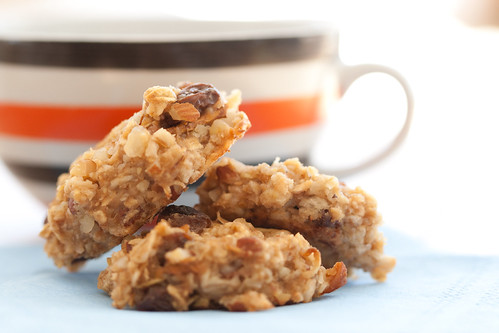
Tasty apple and oat morsels that don't look much, but taste wonderful

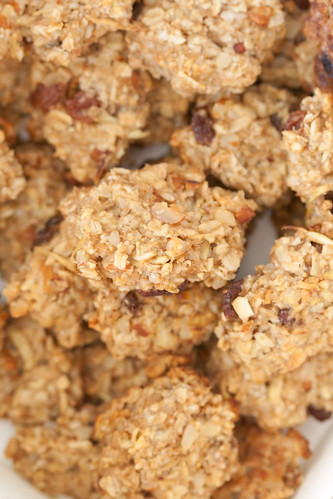
Apple oat almond morsels / Õuna-kaerahelbekäkid

Disclosure: I was sent a free review copy of the Green Market Baking Book: 100 Delicious Recipes for Naturally Sweet and Savory Treats by the publishers. A proper book review is yet to come, but here I sing praises to one little recipe from that book - apple oat pecan drops (page 121). These soft oat cookies (or morsels) don't look much, but I've made them no less than three times during the last week. As pecans are prohibitively expensive - and hard to come by - over here, I've used chopped almonds instead. I love them - they're soft, yet ever so slightly chewy, naturally sweet (apple! raisins!), healthy (no added sugar and virtually fat-free), very simple and quick to make, vegan, and rather addictive. I baked them last Friday, just to try a recipe from the book, then made another batch to take along to a a pop-up apple cake café on Saturday (the first person to try them bought 20!), and then another batch to a little village fête yesterday - and I will certainly make them again soon.

Apple and oat drops
(Õuna-kaerahelbeampsud)
Makes about 25-30 tasty morsels

Apple oat almond morsels / Õuna-kaerahelbekäkid

1,5 cups rolled oats (about 350 ml or 130 grams)
1 Tbsp whole wheat flour or spelt flour
2 large apples, coarsely grated
1 Tbsp mild oil (I used rapeseed)
0.5 tsp vanilla extract or 1 tsp vanilla sugar
4-5 Tbsp (hot) water
0.5 cup small seedless raisins or currants (about 75 g)
4 Tbsp chopped walnuts, pecans or almonds

Preheat the oven to 350 F / 180 C.
Using a fork, mix together oats, flour, apples, oil, vanilla and water. Mix in the raisins and the nuts. Let the mixture sit for 15 minutes.
Line a baking sheet with parchment paper. Drop the batter onto the baking sheet by the spoonful (either a heaped teaspoonful or a scant tablespoonful).
Bake in the middle of the preheated oven for about 15 minutes, until the morsels are light golden brown.
Cool a little, then enjoy!

Tuesday, July 26, 2011

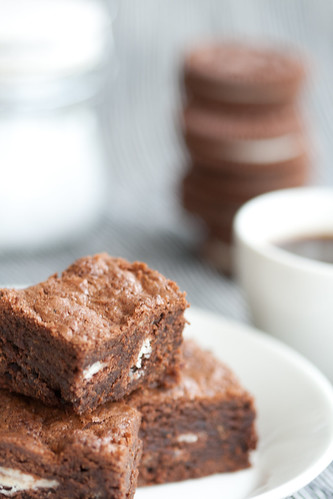
Dangerously moreish (frozen) Oreo brownie bites

Domino brownie / Oreo brownie

To be fair, these should be called Domino brownies, as I used Domino cookies, the Finnish equivalent of Oreo sandwich cookies. But if I'd call them Domino brownies, most of you would expect something like this as opposed to the cute brownie bite above. Also, most of my American readers (that's about 2/3 of all readers of Nami-Nami) don't have access to Domino cookies anyway, and could use more familiar Oreo ones for the same result.

Now, the frozen bit. I first read about frozen brownies a while ago, but dismissed the whole idea. Who likes frozen cakes anyway? They'd be cold and hard and utterly unpleasant, right? Or that what I thought. On the other hand, I've thrown away quite a few very good brownie pieces during my lifetime, just because I forgot them on the countertop for a day too long and they became dry and boring. That's not happening any more, as I've discovered - and totally fallen for - the joys of frozen brownies. You see, a good brownie, made with lots of butter, sugar, chocolate and just a little flour - and, most importantly, NOT overbaked - is absolutely wonderful eaten straight from the freezer - cooling, delicious and almost thick ice-cream-like. I've been cutting the brownies into relatively small pieces after cooling, and we've been nibbling through two batches of those frozen brownie bites during the last week already. Not just the three of us, of course, but with some help from our Scottish friends, grandparents, nephews and various babysitters :)

Estonian summer has been warm and sunny this year (again), and a frozen chocolate brownie is just what you might need to cool yourself a little..

The idea for putting chopped cookies into my brownies is from Ina Garten (here's her recipe for outrageous Oreo crunch brownies), but I used my old and trusted brownie recipe as a basis. Here's my version, that even my non-chocoholic-K. loves.

Have you been freezing your brownies? Do you like them or hate them?

Domino or Oreo brownie bites
(Domino-brownie koogikesed)
For a 10 inch/24 cm square baking tin

200 g unsalted butter
200 g dark chocolate, coarsely chopped (I used Callebaut bittersweet chocolate couverture chips)
3 eggs (size M or L)
200 g caster sugar
100 g plain flour
0.5 tsp fine salt
0.5 tsp vanilla extract
15-20 Domino or Oreo cookies, roughly chopped

Line a 10 in/24 cm square baking dish with parchment paper. Heat the oven to 170˚C/350F.
Place a heatproof bowl over a saucepan of simmering water. Add butter and chocolate and heat, stirring, until chocolate is melted and the mixture is smooth. Allow to cool slightly.
Whisk eggs, vanilla and sugar in a large bowl. Fold in the chocolate mixture.
Stir in the flour, salt and cookies, stir until combined.
Pour batter into the prepared baking pan and smooth top with a spatula.
Bake for about 30 minutes, until the brownie looks dry on top, but is still nicely moist inside.

When you want to serve your brownie warm, then cool a little and cut into big squares (9, perhaps?), serve alongside a big scoop of vanilla ice cream.

For frozen brownie bites, cool completely, then cut into small squares or rectangles and place into a freezer box. Enjoy from frozen.

Tuesday, October 05, 2010

Macaroni & Cheese a la Nancy Reagan

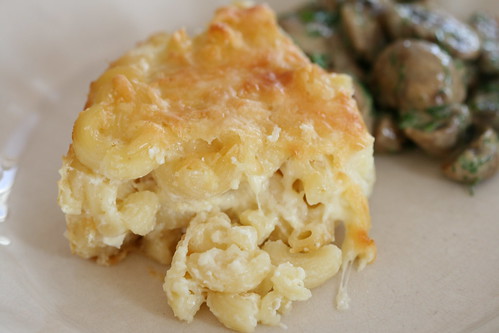
Nancy Reagan's macaroni and cheese / Reaganite makaronivorm

I cannot remember where exactly I got this recipe from (the Internet is a wide, wide world), but apparently that's the way Nancy Reagan would make mac'n'cheese for her hubby. Please, please don't read any politics into this choice of recipe :) - it appealed to me because of its simplicity. It's a good mac'n'cheese recipe for those moments when you're craving something simple and comforting, but haven't got many eggs in your fridge nor bacon nor cream.

As you can see from the picture below, then I've combined it with some Georgian creamy & herby mushrooms. They worked together like a dream.

What's your favourite macaroni & cheese recipe and do you eat it as it is or as a side dish?

Nancy Reagan's Macaroni & Cheese
(Reaganite makaroni-juustuvorm)

Nancy Reagan's macaroni and cheese / Reaganite makaronivorm

250 g small pasta (f.ex. elbow pasta)
water & salt, for boiling pasta
1 tsp butter
1 large egg
250 ml (one cup) of milk
1 tsp mustard powder/dry mustard
1 tsp finely ground sea salt
200-250 g grated cheese

Cook pasta al dente, drain (keep a spoonful of the cooking water for later). Stir in the butter and whisked egg, then transfer into a buttered round gratin dish.
Mix mustard powder, salt and a spoonful of hot pasta-cooking water, then stir in the milk and about 3/4 of the grated cheese. Pour over the pasta in the gratin dish. Toss a little, then sprinkle the rest of the cheese on top.
Bake in a pre-heated 170 C/350 F oven for about 45 minutes, until the custard is set and cheese lovely golden.

Monday, October 04, 2010

American Apple Pie

American apple pie / Ameerika õunapirukas

This is a very American apple pie - very rich, very high, and also very delicious. I had seen them popping up in various American food blogs and finally tried out my own version last year. It's quite unlike any of the typical apple cakes and pies we see here in Estonia, and thus providing a nice change to me, my family and friends.

American Apple Pie
(Ameerika õunapirukas)

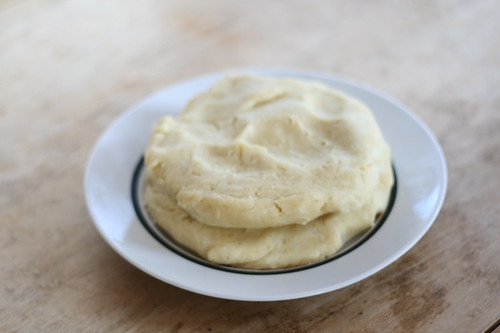
Making American apple pie / Ameerika õunapirukas (tainas)

Pastry:
300 g plain flour
1 Tbsp (demerara) sugar
1 tsp salt
200 g cold butter
4 Tbsp cold water

Filling:
1 kg cooking apples (e.g. something not too sweet or too soft)
3 Tbsp plain flour
100 g caster sugar
0.25 tsp ground allspice
0.25 tsp ground nutmeg
0.5 tsp ground cinnamon
1 tsp vanilla sugar
2 Tbsp cognac or brandy

Egg wash:
1 egg + 2 tsp water, whisked

Start with the pastry. Put flour, salt and sugar into the bowl of the food processor, then add cold cubed butter and blitz until you've got fine crumbs. Add about 4 Tbsp cold water and process once again. (Avoid overworking your pastry, as it'll result in hard cake crust).
Divide into two, press into flat discs, and place into the fridge for at least half an hour.
Meanwhile peel and core the apples, cut into thin slices or wedges.
Take a large bowl, mix flour, sugar, cinnamon, allspice, vanilla and nutmeg. Add the brandy and stir gently.

Take the pastry discs out of the fridge and roll both of them into a circle (about 28 cm in diameter). Line a 24 cm fluted pie dish with the pastry. Top with apple slices, piling them high in the middle. Top with the other pastry disc, pressing the edges tightly together. (If you wish, you can decorate the top disc with pastry leaves and such like).

Brush with an egg wash. Bake in the middle of a pre-heated 180 C oven for about 40 minutes, until the apples are soft and the pie is lovely golden brown.

Cool a little before serving.

Wednesday, August 25, 2010

Snickerdoodles - nutmeg cookies rolled in cinnamon sugar

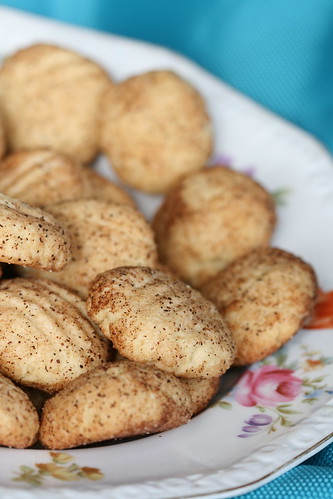
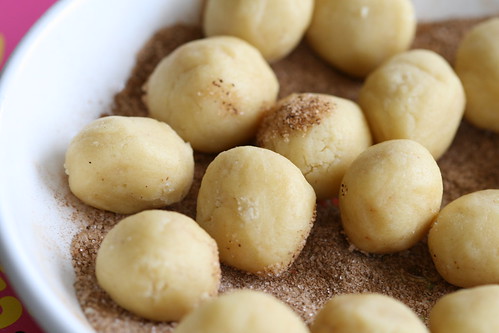
Snickerdoodles / Muskaatküpsised

I'm not the first blogger to write about Snickerdoodles (SmittenKitchen, EggBeater, Pinch My Salt, Andrea Meyers have all beat me to it), but I love the photo I made, so I want to blog about them as well :) Additionally, my recipe uses metric measures, making it more useful for a lot of Internet-users out there ;)

I don't know whom to credit for the recipe. All the cookbooks I consulted - be it Nigella Lawson, Rachel Allen or someone less famous - had almost exact recipe, almost verbatim, and mine is a combination of quite a few of them. The only changes I made was making my cookies a wee bit smaller. I also seems to me that the photos of Snickerdoodle cookies in the British food magazines and cookbooks depict cookies that are slightly rounder (as opposed to the very thin and flat ones in American foodblogs and cookbooks).

These cookies keep for a week in a air-tight cookie jar.

Snickerdoodles
(Snickerdoodles-muskaatküpsised)
Makes about 3 dozen cookies (2 cookie sheets)

Snickerdoodles / Muskaadiküpsised

250 g plain flour
0.5 tsp grated nutmeg
1 tsp baking powder
a pinch of salt
125 g unsalted butter, softened
100 g caster sugar
1 large egg
1 tsp vanilla extract

Cinnamon sugar:
2 Tbsp caster sugar
1 Tsbp ground cinnamon

Preheat the oven to 180 C/370 F.

Mix flour, nutmeg, baking powder and salt in a medium bowl.
Cream egg and sugar until pale and fluffy, whisk in the egg and vanilla extract. Fold in the dry ingredients and press into a neat dough ball.
Mix cinnamon sugar ingredients in a small shallow bowl.
Take small walnut-sized pieces of cookie down and roll them into small balls (I was diligent enough to weigh that each dough ball measured 12-14 grams :)). Roll each ball in cinnamon sugar until covered, then place onto a lined baking sheet, leaving about 3 cm between cookies.
Flatten the cookies lightly with the palm of your hand or by pressing with the fork.
Bake in the pre-heated 180 C oven for about 12-15 minutes, until cookies are light golden brown.
Remove from the oven, leave to cool for a couple of minutes, then transfer onto a wire rack to cool.

Wednesday, December 23, 2009

Eggnog Recipe


After reading about the popular American Christmas tipple, eggnog, for years, I finally took the plunge and made some last weekend. We loved it, and I'm probably making another batch tonight for tomorrow's Christmas Eve dinner, and then another one for the New Year's Eve party. The recipe below is based on Melissa's and Elise's recipes, and make an excellent Christmas-time drink.

Eggnog
(Eggnogi jõulujook)
1 litre (serves about 6)

4 large eggyolks
100 g caster sugar
500 ml milk (2 cups)
1 vanilla pod
1 cinnamon stick
250 ml whipping cream
2 Tbsp bourbon whisky
2 Tbsp dark rum

freshly grated nutmeg, to serve

In a large bowl, whisk egg yolks until frothy, then slowly beat in the sugar, whisking until fluffy.
Combine milk, cinnamon stick and vanilla pod (halved lengthwise) in a thick-bottomed saucepan. Slowly heat mixture on medium heat until it is steaming hot. Do not boil! (If you're not in a hurry, then remove the saucepan from the heat and let infuse for 30 minutes. Slowly reheat again before proceeding).
Temper the eggs by slowly adding ladlefuls of hot milk mixture into the eggs, whisking constantly. Pour the mixture back into the saucepan.
Cook on medium heat, stirring constantly with a wooden spoon, until it begins to thicken slightly, and coats the back of the spoon (candy thermometer should show 71C). Do not allow the mixture to boil, or the heat will curdle the egg yolks!
Remove from heat and immediately stir in the lukewarm cream (this will bring the temperature down and keep it from curdling).
Remove the vanilla pod and cinnamon stick. Cool until lukewarm, then stir in the bourbon and rum.
Chill before serving. NB! Grate some nutmeg on each serving!!

Thursday, November 19, 2009

Thanksgiving in Estonia: baking a pumpkin pie without Crisco and canned pumpkin


A selection of pumpkins at Tallinn Central Market, September 2007

Last week I got an email from a young American women who had recently moved to a small town in South-West Estonia. She wants to host a Thanksgiving dinner to her family and local friends, but didn't know where to get a whole turkey (not the most popular poultry bird here in Estonia) nor did she had a recipe for pumpkin pie that didn't use canned pumpkin and Crisco. I promised to post a recipe for an "Estonian" version of the American pumpkin pie, using the widely available yellow pumpkin, just like the one pictured above on the left.

This is for you, Laura W. :)

Pumpkin Pie
(Ameerika kõrvitsapirukas)
Serves 10


For the pie crust:
175 g plain flour
2 Tbsp sugar
125 g butter
1 egg yolk

Filling:
300 g coarsely chopped yellow pumpkin
2 eggs
175 g caster sugar
1 tsp cinnamon
1 tsp powdered ginger
a pinch of salt
2 Tbsp plain flour
200 ml whipping cream (35%)

For serving:
whipped cream and cinnamon

Make the pie crust first, by mixing flour, sugar and butter with a knife until crumbs for. Add egg yolk and knead until the pastry forms a ball. Line a 24-26 cm pie dish with the pastry (either rolling the pastry and transferring to the pie dish, or simply pressing it into the dish with your fingers). Place to the fridge for 30 minutes to relax.
Place cubed pumpkin into a small saucepan, pour over enough water just to cover. Add a pinch of salt and bring to the boil. Simmer for 8-10 minutes, until the pumpkin is soft. Drain thoroughly!!! Cool a little, then pureé with a blender.
Whisk the eggs slightly, then mix with cooled pumpkin alongside with other ingredients.
Pour the filling onto the pie crust.
Bake in the lower part of a 200 C / 400 F oven for 40-50 minutes, until the filling is golden brown and almost set.
Cool completely before serving with some whipped cream and a dusting of cinnamon.

Sunday, May 03, 2009

My favourite cheesecake recipe


Manhattan cheesecake with strawberry, mint and balsamic vinegar salsa

I just realised that I haven't shared my favourite cheesecake recipe with you. This needs to be corrected a.s.a.p., as I've told some of my Edinburgh friends that they'll find the recipe on the blog. The recipe is originally from a decade-old issue of BBC Good Food, but I've tweaked and changed both the ingredients and timings over the years. Lovers of oh-so-sweet cheesecakes out there - beware - this is a rather unsweet cheesecake. Just how I like it. It's also not as high/tall as some of the cheesecakes I saw in the US last summer - but again, I've never been a huge fan of tower-high cakes myself. 

What's your favourite cheesecake? Feel free to leave a link to the blog post/recipe in the comments.

Manhattan Cheesecake
(Manhattani toorjuustukook)
Serves 8

Base:
8 Digestive biscuits, crushed (I use LU brand, each cookie weighs ca 14 g)
2 Tbsp sugar
50 g unsalted butter, melted

Filling:
400 g full-fat Philadelphia cream cheese, at room temperature
75 g sugar caster 
2 large eggs
0.5 tsp vanilla extract

Top layer:
250 g sour cream
2 Tbsp caster sugar
0.5 tsp vanilla extract

Pre-heat the oven to 350 F/180 C. 

Line the base of a 20-23 cm springform tin with a baking paper. 
Crush the Digestive biscuits finely, mix with sugar and melted butter. Press the biscuit mixture onto the base of the cake tin. Place into the fridge for 10 minutes.
To make the filling, soften the cream cheese in a bowl, add other ingredients. Mix thoroughly with a wooden spoon, or blend for a few minutes, using an electric mixer (I like to do the latter, as it results in a lighter and creamier cheesecake filling). 
Pour over the biscuit base and bake in the middle of a preheated 350F/180C oven for 25-30 minutes, until the filling is more or less set (it shouldn't wobble too much, when you lightly shake the cake tin). 
Remove from the oven and cool for 20 minutes.
Turn the heat up to 230C/450F.
Mix sour cream, sugar and vanilla extract, then gently spoon onto the cooled cake. Return to the oven for 5-7 minutes, to 'dry out' the sour cream layer a little.
Remove from the oven and cool completely before serving. 

* The cheesecake on the photo is baked in a 20 cm cake tin, and is 3,5 cm high. 

Monday, January 14, 2008

A Weekend Full of Cooking, and a Recipe for Chocolate Brownies

Last weekend I baked no less than four cakes (chocolate buttercream cake with mocha glaze, saffron and carrot cake with cream cheese frosting, Manhattan cheesecake, and chocolate brownies), a cookie sheet full of small potato puff rolls, and prepared a festive salmon dish with lime and mustard. These were all for K's mum's birthday parties on the weekend. We attended just the one on Saturday, but were asked to prepare cakes for the other birthday party session as well:) Of course, I also cooked casual meals for myself and K. (sauerkraut soup with chicken drumsticks for dinner last night, and curd cheese patties with apples for dessert; K. made us these pretty curd cheese pancakes for brunch yesterday. We enjoyed the pancakes with some Cherry Republic's Blue Cherry Preserve - a surprise gift from one of my US readers, Ülle.

I love weekends like that.

And it looks like there's something American in the air at the moment. Only recently I found myself making coleslaw in the midst of winter. And two of the four cakes I brought along to K's mum's place were distinctly American - Manhattan cheesecake and Chocolate brownies. It's not surprising, of course, considering that many of my favourite food blogs and daily reads are written by Americans. No wonder then that my culinary mind and appetite lusts after American classics every now and then. However, the brownie recipe I've used for years is from Thorntons, the British high-street chocolatier. I've tried few others, but this is the one I keep returning to over and over again, when I'm craving chocolate. I don't like crumbly and over-baked brownies. This recipe results in brownies with a perfectly chewy-crispy top, and moist-chocolatey inside (even if one cannot really see that on the photo). I love large squares of it when still warm. And when it's cold, I cut it into tiny squares - no bigger than 2 cm - and eat as nutty chocolate candies :)

Chocolate Brownies
(Šokolaadiruudud)
Makes 16


200 g butter
200 g dark chocolate (min. 70%)
3 medium eggs
250 g sugar
100 g plain/all-purpose flour
100 g walnuts, chopped
0.5 tsp salt
0.5 tsp vanilla extract

Line a square cake tin (24x24 cm) with a parchment paper.
Melt the butter and chocolate in a bain marie or microwave. Cool a little.
Whisk eggs and sugar with an electric mixture. Stir in the melted chocolate and butter mixture.
Fold in flour, salt, chopped walnuts and vanilla extract and stir until well combined.
Pour the batter into the tin, and bake in a preheated 170˚C oven for 30-35 minutes, until the cake is chewy-crisp on the top and still moist inside.
Serve when still warm.
Alternatively, let cool in a tin, then cut into (smallish) squares.

Thursday, January 10, 2008

Coleslaw, my first ever

I had never made - or even tried - the American coleslaw salad* until a fortnight or so ago. And whereas I understand it's a typical salad to eat on your summer barbeque, I felt the sudden urge to try it just before Christmas - must have been all the substantial Christmas feasts I was attending during that time. I used Elise's coleslaw recipe as a starting point, and came up with this version. And I must admit I liked this simple cabbage salad a lot - the light mayonnaise dressing, the crunchy carrot and cabbage, the lively colours - all of it.

I actually liked enough to throw together a last minute red cabbage coleslaw for our New Year's Eve Feast. And definitely enough to consider making it again soon. So if you've got a specific coleslaw recipe you think I should try, tell me. I'm all ears!

You can read more about coleslaw over at Elise's or Wikipedia.

Coleslaw
(Ameerika kapsa-porgandisalat 'Coleslaw')
Serves 4


300 grams white cabbage
2-3 carrots, peeled
1 small red onion
a handful of parsley
3 Tbsp mayonnaise
2 Tbsp plain yogurt/sour cream
1 tsp strong mustard
salt
black pepper

Wash the cabbage and shred with a sharp chef's knife or a kitchen mandoline. Cut carrots into matchsticks (i.e. julienne).
Halve the onion, then cut into fine slices and separate the slices into rings.
Mix the vegetables in a large bowl, throw in the chopped parsley.
Mix mayonnaise, sour cream, mustard, salt and pepper in a small bowl, then fold into the cabbage mixture.
Serve.

* I understand that coleslaw can be pretty much any shredded cabbage salad, but the American coleslaw uses mayonnaise dressing?

Monday, October 29, 2007

I'm a Daring Baker: Bostini Cream Pies


Yes, it's that time of the month again when Daring Bakers strike across the foodblogosphere! And I'm one of them. Since joining the ranks of Daring Bakers I've made Jewish Purist's Bagels, then a fancy Strawberry Mirror Cake, followed by a delicious Milk Chocolate & Caramel Tart a la Eric Kayser, and last month I was baking very comforting Sticky Buns & Cinnamon Buns. This month a lot of Daring Bakers are making Bostini Cream Pies. October challenge was set by Mary of AlpineBerry, and you can find the recipe here. Mary tells you all about the background of Bostini Cream Pies, but apparently it's an adaptation of Boston cream pie (vanilla layer cake with cream and topped with chocolate glaze). Boston cream pie is an American classic - the official state dessert of Massachusetts, no less - created by French chef M. Sanzian at Parker House Hotel in Boston a while ago.

Bostini Cream Pie is similar, yet different. The dessert was nice - a combination of rich vanilla custard, light orange chiffon cake and a glossy dark chocolate glaze. It was easy to make and assemble, and I used my silicon muffin tray for baking the chiffon cakes which worked really well. We enjoyed this American classic just before watching a great American movie (TransAmerica), so it was a thoroughly American Sunday:) However, there's something about the American cakes & desserts that I never understand. As it was just two of us eating it this weekend, we halved the recipe, which should have yielded four desserts. Yet we still ended up with enough custard, cakes and chocolate glaze to feed at least 6 (if not 8) comfortably - and believe me, neither I or K. can boast to have a small appetite. I could, in theory, have eaten a 1/8th of the original recipe instead of lunch or dinner, but never ever as a dessert after the starter and main course..

Anyway - my favourite Daring Baker challenge so far is still the Milk Chocolate & Caramel Tart a la Eric Kayser, K. swears by the Strawberry Mirror Cake. We're both looking forward to the next month's challenge :)

You can learn how other Daring Bakers did with this month's challenge by browsing through the blogroll here. There are about 200 Daring Bakers already, so be patient:)

Saturday, October 06, 2007

Cooking from The Cook's Book: Salmon with Cajun Blackening Spices


I haven't had any fish recipes on the blog for a while (not since the picturesque teriyaki salmon, but that post didn't contain a recipe), so it's time to remedy the situation, especially as 'eating more fish' was one of my 2007 foodie resolutions.

I chose a recipe from Jill Norman's The Cook's Book: Step-by-step techniques & recipes for success every time from the world's top chefs, a book I gave to K. as a Christmas present last year after reading Sam's enthusiastic praises to Jill Norman's hefty tome. The book is divided into sections, each full of great instructions and recipes by the masters of their field - Dan Lepard (Breads & Batters), Ferran Adria (Foams), Marcus Wareing (Meat), Ken Hom (Chinese Cooking), David Thompson (Thai Cooking), Pierre Herme (Pastry & Sweet Doughs; Desserts), to name just a few. I've tried quite a few recipes from the book (Pierre Herme's recipe for pâte brisée with a twist is a particular favourite of mine; K. has been taken by Madame Guérard's method for deep-frying eggs), and due to the accumulation of our newest kitchen gadget have been reading up on Adria's chapter recently :)

The recipe is from Peter Gordon's chapter on Flavourings, and has been very slightly adapted. I reduced the recipe to feed the two of us; only used whole spices, as that's what we keep in the house; used fresh garlic, as I've never understood the appeal of dried garlic powder. I also cooked my salmon fillets for a wee bit longer than prescribed by Peter Gordon, yet still leaving salmon tantalisingly opaque-pink inside. Note that although it is usually recommended to dry-roast your whole spices first, it's not necessary here, as the spices will be coming into direct contact with the heat anyway.

And yes, of course it's a keeper. I wouldn't be sharing the recipe with you otherwise.

Salmon With Cajun Blackening Spices
(Peter Gordoni lõhefilee Cajuni vürtsidega)
Source: Peter Gordon in The Cook's Book (p 99), very slightly adapted
Serves 2-3


2 salmon steaks or fillets

1tsp cumin seeds, crushed
1 tsp coriander seeds, crushed
2 tsp smoked Spanish paprika, pimenton
1 tsp black peppercorns, crushed
1 tsp dried thyme
a pinch of dried oregano
2 tsp fine salt
1 garlic clove, finely minced

olive oil or rapeseed oil, for frying

Crush all cumin seeds, coriander seeds and peppercorns in the pestle & mortar, add other spices and finely chopped garlic clove. Mix and rub over salmon fillets or steaks (both sides!). Cover the tray and leave to marinate at room temperature for about 30 minutes.
Heat a heavy-bottomed frying pan on a moderately high heat until hot, add the oil. Place salmon fillets in the pan. Leave to cook for 2-3 minutes, without moving them (this helps to get a nice and even browning).
Turn salmon fillets around, cover the pan with a lid and cook for another 2-3 minutes, depending on how cooked you like your salmon.
Transfer onto warmed plates and serve with a cucumber salad and a dollop of thick yogurt/sour cream.

Monday, August 27, 2007

As American As ... Nigella Lawson's Rum-soaked Banana Bread

There are a couple of grocery staples that we as 'average' Estonians would most certainly pick up on our typical supermarket trip. Some rye bread (unless I'm baking my own), a carton of milk, some yogurt for breakfast and curd cheese for baking, a bag or two of sour cream. And a bunch of bananas. Yep. More often than not, K. and I throw a bunch of bananas into our shopping basket, as they're a useful standby if hunger pangs hit. Of course, now being late summer, we've got the first of local summer apples - Suislepp, Valge Klaar, Sõstraroosa - that are much better for that purpose. But I guess we're creatures of habit, so occasionally - and absent-mindedly - bananas still appear in our shopping basket and on our countertop, only to wilt there slowly while we're eating apples and plums that are in season just now..

That's exactly what happened last week, and that's why I was baking a banana bread in the heat of the summer. The recipe is from my favourite Nigella book, How to Be a Domestic Goddess: Baking and the Art of Comfort Cooking; she has adapted the recipe from Jim Fobel's book Old-Fashioned Baking Book: Recipes from an American Childhood. How does this compare with your favourite banana bread, I wonder? Is this a typical American banana bread recipe, as Jim Fobel & Nigella Lawson suggest?

Nigella Lawson's Rum-soaked Banana Bread
(Nigella Lawsoni rummihõnguline banaanikeeks)
Nigella's recipe is available here, below is my adapted version.
Serves 10


100 g sultanas
75 g dark rum
175 g plain flour
2 tsp baking powder
0.5 tsp baking soda
0.5 tsp salt
125 g unsalted butter, melted
150 g sugar
2 large eggs
4 small very ripe bananas (about 300 g peeled weight)
60 g walnuts, coarsely chopped
1 tsp vanilla extract

Put the sultanas and rum in a small bowl and soak for about an hour.
Combine the flour, baking powder, baking soda and salt in a medium-sized bowl.
In a large bowl, mix the melted butter and sugar and beat until blended (I used my KitchenAid mixer for this). Beat in the eggs one at a time, then the mashed bananas.
Stir in the walnuts, rum-soaked sultanas (including rum) and vanilla extract. Add the flour mixture, a third at a time, stirring well after each bit.
Scrape into the loaf tin and bake in the middle of a pre-heated 180ºC oven for about 1 hour, until an inserted toothpick comes out cleanish.
Leave in the tin on a rack to cool, and eat thickly or thinly sliced, as you prefer.

Saturday, June 30, 2007

Presidents who lunch: Toomas Hendrik Ilves & George Bush's luncheon menu at the White House

Klõpsa siia, kui soovid lugeda eestikeelset menüüd.


Estonian President Toomas Hendrik Ilves and US President George Bush shaking hands in the White House, June 25, 2007.
Photo: Mike Theiler, courtesy of
the Office of the President of Estonia.

Well, if George Bush had lunch with Toomas Hendrik Ilves in Estonia (that was in November 2006), it was only a matter of time that Toomas Hendrik Ilves would fly to the US to have lunch with George Bush in return (as he did early this week). Ilves and Bush actually met over two days, which was quite amazing considering that the first leds a country of barely 1.4 million people and the other a country of more than 300 million.

Anyway, here's what they had for lunch:


Click on the photo to enlarge. Photo courtesy of Eesti Ekspress.


I'd be interested to hear what American foodbloggers think about this menu. Was it seasonal? Was it representative of 'American cuisine'? And if yes, was it representative of modern or new or traditional or particularly regional American cuisine?

PS Curious to know what the Queen of England or the Emperor of Japan were served on their official visits to Estonia? Click on the Festive Menus label on the right hand side to find out.

Friday, August 18, 2006

A lovely peach cobbler

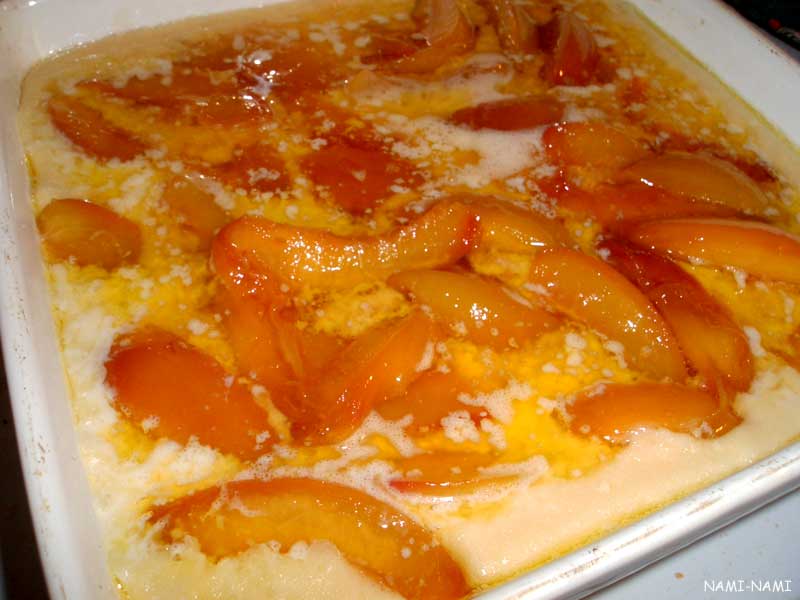
Apple Crisp? Rhubarb Crumble? Peach Cobbler? These type of puddings were all unknown to me until I moved to Edinburgh and shared my kitchen with postgrads from all over the world, including lots of Canadian girls doing diplomas in education. Whereas I was baking Canadian apple cakes, they were throwing together apple crumbles and crisps in no time whatsoever. I was hooked. I mean, I still make MY CAKE regularly, but sometimes you just want something even easier. There are differences between all those puddings (if you cannot tell your crisp, betty, cobbler, crumble, buckle, pandowdy and grunt apart, then read this definitive guide by Martha Stewart); this particular cobbler was inspired by a recipe and picture seen over at eGullet.

I've reduced the quantities a little, as well as replaced the self-rising flour with plain flour. Using demerara sugar gave a delicious hint of caramel to the finished dish, and we devoured it with some fresh vanilla custard.

Peach cobbler
(Virsikuvormi retsept)
Adapted from Food Network
Serves 4-6


Peach compote:
6 large peaches, stoned and sliced
150 ml demerara sugar
75 ml water

To the tin:
100 grams butter

Batter:
300 ml plain flour
a pinch of salt
2 tsp baking powder
200 ml sugar
300 ml milk

Put sliced peaches, sugar and water into a saucepan, shake to combine, and bring to the boil. Simmer on a low heat for about 10 minutes, stirring gently every now and then. Remove from the heat.

Take a medium-sized oven dish, put the butter into the dish and place into a 200 C oven to melt.

For the batter, mix sugar, flour, baking powder and a pinch of salt. Mix in the milk, little by little. Pour the batter onto the melted butter - do not mix!

Spoon the peach compote onto the batter, drizzle the sweet liquid on top.
Bake at 180 C for 30-45 minutes, until the cobbler is golden brown.

Serve with whipped cream, vanilla custard or vanilla ice cream.

UPDATE 18.8.2006
Sam included this post in her BlogHer entry "Once More Unto The Peach" - thank you, Sam!

UPDATE 21.8.2006
I made this cobbler again last night. My friend George came over to cook his famous lemon chicken in my kitchen for a mixed bunch of friends (George - a Greek/South African currently residing in the US, our friend Paul and his girlfriend Anjie - both English and studying/working in Edinburgh, and my Romanian friend Ruxandra who was visiting from England). I replaced about a fifth of the flour with wholemeal flour (simply because I ran out of plain flour), and scattered few handfuls of blackcurrants on top of the cobbler. Again, very tasty, the wholemeal flour making it somewhat more earthy and, well, wholesome, in flavour.

Monday, November 28, 2005

(Non-)Canadian apple cake


Photo updated in August 2008. I've also added gram measurements for dry ingredients in addition to volume measurements.

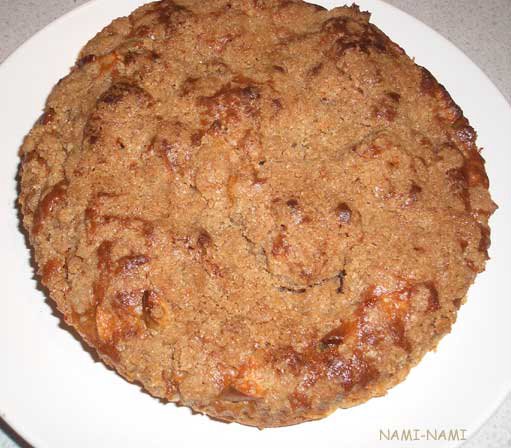
This is my most faithful apple cake recipe – a recipe that has been with me for a lot more than a decade. Despite having tried numerous other apple cake recipes – some fancier, some humbler, some trickier, some simpler – this is the recipe I come back to most often.

In 1978, a book was published in Estonian, called "Maailma toite" or "Dishes of the world". It was a collection of numerous recipes collected from various sources and a small number of pictures. Chapters were listed according to regions or countries, each beginning with a small introductory paragraph about what people eat in the given country. I loved the book – I liked the descriptions of foods from faraway places that I could never visit in person (or that’s how it seemed behind the Iron Curtain at the time), and reading about these foods gave me a sneak preview into the lives on the other side of than notorious ‘invisible but definitely there’ Curtain..

Once I reached my early teens, I had somehow already been bitten by the foodie bug, and I attempted cooking a number of the dishes. Some where huge successes, some were not. I can still remember the reserved enthusiasm that my Austrian carrot pure soup was met with. However, under the section "Canada" I came across a recipe for apple cake – Kanada õunakook. I fell in love with it then and there – and as I said, this has proved to be a long-term relationship. This is the cake that I bake most often. This is the cake that is often requested when we go to visit friends and relatives. This is also the cake that has caused me most embarrassment. I remember early on, my uncle J. had asked me to bring along my delicious apple cake to his birthday party. Somehow I ended up using only a third of the flour in the batter that time, but too inexperienced at the time to see that something was clearly wrong with it. The resulting cake was dense, hard and utterly bitter (the cinnamon overkill) and was sitting still pretty much untouched on the table at the end of the party. Luckily, I seem to have redeemed myself since then and restored my Domestic Goddess reputation.

As I said, this recipe was called “Canadian apple cake” in my book, and that’s how my family knows it back home. During my years in Edinburgh, I’ve shared a kitchen with quite a few Canadians (Hi! Amanda!!! :), and although they all loved it, they couldn’t really see why it was Canadian. Canadian or not, it’s a delicious apple cake..

Canadian apple cake
(Kanada õunakook)


Batter:
300 ml plain flour, sifted (165 grams)
0.5 tsp fine salt
2 tsp baking powder
1 tsp cinnamon
100 ml sugar (85 grams)
1 large egg
50 grams of butter, melted
100 ml milk (100 grams)
ca 2-3 large apples, cored and cut into small cubes

Crumb:
4 Tbsp brown sugar
2 Tbsp plain flour
1 tsp cinnamon
2 Tbsp butter

Mix the dry ingredients. Mix the butter, milk, and egg, pour into the dry mixture and mix. Fold in the apple cubes. Pour the batter into buttered loose bottomed cake tin.


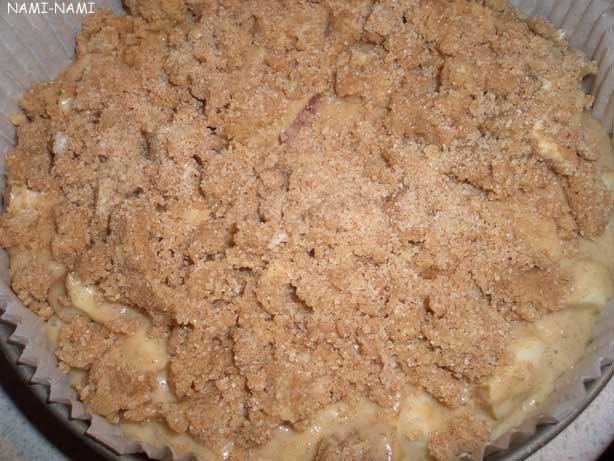
Mix the crumb ingredients with a knife, sprinkle over the cake.


Bake at 200-210˚C for 30-40 minutes, until a toothpick comes out clean and the cake is nice golden brown.

Let it cool slightly (although it’s beautiful hot with a cold glass of milk). Sprinkle with icing sugar. Serve with vanilla ice cream, creme anglaise or on its own.

The moist apple pieces in the cinnamonny cake? And the cinnamonny caramelized crunchy topping?

Mmmmmmm!! I just thought of a way to Canadize this cake a bit, and maybe even make it live up to its name. What if I’d replace the brown sugar in the crumb mixture with maple sugar??? There’s an idea for next time...

UPDATES: here are links to some other foodbloggers who have kindly tried - and liked - my apple cake:

4 December 2005: Anne over at Anne's Food

12 December 2005: Drstel at Baby Rambutan

14 December 2005: Zubaida over at Kitchen Culture

16 January 2006: Shalimar over at Wanderlust

16 January 2007: Joey over at 80 Breakfasts

14 April 2007: Nupur over at One Hot Stove