Showing posts with label Cuisine: British Isles. Show all posts

Monday, March 21, 2016

Lemony bread and butter pudding with custard and berries


It's been a while since my last proper blog post, I know. It's not that I've neglected my food-loving readers, I've just been focusing on my Estonian readers during the last months. Apologies :) But here I am, attempting to start blogging again with this fun take on bread and butter pudding.

Why bread and butter pudding? We were sorting the bread and butter recipes over on my Estonians site with one of my editors, Kaare, and while doing the research, I came across this shortcut version in the British food magazine Delicious. Meanwhile, if you read Estonian, you can check out Kaare's great article on this humble - yet versatile dessert: Millal Sa viimati saiavormi sõid?

Lemony bread and butter pudding with custard and berries
(Saiavorm sidrunivõide, vanillipudingi ja marjadega)
Serves 6 to 8

400 g good white bread (brioche, challah or such like)
butter, softened
500 ml (2 cups) fresh vanilla custard
200 ml double cream/whipping cream
300 g berries (raspberries, blackberries, blueberries)
6 Tbsp lemon curd or toffee/caramel sauce

Preheat the oven to 160°C . Thickly slice the bread and butter one side of each slice. Cut each slice into large triangles or halves and layer in a 2 litre ovenproof dish.

In a 1-litre jug, mix the vanilla custard and fresh cream, then pour in around the bread slices, pressing the bread down gently. If you can, leave to stand and absorb for about half an hour. 

Scatter berries on top, tucking them between the bread slices. Spoon dollops of lemon curd or caramel sauce on top.

Bake in a preheated oven for 40-50 minutes until the bread slices on top are golden brown on edges and nicely crispy.

Leave to rest for 10 minutes before serving. Serve with a jug of cream or milk (pictured). 

How do you make bread and butter pudding?

Wednesday, January 28, 2015

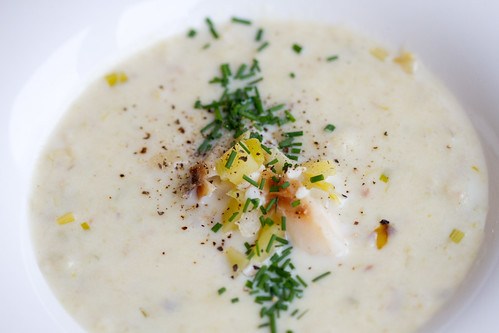
Cullen Skink, a Scottish smoked haddock and potato soup (gluten-free)


IMG_3073.jpg

Few days ago the Scots - and friends of Scotland - celebrated yet another anniversary of the birth of Robert Burns, hosting or attending a Burns Supper. Any self-respecting Burns Supper begins with a proper Scottish soup. I've shared a recipe for Cock-a-leekie before, other options are Scotch broth and Cullen Skink.  Now it's time to share my recipe for the smoked haddock and potato soup - think of it as a Scotch chowder :)

The soup is from the North-East of Scotland, from the fishing town of Cullen. Originally it's a comfort food, cheap and easy fare, and it's still popular in and around Cullen. Yet somehow that humble soup has tranformed into a fancy fare to be enjoyed at various festive Scottish occasions.

Scots know their smoked fish. Arbroath Smokie is a pair of salted haddocks, hot-smoked in a humid smoking chamber. Finnan Haddie, the traditional fish used for making Cullen Skink, is gutted and cleaned haddock that's been dry-salted and then smoked in a cool smoking chamber for 8-9 hours. If Finnan Haddie is hard to find where you live - that's probably most of the world apart from the British Isles - (and avoid the bright yellow dyed stuff, it discolours the soup), then any other nice smoked white fish would do. I used smoked cod, a user of my Estonian Nami-Nami site said that the soup worked well with smoked herring.


Cullen Skink
(Šoti suitsukalasupp)
Serves 6 as a starter, 3 as a main dish

IMG_3083.jpg


500 g smoked haddock (ideally Finnan Haddie)
500 ml (2 cups) of water
butter for frying
1 yellow onion, chopped
1 large leek, cleaned and sliced
2-4 floury potatoes, peeled and cut into chunks
500 ml (2 cups) whole milk
1 bay leaf
salt and freshly ground black pepper
fresh chives, finely minced

Place the fish into a pan, add the bay leaf and cold water. Gently bring into a boil, then simmer for about a minute or two. Remove the fish from the pan, transfer onto a plate and leave to cool. Keep the fish stock!

In another pot melt the butter gently. Add onion and leek, cover and sauté gently for a about 10 minutes. Stir every now and then, do not brown! Season with salt and pepper. Add potato pieces to the onion and leek, give it a stir. Add 500 ml/2 cups of fish stock, bring into a boil and simmer until the potato is cooked.

At the same time remove the fish from the bones carefully, flake into smaller pieces (discard the fish skin and bones). Using a slotted spoon, take couple of spoonfuls of the potato-leek mixture from the soup and put aside. Discard the bay leaf. Add the milk, bring gently into a boil. Add about half of the smoked fish. Mash the remaining soup or pureé using the hand-held/immersion blender. Season with salt and pepper.

To serve, place a large spoonful or two of potato-leek-smoked fish mixture into the middle of each soup bowl, then ladle the liquid soup neatly into the bowls as well. Garnish with chives and serve.

Tuesday, March 26, 2013

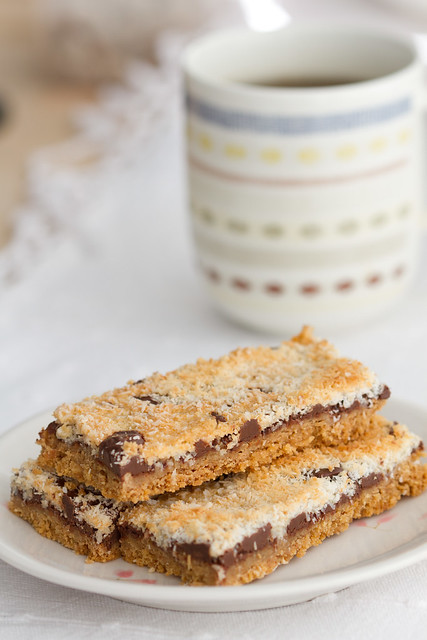
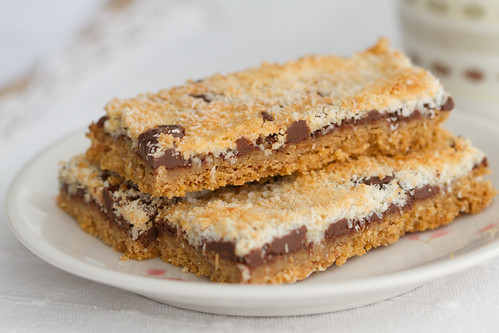
Simple Magic bars recipe

Sue Lawrence's Anta Bars

I was due to give a Scottish cookery class last Sunday in Aegviidu - a small town about an hour from Tallinn. While finalising the menu for the cookery class (skirlie and clapshot and cranachan and such like), I flipped again through the pages of Scottish author's Sue Lawrence's excellent "A Cook's Tour of Scotland: from Barra to Brora in 120 recipes". One of the last recipes in the book was for Anta Bars - a tray cake that Sue Lawrence was served at the Anta Pottery's tearoom in Fearn, Tain, near Ross-shire in the Scottish Highlands (see here for the exact address). Ingredients? Digestive biscuits, butter, sweet condensed milk, milk chocolate and desiccated coconut. Very similar to Magic bars, though these tend to have a layer of nuts included as well, and are layered somewhat differently (I rely on the Joy of Baking blog for this information).

I had a whole packet of sweet condensed milk I wanted to use, and while I really wanted to make the Millionaire's Shortbread, I decided to give these Anta Bars a go instead. Why? Well, for the Millionaire's Shortbread (also known as caramel shortbread) you need to boil the condensed milk first, whereas the Anta Bars have a layer of regular sweet condensed milk drizzled over the cookie crumb base. So much simpler and quicker.

A word of warning, however. While Scotland can be really proud about the great quality of their produce and ingredients (venison, lamb, beef, salmon, raspberries, shortcakes, haggis etc etc), then this cake is not the healthy option, for the fainthearted or for those counting their calories. It's extremely sweet. You know, tooth-achingly sweet. Definitely an occasional treat rather than your regular afternoon tea or coffee cake :)

Sue Lawrence's recipe was excellent - no surprise, as she is considered one of the best Scottish food writers of our times. However, I did reduce the amount of coconut flakes after the initial attempt, as I had hard time getting the original amount (170 g of desiccated coconut) to stick to the cake and not fall off. Also - even if you might be tempted to use dark chocolate instead of milk chocolate, perhaps to counteract the sweetness, then don't - this cake needs the much sweeter milk chocolate. Trust me, I tried both versions..

Anta Magic Bars or a recipe for caramel, milk chocolate and coconut slices
(Anta koogiruudud)
Source: Sue Lawrence's "A Cook's Tour of Scotland", sligthly adapted
Serves about 24

Sue Lawrence's Anta Bars

140 g butter, melted and cooled
350 g Digestive biscuits or graham crackers
300 g sweetened condensed milk
200 g good-quality milk chocolate, chopped (or use chips)
100 g desiccated coconut

Line a baking sheet/Swiss roll tin (about 25x35 cm) with a parchment paper. Preheat the oven to 180 C/350 F.
Finely crush the Digestive biscuits (I used my food processor), then mix thoroughly with melted butter. Spoon the biscuit mixture into the cake tin, pressing down. Drizzle the sweetened condensed milk evenly over crumb mixture.
Now scatter the chopped chocolate evenly on top, finally sprinkle with coconut flakes, patting down lightly.
Bake in the middle of the preheated oven for about 20 minutes, until the coconut is golden brown.

Remove from the oven and leave to cool completely before cutting into small squares or bars.

Other foodbloggers have been testing Sue Lawrence's recipes:
Cock-a-leekie soup by Pille @ Nami-Nami
Mince and tatties by Pille @ Nami-Nami
Chocolate brownie with raspberries by Pille @ Nami-Nami
Smoked salmon frittata by Pille @ Nami-Nami
Haggis and winter tzatziki wraps by Sophie @ Mostly Eating (intrigued!!!)
Passion cake by Maggie @ Kitchen Delights
German apple cake by Celia @ English patis

Thursday, January 24, 2013

Scottish food: Cock-a-Leekie soup

Originally posted in February 2007; fully updated in January 2013. Cock-a-leekie soup / Kana-porrusupp

Photo by Juta Kübarsepp for the January 2013 issue of Kodu ja Aed. Recipe and styling by Nami-Nami. The tablecloth is Estonian national tartan - the blue, black and white representing the Estonian flag, the red and golden representing Scotland's Rampant Lion. 

Tomorrow the friends of Scotland and all things Scottish across the world celebrate Robert Burns' birth anniversary, hosting or attending a Burns Supper. And any self-respecting Burns Supper begins with a proper Scottish soup - either Scotch Broth or Cock-a-Leekie. As the latter is a) considerably cheaper and b) considerably easier, and something that I've cooked over and over again. Amazingly, so few ingredients (a chicken, some leeks and some juicy prunes) can result in such a flavoursome soup.

Here's the recipe for a lovely and flavoursome cock-a-leekie. It started off as a recipe from Sue Lawrence's Scots Cooking: The Best Traditional and Contemporary Recipes (excellent book, by the way!), but I've tweaked both the amounts and the instructions, including the cooking method, considerably.

Cock-a-leekie
(Cock-a-leekie supp ehk šotlaste kana-porrusupp)
Serves 10 as a starter or 4 to 6 as a main course. 

1 chicken (1.5 kg)
3-4 large leeks (1 kg)
20 black peppercorns
1 bay leaf
about 2 litres water
20 juicy prunes, stoned and sliced
fresh parsley, chopped

Place the chicken in a large saucepan. Halve the leeks lengthwise, wash them well, then cut off the green parts. Chop these roughly and add to the pan with the peppercorns and bay leaf. Add the water - it should just cover the chicken. Season lightly with salt.
Bring slowly into the boil, skim off any scum that appears at the surface. Then cover and simmer for about 1.5-2 hours, until the chicken is cooked. Remove from the heat and let it cool.
Take out the chicken and remove the leeks, either with a slotted spoon or by draining the soup through a colander. Discard the cooked leeks. Remove the chicken flesh from the bones and chop into smaller pieces.
Chop the white part of the leeks, add to the pan with the prunes and chicken and bring to the boil again. Simmer for about 10 minutes, until the leeks are just done.
Season with plenty of salt and pepper and serve with chopped parsley on top.

Wednesday, January 16, 2013

Pan-Seared Oat-Crusted Salmon or Trout

Oat-crusted salmon / Kaerahelbepaneeringus lõhefilee
Photo by Juta Kübarsepp for the January 2013 issue of Kodu ja Aed magazine. The tablecloth is Estonian national tartan - the blue, black and white representing the Estonian flag, the red and gold representing Scotland's Rampant Lion.

Burns Supper is nigh and it's a great opportunity to cook some Scottish recipes again. Here's a salmon with a crispy mustard and oat crust that's easy to make and yet festive enough for a good Burns Supper (if you're not serving haggis, that is). The Scots tend to cook herring this way, but sadly it's almost impossible to get fresh herring over here. Salty herring - whole or filleted - in brine is widely available, but fresh, no.

Luckily this method works brilliantly with other oily fish as well, especially salmon and trout. You can use filet from the tail-end (it's easier to cook), or use butterfly steaks, like I did.

Oat crusted fish 
(Kaerahelbepaneeringus kala)

one salmon or trout butterfly steak or filet per person
sea salt and freshly ground black pepper
sharp Dijon mustard (or Põltsamaa, if you're in Estonia)
quick-cooking oats or coarse oatmeal
oil, for frying

Season the fish with salt and pepper, then smear lightly with some mustard (use too much mustard and your oats won't stick to the fish while you're frying). Dip the fish into oats. If you're using the skin-on fish filet, then just the flesh side, obviously.

Heat the frying pan until hot over moderately high heat, then drizzle with oil. Add the fish and fry until crispy and golden brown on both sides (my butterfly steak needed about 3 minutes on one side and 2 on the other).

Serve with a sautéed spinach (on the photo) or kale or some mushy peas.

If you want  some dressing to go with it, then I recommend flavouring some creme fraiche with mustard, salt, pepper and finely chopped chives.

PS I've tagged the recipe as gluten-free, but you must use certified gluten-free oats and mustard then.

Other Scottish recipes suitable for Burns Supper:

Appetisers/canapés:
Red onion and whisky marmalade
Mini haggis tarts
Tattie scones

Starters:
Cock-a-leekie or chicken and leek soup with prunes

Main course:
Oat crusted fish

Dessert/pudding:
Cranachan or raspberries, cream and tipsy oats
Shortbread
Scottish lemon cake
Chocolate raspberry brownie

Thursday, November 01, 2012

Scottish shortbread, the way I like it

A cow, the Saltire, Scottish Parliament and me

There's a personal reason to celebrate all things Scottish today - namely, it was exactly seven years ago that I met my dear partner K. at a reception at the Scottish parliament in Edinburgh (housed in the lovely building behind me on the photo above, though the picture is taken about 7 months later), which eventually led me to moving back home to Estonia, and living a very happy life with a wonderful partner and two gorgeous kids. Oh, and a lovely garden.

The Scottish dish I'm celebrating today is the wonderful, melt-in-your-mouth, buttery Scottish shortbread. It's soft, yet crunchy - the crunchiness is enhanced by the use of fine semolina in the recipe. You cannot have a cup of tea without those, really.

Scottish shortbread / Šoti liivaküpsis

Here's the home-made Scottish all-butter shortbread - the recipe is from Delia Smith - and as it's a pretty classic one, there's been no reason to change it. I used a special shortbread tin, marked with the thistle, but you can just as well use a regular springform tin or even roll the dough out and cut into preferred shapes with a cookie cutter (remember to adjust the cooking time for smaller cookies!)

Scottish butter shortbread
(Šoti liivaküpsised)

175 butter, at room temperature
75 g caster sugar
175 all-purpose flour, sifted
75 g fine semolina/cream of wheat
a pinch of salt

Preheat  the oven to 150 C/300 F.

Using your wooden spoon, cream the butter in a bowl.
Add the sugar, flour, semolina and salt. Mix with the spoon until combined, then use your hands to knead the dough (or simply use a food processor). Avoid over-working the dough, however, as the butter might melt and compromise the texture!
Transfer the cookie dough onto a lightly floured surface. Using the rolling pin, roll into a 20 cm circle and transfer it into a 20 cm springform. Press lightly, then pierce with a fork thoroughly (this keeps the shortcrust pastry from raising during baking).
Bake the shortbread for about 60 minutes in the centre of the preheated oven, until it's pale golden and feels firm to the touch.
Remove it from the oven and cut into 12 wedges.
Sprinkle generously with caster sugar, if you want, and store in an airtight box.

Thursday, May 17, 2012

Beer, mustard and cheese bread recipe, inspired by Welsh Rarebit

Mustard and beer bread / Sinepi-juustu-õlleleib

Are you familiar with the British pub classic, Welsh Rarebit? It's a slice of toasted bread topped with a melted cheese, mustard and beer concoction. Excellent, if rich, comfort food. Those three flavourings are all present in this soft yeast bread that's been a favourite for years - I even included a recipe in my first cookbook. It's soft and tender, with plenty of gutsy flavours going on. It's obviously not a bread that you'd toast and slather with jam, but with some extra cheese or a slice of good country ham - oh yes!

See also Felicity Cloake's post How to cook perfect Welsh rarebit in the Guardian to give you some insights into the dish that inspired this bread. 


Beer, mustard and cheese bread
(Õlle-juustuleib)
Makes 2 loaves

Welsh rarebit bread / Õlle-juustuleib

500 ml dark beer (ale, porter, stout - all work; 2 cups)
50 g fresh yeast or 2 envelopes fast-action instant yeast
3-4 Tbsp light syrup (golden syrup or corn syrup is fine; about 80 g)
2 tsp fine salt
150 g hard cheese, coarsely grated (Cheddar's good, or any Estonian cheese :))
600-650 g all-purpose flour*
1-2 tsp English mustard powder (I use Colmans)
100 ml vegetable oil or 75 g butter, melted and cooled

Use a large mixing bowl.  If using fresh yeast, then crumble it into lukewarm (37C) beer and stir until dissolved. Add the syrup, then fold in the grated cheese and about half of the flour. Add the salt, mustard powder and knead in the rest of the flour. Finally add the oil/melted butter. 
(If you're using the fast-action instant yeast, then simply mix all the dry ingredients, then add the beer, syrup, cheese and mix, finally adding the oil/butter). 

* A note on the amount of flour. I've successfully made this with 600 g flour, which is about 1 litres or about 4 heaped cups.  You may need a little more - you're aiming for a soft, dropping consistency.

Cover the dough with a clean kitchen towel, place the mixing bowl into a warm and draught-free location and let the dough raise until doubled in size. This will take about an hour.
Transfer the dough onto a lightly floured worktop. Lightly knead the dough and divide into two equal parts. Form into oblong loaves and transfer into buttered or lined baking tins. (I've used 22 cm/2 litre bread tins to make high loaves and 30 cm/3 litre bread tins to make smaller loaves).
Bake in the middle of a pre-heated 175 C/350 F oven for about 45 minutes, until well risen and golden brown on top.

Welsh rarebit bread / Juustu-õlleleib

Alternatively, you can free-form the loaves and bake them on a baking sheet, as above.

More unusual takes on Welsh Rarebit:
Welsh rarebit lamb nachos @ Endless Simmer
Cheddar, beer and mustard pull-apart bread @ Smitten Kitchen (an idea not so dissimilar to this)
Welsh rarebit souffle @ Amuse Bouche

Wednesday, January 25, 2012

Tattie scones recipe to mark The Bard's 253rd birth anniversary

Tattie scones / Potato scones / Kartulikakud

Scots across the world (both true and honorary, like me) are celebrating Rabbie Burns' aka The Bards 253rd birth anniversary today. I've already ordered a sheep's pluck and will be making my own haggis over the weekend (yay! for the first time!), but today I made something less exotic - tattie scones. Tattie scones or potato pancakes are the Scottish equivalent of Jewish latkes and Norwegian lefses, and one of my fondest breakfast memories from Scotland (those of you who are new to Nami-Nami and are wondering about the Scottish connection:  I spent seven years studying and working in the beautiful capital of Scotland, Edinburgh, returning to my dear homeland in October 2006. That definitely makes me an honorary Scotswoman, I think :)).

Tattie scones are brilliantly easy to make. You can use freshly boiled potatoes,  leftover potato mash or even cold cooked potatoes. I've tried them all; the ones I made earlier today were from cold boiled potatoes ('tatties' in Scottish).

Tattie Scones
(Šoti kartulipannkoogid)
Serves two to four

250 g (cooked) potatoes
25 g (about 2 Tbsp) butter
60 g (100 ml or 7 level Tbsp) all-purpose flour
0.5 tsp fine salt
0.25 tsp baking powder

oil or butter for frying

If you're using uncooked potatoes, then peel and cut into chunks, then boil in lightly salted water until done. Drain thoroughly, then mash and mix with rest of the ingredients.
If you're using cooked cold potatoes, then grate them finely, knead in the softened butter and then add the dry ingredients and mix until combined. The dough should be soft and pliable.
Divide into two and form each into a round disk. Working with one dough disc at the time, roll it on a lightly floured surface into a flat pancake, about 5-7 mm thick. Cut into sectors (I usually cut into four large sectors or 6 to 8 smaller ones).
Heat a heavy frying pan to medium-hot, add some oil or butter. Transfer the tattie scones onto the frying pan and gently fry on both sides, until golden brown spots form (that'll take about 3 minutes on both sides, depending on your frying pan and on the thickness of the scones).
Transfer onto a wire rack to cool. Serve with some butter (traditional) or some herb cream cheese (on the photo).

Other favourite Scottish recipes @ Nami-Nami:
Cook-a-leekie soup
Cranachan (a raspberry and whipped cream dessert)
Mince and tatties
Oatcakes

Other foodbloggers writing about tattie scones:
Wendy @ A Wee Bit of Cooking (lovely heart-shaped ones ;))
Emma @ The Laughing Gastronome
Susan @ The Well-Seasoned Cook (LOVE the sprinkling of caraway seeds!)
Valli @ More Than Burnt Toast

Thursday, October 06, 2011

There's no Cheddar without an oatcake

Oatcakes / Kaeraküpsised

We've been eating lots of cheese recently. Upon returning from France in early September, we brought along some wonderful French cheese - Livarot (aka 'the Colonel'), Pont-l'Évêque and an excellent Camembert by Domaine the Saint-Loup (after all, we had been travelling in Normandy with our family, so we had to include a Camemembert as well). We had a nice cheese tasting evening with our friends - enjoying those three cheeses, a nice crusty baguette, fig and apricots jams, nice wine and even some apples from the orchard of Olivier Roellinger's chateau :)

Just days later K. went on business to my dear old Edinburgh. While there, he visited the best cheesemonger in town, Iain Mellis, and brought back a wonderful selection of British cheese - my old favourite, Cashel Blue (an Irish farmhouse cheese that I've mentioned here earlier), as well as two new cheeses - an excellent Cheddar called Keens Cheddar (from Somerset) and a gem of a find, Berkswell (from West Midlands). We had invited the same cheese-tasting buddies over, and had another very enjoyable night contemplating the characteristics of the cheeseboard. While preparing for the night, I knew from the beginning that a baguette alone - however lovely and crusty - will not do. You simply cannot have a good British Cheddar without an oatcake :)

While I was still living in Scotland, I had a good choice of various oatcakes to go with cheese. However, my favourite was a small oatcake from the selection of Marks & Spencer that was speckled with coarsely ground black pepper. They used to sell them in the little M&S outlet at the Waverley train station, and I often bought a box to nibble on my commute from Edinburgh to Stirling (I did a 9-month post-doc at the University there during my last year in Scotland). And that's the kind of oatcake I wanted to serve with our selection of British cheese. After some searching, I came across just the thing. You'll find the original recipe in Hugh Fearnley-Whittingstall's River Cottage Every Day (look for Bill's Rona oatcakes, or see the recipe in The Guardian), here's a very slightly tweaked version that we loved and that I'll keep.

Peppery oatcakes
(Kaeraküpsised)
Makes about 30-40 small oatcakes

150g medium oatmeal (I used Veski-Mati kaerajahu)
150g wholemeal oats
0.25 to 0.5 tsp freshly ground black pepper
0.5 tsp salt
5 Tbsp or 75 ml rapeseed oil or olive oil
about 150 ml freshly boiled water

Preheat the oven to 180 C/350 F and line a large baking tray with parchment paper.
Mix all the dry ingredients in a bowl, make a well in the centre. Pour the oil into the well, then pour in enough boiling water to bind it into a firm, not sticky, dough. Work quickly. Don't worry if you over-water a bit - you can remedy the situation by adding more oatmeal.

Form the dough mixture into a ball and leave it to rest for 15-30 minutes.

Dust your worktop with some extra oatmeal, and roll out the dough to about 5 mm or 1/5th of an inch thick.

Cut out discs with a cookie cutter (I used a 5 cm one). Place the oatcakes onto the baking sheet and bake for 15 minutes, then turn and bake for a further 5 to 10 minutes. Cool on a rack.

Store in an airtight container and serve with your favourite Cheddar.

Monday, June 27, 2011

It's Pimm's Time!

What's your favourite way of enjoying Pimm's?

Making Pimm's Cup

Last Thursday Estonians celebrated summer solstice - Jaanipäev - and we had 4 consecutive days off. Being a stay-at-home mum, I'm always at home, but it was wonderful to have our family's busy bee K. stay at home for 4 days in a row. We had friends over on Thursday night (dry, but sadly too windy for lighting a bonfire outside, so we stayed indoors), went to the Tallinn Zoo on Friday, had a wonderful meal at our friends' place on Saturday and hosted various visitors (all grandparents of our kids, plus some more) on Sunday. In addition we managed to do quite a lot of cooking, make three different types of jam for spreading over pancakes during the winter, and spend quite a few hours gardening - and taking pictures of our beautiful garden. I just wish that all summer weekends be four days long!

Peony / Pojeng

On Saturday night, when packing our family up for visiting nearby friends, we also grabbed a bottle of Pimm's No 1 from our drinks cabinet and stocked up on various mixers at a nearby store. I fell in love with that British summertime classic when living in Scotland for seven years, and I've got many fond memories associated with that drink. For those of you unfamiliar with Pimm's, it's a gin-based liqueur that was first produced in 1823 by - yes, you guessed already - a certain Mr Pimm. James Pimm was a farmer's son from Kent, who was the proprietor of an oyster bar in the City of London. He sold a cocktail containing gin tonic, quinine and an assortment of herbs to aid digestion. The drink became very popular, and Mr Pimm's began selling it ready-mixed.

There have been other versions of Pimm's over the years, based on vodka and brandy and others. Currently only two varieties are made Pimm's No 1 (gin-based) and Pimm's Winter Cup, which is a version of the brandy-based Pimm's No 3 (with added orange peel and spices; apparently excellent with warmed apple cider).

Pimm's Cup
Pimm's No 1, Appletiser, ice cubes, slice of lemon and some borage flowers.

The traditional way of enjoying Pimm's is to mix one part of Pimm's No 1 to three parts of mixer, serve it with ice cubes and a slice of fruit (lemon, orange, strawberry), slightly bruised mint leaves and some borage flowers (a slice of cucumber works as well). Ginger beer and good English lemonade are popular mixers, but both are hard to find over here (and I doubt that anyone will start importing my favourite Fentimans sodas and drinks any time in the near future). We tried four different Pimm's Cups with our friends - with Ginger Ale (Schweppes), Bitter Lemon (Schweppes), Appletiser, San Pellegrino Limonata. Although the lemonade Pimm's are popular - and all four were definitely quaffable and very much so - then K. and I loved the versions with Ginger Ale and Appletiser most - the latter being the more dry option of the two.

Making Pimm's Cup

We've been mixing Pimm's Cup over the weekend (don't worry, I've been only sipping a little), and another favourite is a generous slug of Pimm's No 1 mixed with San Pellegrino's red orangeade (Arancia Rossa), garnished with a slice of orange. If we continue on this pace, then I must humbly ask my Scottish friends Emma & Michael to bring us another bottle of Pimm's No 1 in July (and Pimm's Winter Cup!), as, sadly, Pimm's isn't available in Estonia :(

Friday, January 28, 2011

Almost a full English breakfast

Almost (full) English breakfast

Trying to think what to make for breakfast this Sunday? Here's what we had last weekend.. No tomatoes and mushrooms, and ciabatta instead of white sliced toast, but otherwise pretty close and rather nice..

Tuesday, January 25, 2011

Cranachan - a perfect dessert to finish a Burns' Supper

Cranachan


Selkirk Grace:
Some hae meat and cannot eat.
Some cannot eat that want it:
But we hae meat and we can eat,
Sae let the Lord be thankit.


Scots - whether real or adopted or simply fans of all things Scottish - all around the world are celebrating the 252nd birth anniversary of their beloved Bard, Robert Burns tonight. A proper Burns Supper includes, of course, a Selkirk Grace (see above) and a haggis & neeps & tatties and an Address to a Haggis and a Toast to the Lassies and several other must-haves - and during my seven years in Edinburgh I had a pleasure of attending several Burns Suppers, some ticking all the right boxes. Lovely memories indeed...

Now, back in Estonia, I must settle for a slightly more low-profile celebration. I cannot get my favourite haggis here, and at this point of time (just 10 days after the birth of our second child), I'm in no shape to make my own :) I might make a cock-a-leekie soup for supper, and finish the meal with a lovely glass of cranachan (going easy on whisky this year, of course).

Cranachan is one of the most popular Scottish puds - and the ingredients - whisky, oats and raspberries - are all excellent in Scotland. You may have encountered this dessert under other names - Cream Crowdie (containing some soft cheese 'crowdie') or Tipsy Oats, for instance. Raspberries are an important component of Cranachan, suggesting that originally this dessert was served during the height of summer, when raspberries are in season. However, it's now served often during Hogmanay (the Scottish new year's celebrations) and during the Burns Supper (but then raspberries freeze rather nicely).

Cranachan
(Šoti viski-kaerahelbedessert)
Serves up to six

Cranachan

100 g medium ground or pinhead oatmeal (rolled oats, if these are easier to get hold of)
3 Tbsp Scotch whisky (I love a smokey whisky here)
400 ml whipping cream
100 g caster sugar (or less, to taste)

300-400 g raspberries

Put the oatmeal or oats on a heavy non-stick frying pan and toast slightly over a medium heat (stir regularly to avoid burning!)*. Take off the heat, drizzle the whisky over the oatmeal and stir to combine. Let stand and cool.
Whisk the cream and sugar until soft peaks form. Stir in the whisky-infused oatmeal and divide between dessert glasses.
Top with plenty of raspberries.
Place into the fridge for about 30 minutes before serving, so the flavours could mingle and develop.
Then serve and enjoy!

* If you want a crunchier pudding, then toast some of the sugar alongside the oats - this gives you a more caramelised oat mixture.

Monday, September 27, 2010

Cauliflower cheese with mustard

Cauliflower cheese with mustard / Lillkapsas sinepi-juustukatte all

This is a delicious cauliflower cheese, but not like the one you know. Instead of a much more traditional Bechamel sauce and cheese topping, this one is covered with a mixture of uncooked double cream, grated cheese and gutsy mustard. Much easier to make, yet very flavoursome and delicious. We love it as a vegetarian main dish, but it'd also make a nice side dish to some good-quality British bangers (cauliflower cheese being such a classic British dish after all).

Cauliflower Cheese with Mustard
(Sinepine lillkapsa-juustuvorm)
Serves 4-5

Cauliflower cheese with mustard / Lillkapsas sinepi-juustukatte all

1 large head of cauliflower
salted water, for boiling

butter, for greasing

Topping:
200 ml whipping cream or double cream
2 Tbsp grainy mustard (I like Maille's Moutarde à l'Ancienne)
150 g grated cheese (Cheddar, Havarti, Eesti juust - it's your call)
sea salt and freshly ground black pepper
some fresh herbs (I like dill here)

Cut the cauliflower into florets. Put the florets into lightly salted boiling water and boil for about 10 minutes, until cauliflower is cooked. Drain thoroughly, then place into a lightly buttered medium-sized shallow oven dish.
Mix cream, mustard and most of the cheese in a bowl, season with salt, pepper and herbs. Spoon the cheese mixture over the cauliflower florets and sprinkle with the rest of the cheese.
Bake in a preheated 200 C / 400 F oven for about 10-15 minutes, until the cheese has melted and the topping is lovely golden.
Serve.

Tuesday, August 31, 2010

Simple scones

Scones

I had no intentions to blog about scones today. Actually, I had a spinach and filo bake lined up. But then Peter G's lemon and date scones popped up on my blog reader and I got an urge to finally put up my scone post. I love a good scone with an afternoon tea - one of the few habits I picked up during my seven years in Scotland :) Although I love a spiced-up scone every now and then (will be so making those lemon and date scones, and also Johanna's raspberry scones soon), I actually prefer a good old-fashioned plain one. This gives me a chance to let one of our home-made jams shine, you see :)

Here's a recipe I love using for plain scones. If you've got a good plain or seasoned scone recipe, then please share the recipe or a link to it in the comments. That'd be much appreciated!

(The photos are from 2008)

Simple scones
(Scones-kakukesed)
Makes eight

Scones

225 g plain flour
2 tsp baking powder
a pinch of salt
50 unsalted butter
2 Tbsp caster sugar
100 ml milk
1 large egg

To serve:
whipped double cream or clotted cream (if available)
thick raspberry or strawberry jam

Dip flour, baking powder, salt and cubed butter into a bowl. Stir to cover butter with flour, then pinch between your fingertips until you've got a crumbly mixture. Stir in the sugar.
Pour half of the milk into a measuring jug, whisk in the egg. Pour into the crumb mixture and give it a stir.
Now add the rest of the milk, a spoonful at the time and stirring very gently, until you've got a soft dough that's not sticky (it's possible that just 1 Tbsp is enough). Do not overwork!
Now dip the dough onto a floured surface and press and form into a circle. Using your hands or a rolling pin, roll the dough into a 2 cm (4/5 inch) thickness (that's about the width of your thumb :)).

Making scones / Scones-kakukesed

Take a round cookie cutter (6 cm in diameter) and dip it first into the flour, then cut out 8 circles (you need to gather and re-roll the dough to make enough scones).

Making scones / Scones kakukesed

Place the scones onto a baking sheet that's either floured or covered with a baking parchment. If you like your scones shiny, then brush with a little milk. If you like your scones matte, then dust lightly with flour.

Making scones

Bake in a preheated 220 C oven for 13-15 minutes, until the scones have risen and are golden brown (you can also test for doneness by tapping the base of a scone - it should sound hollow).

Transfer the scones to a metal rack to cool. If you prefer your scones slightly crispy, then leave them as they are. If you love yours softer, then cover the hot scones with a clean kitchen towel.

Scones

Serve warm with a spoonful or two of jam and whipped cream. A good scone can be split into two halves with a fork alone (and you can see that the recipe gives you exactly this type of scones :))

Monday, March 15, 2010

Scottish Lemon Cake

Scottish lemon sponge / Šoti sidrunikeeks

I've been busy testing recipes for two Georgian cookery classes taking place this week, hence the silence on the blog. I cannot yet blog about any of the Georgian dishes, so instead you'll get a recipe for this simple lemon cake. It's based on a recipe from a Scottish food writer, Claire MacDonald. It's a nice, lemony, moist and crumbly small cake that's perfect with a cup of tea on a cold afternoon. We still have LOTS of snow over here, so cakes like this are totally justified and even more, needed :)

You'll get a small cake that feeds five to six.

Scottish Lemon Sponge Cake
(Mahlane šoti sidrunikeeks)

120 g unsalted butter, softened
150 g caster sugar
150 g plain flour
1 tsp baking powder
a pinch of salt
2 large eggs, lightly whisked
5 Tbsp milk (75 ml)
grated zest of 1 lemon

Lemon syrup:
1.5-2 lemons, juiced
6 Tbsp confectioners sugar/icing sugar

Cream the butter and sugar until pale and creamy.
Sift flower, baking powder and salt into another bowl, mix with grated lemon zest.
Add the dry ingredients, milk and eggs to the butter mixture and stir thoroughly until combined.
Spoon the batter into a buttered loaf tin or bundt pan.
Bake in the middle of a pre-heated 180 C oven for about 40 minutes.
Remove from the oven and let cool for about 5 minutes. Then carefully lift the cake out of the tin and place on a large piece of foil.
Mix lemon juice with icing sugar and drizzle over the warm cake. Wrap into the foil and let cool completely before serving.

Thursday, December 17, 2009

Nice Christmas Fruitcake


I say 'nice' in the title, as I cannot remember eating a Christmas fruitcake that I really liked when I lived in the UK (and I tried quite a few during my seven years there), but I LOVED this one. I know you're supposed to bake your fruitcake weeks in advance, and let it age and develop in a cool storage before eating it. I baked the one on the photo on Monday, and am dangerously close to having none left by tomorrow evening. That's why bought another several bags of dried fruit today, mixed them with booze. Will be baking another one of this tomorrow, just to make sure I have some to take along to the first of the many Christmas parties this weekend...

The type of dried fruit you use is entirely up to you. I used dried sweetened cherries, seedless raisins, dried apricots and dried pineapple pieces on Monday. At the moment I've got all these plus dried papaya pieces macerating away. As for the booze, anything rum-based will work best, I think. I've used rum-based Blossa glögg, Havana Club rum or even Vana Tallinn rum-based liqueur (those who've been to Estonia know what I'm talking about :)) If you don't like rum, use brandy instead.

English Christmas Fruitcake
Makes one large loaf or two smaller ones


250 g butter, at room temperature
200 g caster sugar (225 ml)
4 large eggs
275 g plain flour (500 ml/2 cups)
2 tsp baking powder
150 ml brandy or rum
600 g of dried fruit of your choice (about 1 litre/4 cups)

Chop the dried fruit into smaller pieces, if necessary, and pour over the brandy or rum. Leave to macerate and soften for at least few hours, preferably overnight.
Cream soft butter and sugar until pale. Whisk in the eggs, one at the time, incorporating each egg before adding the next one.
Mix flour and baking powder, then stir into the egg and butter mixture.
Fold in the dried fruit (plus any booze that's left in the bowl).
Spoon the batter into a buttered large (2-quart) baking tin.
Bake in a preheated 175 C oven for about one hour, until a toothpick inserted in the middle comes out clean.

Cool, then wrap into a parchment paper and foil and leave to age for a few weeks (or a day, if you're like me:))

Tuesday, August 12, 2008

Chocolate Brownie with Raspberries


How many chocoholics are out there? Hands up, please!? Well, I thought as much. If you like chocolate as much as I do, here's a recipe for you. It's adapted from Sue Lawrence's lovely cookbook "Sue Lawrence's Scottish Kitchen: Over 100 Modern Recipes Using Traditional Ingredients" (UK link/US link), but I've reduced the sugar content by one-fifth with no ill-effect to the texture, but your hips - and tastebuds - will thank you for that, trust me. You'll get a moist and flavoursome chocolate brownie with sweet-tart raspberry spots throughout.

Raspberries are one fruit/berry that really thrive in the cool and humid Scottish climate, so various raspberry desserts abound in Scottish cookbooks (think of cranachan, the traditional Scottish oat-raspberry-whisky concoction; more recent and prettier picture here). Luckily, raspberries also love Estonian climate - and my mum's garden - so I can easily access these lovely sweet-tart berries here.

My dear K. thought these were too chocolatey (what's that???), but my friends all helped themselves to a (large) second piece :)

Chocolate Brownies with Raspberries
(Šokolaadiruudud vaarikatega)
Makes 16 squares

350 g dark chocolate (55-60%), broken into pieces
250 g unsalted butter, cut into cubes
3 large eggs
200 g soft dark brown sugar (muscovado)
100 g plain/all-purpose flour, sifted
1 tsp baking powder
a pinch of salt
300 g raspberries (can be frozen, do not de-freeze!)

Place chocolate and butter in a small heavy-based saucepan and heat over a low heat, stirring occasionally, until almost melted. Remove from the heat when just small pieces of chocolate remain (the chocolate will continue softening) - take care not to burn the chocolate! Cool a little.
Whisk the eggs until thick and pale foam forms, then add sugar in three batches, still whisking. Fold into the cooled chocolate-butter mixture, then stir in the flour, baking powder and salt.
Butter a 23 cm square brownie pan.
Spread half of the chocolate batter into the pan, then scatter raspberries over and top with the rest of the batter.
Bake in a preheated 170 C oven for about 40 minutes, until the cake looks baked on top. Test for doneness with a wooden toothpick - the brownie cake is done, when the toothpick remains just a little bit moist.
Remove from the oven and cool on a metal rack for about 20 minutes.
Cut into squares (4x4 seems to work well, considering the intense chocolate flavour), but let cool completely in the cake pan before removing.

Other brownie posts on Nami-nami:
Chocolate Brownies with Walnuts Recipe (January 2008)

Wednesday, July 09, 2008

Eton Mess Recipe


Suddenly, in the midst of summer (when all sane people should be relaxing either on the beach or at their summer cottage on the countryside), I'm too busy to even blog properly. I'd love to tell you all about my trip to the USA (in May/June!), our fabulous meal at El Bulli (in April!!) or about those 1,5 kilos of wild strawberries we picked and turned into jam (last weekend). But not yet..

However.. Tonight we had some very dear friends visiting from Sweden. Eva and Arne are a couple in their early 70s, and we have known each other since 1990. Every few years they take their small motorboat to Estonia to visit my parents and the country they've come to love. As we hadn't seen for a few years, I invited them, my parents and my sister's family over for dinner tonight. I needed a quick and non-elaborate dessert idea, and as strawberries are still very much in season here, I decided to make Eton Mess.

I know you don't need a recipe, but just in case you do, here it is :)

Eton Mess
(Eton Mess e. inglise maasikadessert beseeküpsistega)
Serves 4, can be easily doubled

200 ml whipping cream
1 Tbsp sugar
250 grams strawberries
50 grams small meringue cookies
fresh mint, to garnish

Whip the cream and sugar until soft peaks form.
Clean the strawberries and cut into smaller pieces, if necessary.
Layer strawberries, meringues and whipped cream into a large serving bowl or into individual glasses.
Garnish with chopped fresh mint and serve.

Wednesday, December 26, 2007

Christmas Recipes: Red Cabbage with Prunes (perfect with roasted goose)


We've just finished doing all the dishes after yet another Christmas party. For the second year already, K. and I have invited our respective families over for a festive Christmas meal. And instead of the traditional black pudding and sauerkraut (we've already had three traditional Christmas meals this week), we served something different this year: roast goose (sourcing and roasting courtesy of restaurant Stenhus, Tallinn*) and braised red cabbage, alongside with some lovely Estonian potatoes, creamy goose giblet gravy, and pickled pumpkin salad. (And

The recipe is from the Christmas 1998 issue of BBC Good Food magazine, but I've fiddled with it a little. You cannot really see the prunes on the photo below, but they were an excellent addition to the braised cabbage, adding a much-needed sweetness.

Hope you've all had a lovely holiday so far.

Braised Red Cabbage with Prunes
(Hautatud punane kapsas ploomidega)
Serves 10


2 Tbsp olive oil
2 red onions, halved and finely sliced
1 kg red cabbage, cut into fine shreds
250 g prunes, halved
a cup of orange juice
2 Tbsp balsamic or sherry vinegar
1-2 tsp salt
coarsely ground black pepper

Heat the oil on a large saucepan. Add onion and saute for about 5 minutes, until it starts to soften.
Add cabbage and saute, stirring every now and then, for 7 minutes.
Add the prunes, orange juice, balsamic vinegar, season with salt and pepper.
Cover the saucepan with a lid and simmer on a low heat for about 30-60 minutes, stirring every now and then, until the cabbage is cooked to your liking (I like it with a bit of bite, but it's also lovely when cooked until soft).
If the cabbage looks too dry at the end of the cooking process, add some more orange juice or water.

* One day I'll reveal why the executive chef of the best gourmet restaurant in Estonia was roasting my Christmas goose this year :)

Wednesday, September 19, 2007

Another way of serving haggis, neeps & tatties


That's exactly how I saw haggis, neeps & tatties served at Peckhams on Nicholson Street in Edinburgh earlier this month (see photo here). I dined there with my friend Melinda on my first night in town, and I simply had to try this at home. Not bad, not bad at all :)

My sauce is a bit different, however - although unconventional, I want my haggis with a caramelised onion gravy.

MacSween of Edinburgh haggis is one food-related thing I miss from Scotland every now and then...