Showing posts with label Cuisine: Italian. Show all posts

Saturday, June 14, 2014

Recipe for torta della nonna, or Tuscan ricotta cake with pinenuts or almonds

Case Vecchie, Sicily

I am still in Sicily, still enjoying the hospitality of Anna Tasca Lanza’s cookery school in Case Vecchie, near Vallelunga. I’ve just got back from the most amazing garden party I’ve ever attended - just under 200 guests seated around a huge long table, set under an elegant makeshift canopy built in the middle of a vegetable patch :) 

Who knows, we may have lingered at the table for another few hours, sipping one of the extremely “quaffable” wines from Tasca d’Almerita, if it weren’t for the thunder and rain that suddenly appeared. Not really out of nowhere - the skies were threatening with rain already yesterday - but apparently heavy showers are pretty much unusual in this part of Sicily in this part of the year. In any case, I use the thunderstorm as an excuse to retreat to my room for a short while and finish another blog post. Being in the company of all those bloggers mentioned yesterday - David, Rachel and Johanna - as well as some others I met today (Elizabeth, Elisia, Alec, Anissa, Linda) - has certainly been very inspiring :)

Filippo and his ricotta.

We arrived at Case Vecchie on Wednesday evening, just in time to have dinner overlooking Fabrizia’s (she’s the owner of the cooking school) gorgeous herb garden. On Thursday morning, just after the breakfast, we ventured out to visit a local shepherd, Filippo at Azienda Agricola Rivitera. We were shown his sheep - 400 in total, milked by hand twice a day, to produce about 800 litres of sheep’s milk during peak times (winter, usually). The milk is turned into wonderfully tasty and fresh ricotta and flavoursome picurinu sicilianu or pecorino siciliano right there, at the small dairy at the premises. We were privileged to watch Filippo making the cheese, and get to taste freshly made tuma and ricotta.


Just before dinner at the courtyard of Case Vecchie (Instagram)

Back at the Case Vecchie, the location for the Anna Tasca Lanza’s cooking school, we perused some of the wonderful products at the Natura in Tasca’s produce range. I chose to bake a cake from my latest cookbook, Torta della Nonna. It’s a typical cake from Tuscany, and while the pâtisseries would fill the cake with thick custard, then at homes the grandmothers (nonna stands for grandmother in Italian :)) would use ricotta cheese. I couldn’t resist the chance to bake this cake with sheep’s milk ricotta, as it’s supposed to be. Back at home in Estonia, I’ve made it with cow’s milk ricotta or goat’s milk ricotta. It’s still lovely, though much milder in flavour. 


The Tuscan ricotta cake I baked at the Case Vecchie (Instagram)

Torta della Nonna or Tuscan ricotta cake
(Toscana ricotta-kook)

Serves eight to ten

Pastry:
100 g butter, at room temperature
85 g caster sugar (100 ml/7 Tbsp)
1 large egg
180 g all-purpose flour (300 ml/1 cup + 3 heapedTbsp)
0,5 tsp baking powder
a pinch of salt

Filling:
500 g fresh ricotta 
85 g caster sugar (100 ml/7 Tbsp)
1 lemon, juiced and zested
2 Tbsp all-purpose flour
3 large eggs
75 g pinenuts or almonds

Butter a 24 or 26 cm (9 or 10 inch) springform pan and/or line with a parchment paper. Preheat the oven to 180 C/375 F. 

First, prepare the pastry. Put the butter and sugar into a mixing bowl and cream with a wooden spoon or a mixer fitted with the blade. Add the egg, then the dry ingredients (mix these first). Spoon the dough into the springform pan and using your hands, spread the dough at the bottom and halfway up the sides - the dough is pretty soft and sticky, so you’re almost pasting it to the bottom and sides. (You may be tempted to add more flour - go ahead, if you wish, but the cake base will be somewhat denser and harder then). 

Place the springform pan into the fridge to wait, while you make the filling. 

(You may use the same bowl you made the dough in). Mix the ricotta, sugar, the juice and finely grated rind of the lemon, flour and eggs in a bowl until combined. Stir in about two-thirds of the pine nuts or almonds. 

Take the cake pan out of the fridge, pour in the ricotta filling. Sprinkle the remaining pine nuts or almonds on top.

Carefully transfer the pan to the pre-heated oven and bake in the middle of the oven for about 45 minutes, until the cake is lovely golden brown on top. 

Take out of the oven, and let it cool till room temperature before cutting into slices and serving. 


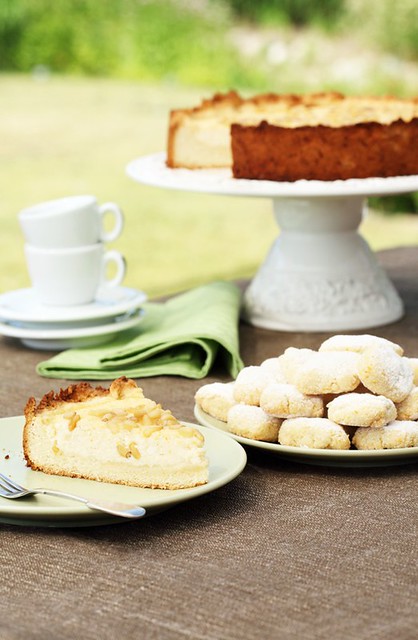
Torta della Nonna and ricciarelli cookies. Photo by Juta Kübarsepp for Nami-Nami. 

Friday, June 13, 2014

Recipe for ricciarelli, delicious gluten-free almond cookies from Siena, Tuscany

TOSKAANA: torta della nonna & ricciarelli
This photo was taken by Juta Kübarsepp for Nami-Nami, the rest are by me or my husband.  

I’m writing this post in Sicily. I’m in a lovely company of David, Rachel and Johanna, enjoying the delicious hospitality of Anna Tasca Lanza Cookery School. La dolce vita, but more about all that in future posts. I do mention that some very nice cookies were baked here yesterday, which reminded me of a lovely Italian cookie recipe I’ve got in my latest cookbook. 

San Gimignano: Agriturismo Montegonfoli

Just over a year ago, in April 2013, I had a lovely holiday in Tuscany with my dear partner and our three small kids - the youngest was just under 6 months back then. We began our family holiday in Florence, then staying in various agriturismos near San Gimignano. On my birthday we took a day trip to Siena. Everybody said that we’d love Siena, but the truth is, we were not so impressed at all - San Gimignano, Volterra, Lucca, Certaldo and the old parts of Colle di Val d'Elsa had been more charming, more real. However, we did love the ricciarelli, the famous almond cookies from Siena. They are light and soft, yet chewy, just a wee bit resistant. If you love marzipan, then you’ll love these!

Certaldo: Osteria del Vicario

Ricciarelli are wonderful with a cup of strong coffee or tea, if you’re not a coffee drinker. In Toscana, they’re a festive food, baked and eaten especially during Christmas, and dipped into a glass of Vin Santo. 

They’re gluten-free. 

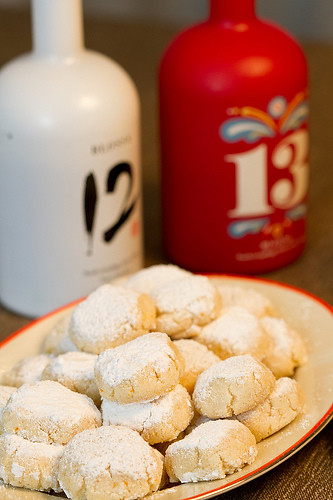
Ricciarelli cookies
(Siena mandliküpsised)

300 g ground almonds/almond meal
280 g caster sugar
100 g icing sugar/confectioner’s sugar 
1 tsp baking powder
a pinch of salt
1 orange, finely zested
2 egg whites 
2 tsp almond extract (optional)

For dusting:
icing sugar/confectioner’s sugar

Mix ground almonds, caster sugar, icing sugar, baking powder, salt and the finely grated orange zest in a bowl. 

In another bowl, whisk the egg whites until soft peaks form. Add the almond mixture, folding gently to combine. You’ll have a rather sticky mixture. (Add the almond extract now, if using). 

Using a teaspoon, take about 20 to 30 grams (about an ounce or so) of the mixture and form into oval/oblong patties, flattening them lightly between your palms. Place onto a cookie sheet, covered with parchment/baking paper, leaving some space between the cookies. They won’t spread a lot, but it’s better to be safe. 

Once you’ve formed all the cookies and arranged them onto the cookie sheet, dust them generously with icing sugar. Leave to dry them out at the room temperature for 1-3 hours - the bigger the cookies, the more time they need to dry. 

Bake in a pre-heated 150C oven for 20-25 minutes, until the cookies are just a little bit golden and hardened at the edges - you don’t want them golden brown, or they’ll be too crispy when they cool. You want your ricciarelli to remain soft and chewy inside!

Cool completely. These will keep for a week in an airtight container.  

ricciarelli2012


More ricciarelli recipes:
Divina Cucina
Jul's Kitchen
Lemons and Anchovies
Cook's Hideout
The Curious Baker

Wednesday, September 19, 2012

No porcini mushrooms? Make sautéed aubergine/eggplants (Melanzane al funghetto)

Sautéed aubergines / Praetud pommud / Melanzane al funghetto

The silver-haired Amalfi-born and England-based Antonio Carluccio is known in the United Kingdom as the godfather of Italian gastronomy. This lovely dish is based on his recipe. Gently sautéed cubed aubergines/eggplants with garlic indeed have a flavour reminiscent of porcini/penny bun/cep mushrooms (Boletus edulis in Latin) - hence the title of this post :) A handy recipe to have when you crave mushrooms but cannot get hold of good ones, or when you want to please somebody who cannot eat mushrooms for whatever reason..

Antonio Carluccio recommends this as a side dish to veal chops or Wienerschnitzler, but it's lovely as a vegetarian main with some crusty white bread as well. 

Choose nice and firm aubergines for this.

Melanzane al funghetto  
(Praetud pommud e. melanzane al funghetto)
Serves four

500 g aubergine/eggplant
2 garlic cloves
8 Tbsp extra virgin olive oil
1 tsp seal salt
freshly ground black pepper
2 Tbsp finely chopped fresh parsley

Peel the aubergines (not compulsory, I actually prefer them unpeeled) and cut into neat 1,5-2 cm cubes. Slice the garlic.
Heat oil on a large skillet over moderate heat. Add the aubergine and garlic and sauté for about 10 minutes, stirring every now and then, until the aubergine softens.
Stir in the parsely, season with salt and pepper.
Serve hot or leave to cool before serving.

Saturday, January 14, 2012

Italian-style chicken with capers, anchovy and tomatoes

IMG_9370.jpg

After lousy November and December (read: dark, wet, cold, windy) we are now in the middle of beautiful January (read: bright, snow, cold). Proper winter weather, which I enjoy, even though it's much harder to push a pram on a snow-covered street, and it's occasionally slippery and icy - sometimes I think that holding on to a pram is the only thing that keeps me upright and in balance :) Ah, the joys of snow-filled cold Nordic winters :)

You need proper hot food to keep your body and soul warm on days like these - and this chicken stew is just the thing. Rosemary and tomatoes, capers and anchovies give this dish plenty of character and a strong Mediterranean feel, almost taking you back to those sun-drenched summer days and warm sea breeze.

I used a whole chicken, cut up to feed six, but you can easily use just drumsticks or bone-in thighs or just breasts, if you're ready to give up some of the chicken flavour.

The recipe is adapted from a recent issue of a Danish food magazine, Mad (that's 'food' in Danish, not a state of mind ;)) They suggested serving this with quinoa. Though I loved quinoa, it seemed too mushy to accompany this dish, so I opted for good Italian bulgur wheat instead.

Italian-style chicken with capers, anchovy and tomatoes
(Mõnus tomatine kanahautis kapparite ja rosmariiniga)
Serves six
Takes about an hour

1 whole broiler chicken, cut up into 8 or 10
some olive oil
4 good anchovy fillets, chopped
6 garlic cloves, sliced thinly
2 onions, peeled, halved and sliced thinly
250 ml (a cup) of dry white wine
300 g cherry tomatoes, halved
400 g can chopped tomatoes
2 Tbsp chopped fresh rosemary
sea salt and freshly ground black pepper
4 Tbsp capers, rinsed and drained

Heat oil on a large heavy sauté pan. Brown chicken pieces on all sides (do that in batches, avoid over-crowding the pan). Put browned chicken pieces on the side.
If the pan looks too dry, add another splash of oil. Add anchovies, sauté for a minute. Add the onions and fry gently for a few minutes. Add garlic, fry for another minute. Do not brown!
Return the chicken pieces on the pan, pour over the wine. Simmer for 5 to 10 minutes, until the wine has reduced by half.
Add the tomatoes (both crushed and halved), season with salt, pepper and rosemary. Simmer gently for 25 minutes or so, until the chicken is cooked through and the sauce has thickened.
Add capers, taste again for seasoning and serve.

Wednesday, December 28, 2011

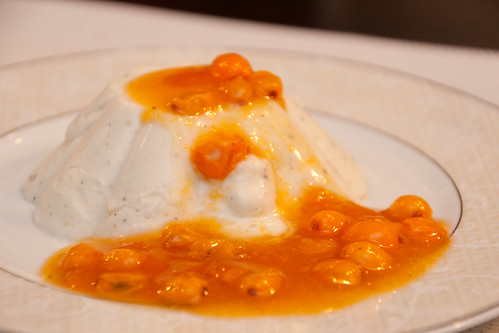
Cardamom panna cotta with apricot and sea-buckthorn sauce

Cardamom pannacotta with apricot and sea-buckthorn topping / Kardemonine pannacotta aprikoosi-astelpajukompotiga

Panna cotta is a dessert that I actually make quite often, even if I've only blogged about it once (Vanilla panna cotta with roasted rhubarb, back in June 2008). It's a good classic Italian dessert that can be served with a number of various toppings and seasoned to your liking.

Here's a rather non-Italian version that is imminently suitable for the festive season. It has a hint of spice in the form of cardamom, and it's much lighter, as some of the cream has been substituted with kefir. Sea-buckthorn berries are one of the new superfoods, and hugely popular and easily available in Estonia. A word of warning - if you taste the panna cotta mixture before you let it set, it may feel too heavy on cardamom. Don't panic, however - the sweet and sour apricot and sea-buckthorn sauce will nicely balance it out.

I like my panna cotta to be on the wobbly side, as they're supposed to be, and I often serve them in a nice glass. If you want a firmer dessert that will hold its shape even after you've turned it onto a plate, you can use some more gelatine.

Cardamom panna cotta with apricot and sea-buckthorn sauce
(Kardemonine kooretarretis aprikoosi-astelpajulisandiga)
Adapted from the Swedish COOP-website
Serves 4

3 gelatine leaves
200 ml whipping cream
2 Tbsp caster sugar
1 tsp ground cardamom
200 ml kefir

Topping:
100 ml (7 Tbsp) smooth apricot jam
100 ml (7 Tbsp) sea-buckthorn berries

Seak the gelatine leaves in cold water for 5 minutes.
Season the cream with ground cardamom, then slowly bring into a boil in a small saucepan. Cook for a few minutes, then remove from the heat and pour in the kefir. Give it a stir.
Squeeze the soaked gelatine leaves to remove excess water, then stir and melt into the cream and kefir mixture, one at a time.
Pour the mixture into individual glasses or ramekins and place into a fridge to set for at least 5 hours.
Before serving, heat the apricot jam gently in a small saucepan. Fold in the sea-buckthorn berries, heat through. Cool a little, then spoon some on top of each panna cotta.

Wednesday, August 10, 2011

Saltimbocca (Italian veal chop with sage and Parma ham)

Saltimbocca

We had this classic Italian dish a fortnight or so ago on our patio. The sun was still high up, late in the evening. There was a warm summer breeze. The grasshoppers were exceptionally noisy that night - one could have easily mistaken them for cicadas. The warmth, the food, the sounds - all made us feel like we're somewhere very nice and very far away :)

This famous Italian dish, Saltimbocca, originates in Rome and translates as "jump in the mouth/leap in the mouth". There are many chicken and turkey saltimbocca recipes in cookbooks and Internet, but the original version is always made with veal. I used fresh sage from my own garden, and garnished the dish with some picture-perfect fresh woodland sage (Salvia nemorosa) from our flowerbed.

Saltimbocca
(Itaalia vasikalõigud salvei ja singiga)
Serves 4

Saltimbocca

4 veal cutlets or escalopes (about 150 g each)
4 thin slices of Prosciutto
4 to 8 fresh sage leaves
freshly ground black pepper
olive oil and butter for frying
about 250 ml (1 cup) dry (Italian) white wine

Place veal slices between two pieces of clingfilm and roll or pat until about 4-5 mm thick. (This is not necessary if your meat pieces are thin already). Remove the clingfilm, season generously with black pepper.
Place 1-2 sage leaves on top of each meat piece. Top with a slice of Parma ham, and secure it with a toothpick (I do it out of a habit, but Cooks Illustrated suggests you can forget the toothpick, as searing the cutlets Prosciutto-side down first helps the ham stick).
Heat about a tablespoon of oil and a tablespoon of butter in a large frying pan/skillet over medium-high heat.
Place the cutlets to the frying pan, ham-side down. Fry until light golden brown, about 3 minutes. Turn over and cook on the other side until light golden brown.
Pour the wine onto the pan and cook until reduced by half. Season.
Serve with potato mash or creamy polenta.

TIP OF THE DAY: If you've run out of white wine, you can use a mix of dry sherry or Marsala and water. Works just as well :)

Saltimbocca

Sunday, July 10, 2011

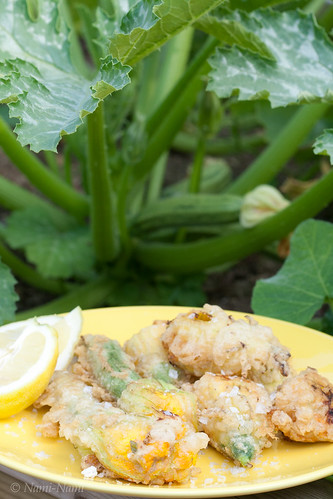
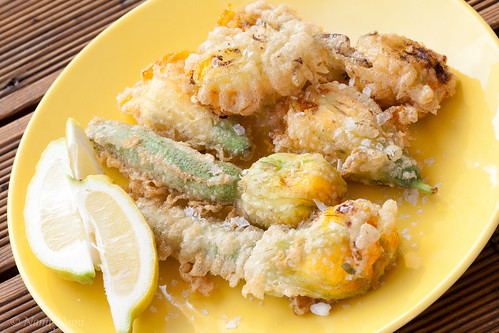
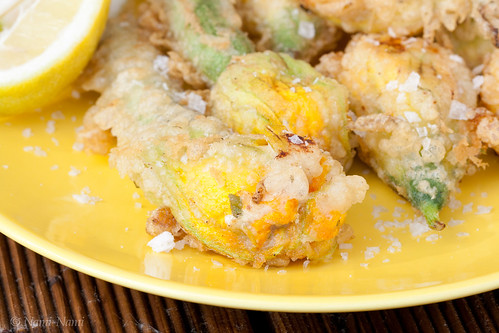
Crisp stuffed courgette flowers aka zucchini blossoms

Stuffed courgette flowers / Täidetud suvikõrvitsaõied

From all the vegetables we're growing in our garden, zucchini/courgette thrives best (closely followed by Jerusalem artichokes). And whereas the fruit might need another few days to be ready, zucchini blossoms are perfect already. Previously I've made zucchini blossom fritters and zucchini blossom frittata, this year I tried to stuff them. I came across two more or less identical recipes - one by Lucas Hollweg in the UK Sunday Times, the other by Jamie Oliver. A bit of tweaking here and there (who uses self-rising flour!?!?), and I came up with this version that we all LOVED.

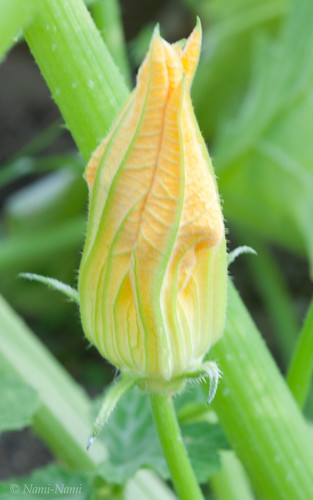
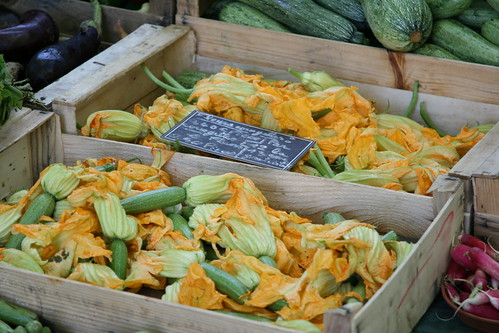
You can use both male and female zucchini blossoms for this dish, as I did. (How can you tell them apart? The female blossoms have a tiny zucchini attached to them; the male blossoms just have the stem). I usually just use the male blossoms, as the female are the ones providing us with tasty courgettes later on. The male blossoms look like this:

Courgette flower / Zucchini blossom / Suvikõrvitsaõis
Male courgette flower/zucchini blossom

However, if you don't need so many proper zucchinis, you can pick the female blossoms as well - it'll give you a more substantial dish.

Courgette flowers / Zucchini flowers / Suvikõrvitsaõied
Courgette flowers @ Lyon Market, France, August 2009. Female blossoms are at the front, male blossoms at the back.

What's your favourite way to stuff courgette flowers/zucchini blossoms?

Deep-fried stuffed courgette flowers
(Frititud täidetud suvikõrvitsaõied)

Stuffed courgette flowers / Täidetud suvikõrvitsaõied

12 large and fresh zucchini blossoms/courgette flowers
vegetable oil, for frying

Filling:
250 g ricotta cheese
25 g freshly grated Parmesan cheese
finely grated zest of half a lemon
a small handful of fresh mint, finely chopped
a generous pinch of freshly grated nutmeg
salt anf freshly ground black pepper

Batter:
120 g all-purpose/plain flour (about 200 ml)
0.5 tsp baking powder
a pinch of salt
250 ml (a cup) of sparkling water/mineral water

To serve:
sea salt flakes and lemon wedges

Make the filling. Mix ricotta, Parmesan, lemon zest and mind leaves. Season generously with salt, pepper and nutmeg. Form the mixture into 12 small balls.
Prepare the zucchini blossoms - I avoid rinsing, if at all possible, and neither do I remove the
filaments from the female flowers. (You're welcome to do so, if you prefer). Make sure there are no little critters hiding inside the blossoms! Using your fingers, gently open each blossom and place one small stuffing ball inside. Gently close the blossom around the filling - either just folding the petals over the stuffing, twisting the petals or using a chive to tie the petals tightly together.
Mix the ingredients for the batter - it should have the consistency of a thin crepe batter.
Heat 4-5 cm (about 2 inches) of oil in a small saucepan. The temperature is about right when a little peeled potato cube or bread cube begins to sizzle and turns into nice golden brown when you drop it into the oil.
Now, working with couple of zucchini blossoms at the time, dip them into the batter, then lower them into hot oil. Fry for about 2-3 minutes, then gently turn them over and let them brown on the other side as well.
Using a slotted spoon, transfer them into a double layer of kitchen paper to drain off the excess oil.
Fry the rest of the stuffed zucchini blossoms in a similar fashion.

Serve hot, sprinkled with some Maldon sea salt and lemon wedges on the side.

Here's another close-up:
Stuffed courgette flowers / Täidetud suvikõrvitsaõied

Thursday, September 16, 2010

Bottomless Polenta Pie with Tomatoes

Polenta "pie" / Maisimannapirukas

Well, I'm not sure I can even call this a pie (hence the 'bottomless' in the title), but I cannot think of a better name either. The recipe is slightly adapted from a Finnish women's magazine Talo & Koti ('house and home', 5/2010), where it was kindly shared by a Finnish chef in France, Jormi Törmanen (can you pronounce that name? ;)). I loved it, but it's pretty mild on its own. I think it's best served as a side dish to some grilled meat or with a green rucola salad drizzled with a gutsy vinaigrette dressing.

I might try shaving some Parmesan cheese (or perhaps shredding some Mozzarella?) on top next time, but it's definitely lovely as it is as well.

Polenta Pie with Tomatoes
(Polentapirukas)
Serves six to eight

Polenta "pie" / Polentapirukas

1 litre of water
1 tsp salt
250 g quick-cook polenta
2 Tbsp butter (or olive oil) + extra for brushing
couple of ripe tomatoes (not too soft)
2 Tbsp fresh rosemary or oregano or thyme, finely chopped
extra-virgin olive oil, for drizzling

Bring the water to the boil in a large saucepan, season with salt. Add the polenta, all at once, whisking vigorously to avoid any lumps forming. Stir in the butter or oil and simmer on a low heat, stirring regularly, until the polenta is cooked (it's hard to give exact timings here, as different products behave differently - look at the cooking times described on the packet).
Butter or oil an oven gratin dish (about 24x34 cm), pour the cooked polenta into the dish.
Cut the tomatoes into thick slices, press onto the polenta. Sprinkle with chopped herbs and drizzle with olive oil.
Bake in a pre-heated 250 C oven for about 20-25 minutes, until the polenta is lovely golden on top and tomatoes are ever so slightly charred on edges.

Polenta pie / Polentapirukas

Sunday, June 20, 2010

Tonnato, the versatile tuna mayonnaise

Tonnato sauce / Tonnato-kaste (tuunikalamajonees)

Vitello tonnato is a popular summer-time dish in Italy, originating in the 19th century Piedmont. Cold thin slices of cooked veal are topped with a creamy tuna and anchovy dressing. I love the classic version a lot, but the tuna mayonnaise is much more versatile. It's been a frequent visitor in our kitchen this spring, and I've given below the recipe I've come to love. I especially like it on top of crisp crostini slices, but it's also a good dressing for some left-over boiled eggs.

What's your favourite tonnato recipe and dish?

Crostini with tuna mayonnaise, garnished with caperberries (Suupisted tuunikalamajoneesiga):
Ciabatta with tonnato spread / Saiaviilud tuunikalamajoneesiga

Vitello tonnato aka cold veal slices with tuna mayonnaise (Vasikalihalõigud tuunikalamajoneesiga). That's the classic way of serving tonnato:

Vitello tonnato / Vasikaliha tuunikalamajoneesiga

Uova tonnata or boiled eggs with tuna mayonnaise, garnished with some capers and lemon zest (Munad tuunikalamajoneesiga):
Uova tonnata / Muna tuunikalamajoneesiga

Tonnato aka Italian tuna mayonnaise
Serves 4

Note that I make my tonnato from scratch and not cheating by simply mixing mayonnaise with canned tuna :)

Tonnato sauce / Tonnato-kaste (tuunikalamajonees)

2 large egg yolks, at room temperature
2 anchovy fillets in oiled
juice of half or whole lemon
10 salted capers, rinsed and drained
1 shallot, finely chopped
freshly ground black pepper
150-200 ml mild olive oil
200 g good-quality tuna chunks in oil

Place egg yolks, capers, anchovy fillets, juice of half a lemon, chopped shallot and some black pepper into the bowl of a hand-held blender. Blend until you've got a thick paste of uniform consistency.
Add oil in a thin stream, still blending the mixture.
Finally add the tuna chunks and blitz a little bit more.
Taste for seasoning - add more pepper, lemon juice or perhaps salt.

Monday, May 03, 2010

Gnocchi Puttanesca

Gnocchi puttanesca / Gnocchi-klimbid puttanesca-kastmega

I've been eating quite a lot of gnocchi dishes recently. There's a nice deli at our neighbourhood that now stocks decent ready-made gnocchi, and it's been a convenient lunch or dinner option ever since. As you know, the classic potato gnocchi are rather bland on their own, so it's the sauce that makes (or not) the dish.

The bold Puttanesca sauce proved to be an excellent accompaniment to the gnocchi.

Gnocchi Puttanesca
(Gnocchi-klimbid Puttanesca-kastmega)
Serves 2 as a light meal

500 g gnocchi (store-bought)

Puttanesca sauce:
1 Tbsp olive oil
1 onion
2 garlic cloves
2 anchovy fillets (in oil)
2 tsp salted capers
large handful of pitted black olives
a generous pinch of dried chilli flakes
400 g can chopped tomatoes
salt and freshly ground black pepper
a generous handful of flat-leaf parsley, chopped
grated parmesan, for serving

Chop onions, garlic and anchovy fillets. Stone the olives, cut the olives into slices. Rinse the capers, drain.
Heat oil in a saucepan, add onions and fry for about 5 minutes over moderate heat.
Add garlic, anchovies, olives, capers, chilli flakes. Give it a good stir, then add the chopped tomatoes and season with salt and pepper. Simmer over moderate heat for 15-20 minutes, stirring every now and then, until the sauce thickens slightly.
Meanwhile bring salted water into boil in another saucepan. Add the gnocchi and boil for 2-3 minutes (or whatever time is given on the packet), until the gnocchi float to the surface.
Drain the gnocchi and stir into the Puttanesca sauce.
Serve at once, sprinkling some grated Parmesan on top.

Tuesday, September 15, 2009

Pesche alla Piemontese or Baked Peaches with Amaretti biscuits


I'm baking lots of apple cakes and plum pies these days, trying to alternate the baking days with simple fruit dishes :) Two days ago I served luscious figs with goat's cheese and Jamon Serrano. Tonight the fruit was peach, and I made a classic Italian dessert, Pesche alla piemontese. You need the crispy and light Italian almond biscuits, Amaretti, for this recipe.

Pesche alla Piedmontese
(Küpsetatud virsikud Amaretti küpsistega)
Serves 4

4 large ripe peaches
100 g Amaretti almond cookies/biscuits
2 Tbsp brandy or cognac
2 Tbsp butter, softened
1 egg yolk

To serve:
whipped cream with vanilla and sugar

Wash the peaches, pat dry, halve and remove the stone. Place on a oven dish, cut-size up.
Crush the cookies into fine crumbs. Drizzle cognac on top and leave to soften for a couple of minutes. Stir in the butter and egg yolk and stir until combined.
Divide the mixture between the peaches.
Bake in the middle of 180 C / 350 F oven for about 30 minutes, until the peaches are soft and the Amaretti topping is golden.
Serve warm or at room temperature, with a spoonful or two of whipped cream.

Sunday, July 12, 2009

Strawberries with Amaretto cream and crushed meringues

Strawberries with Amaretto whipped cream and crushed meringues / Maasikad vahukoore, amaretto ja beseeküpsistega

Another simple strawberry dessert that's ready and served within minutes. The recipe idea is from a Swedish recipe leaflet Arla Köket (2/2001, Jordgubbar på italienska).

Cut strawberries into small cubes, sprinkle with some sugar (optional) and divide between serving glasses. Whisk some whipping cream until soft peaks form, then season with a splash (or two) of Amaretto. Spoon over strawberries. Finally, crumble some meringues and sprinkle on top of cream.

A lovely contrast of flavours and textures, trust me :)

(Itaalia maasikadessert)

Wednesday, June 11, 2008

Jamie Oliver's Panna Cotta with Roasted Rhubarb Recipe (slightly adapted)


I'm back from my 12-day US trip, when I managed to present a paper in Bloomington, spend 4 wonderful days in St Louis with Alanna, and finally wander around the hot-hot-hot New York for five days. During the trip I ate lots of food and met many lovely foodbloggers, and I'll certainly tell you more soon..

But it's good to be back home, where the temperatures are much more tolerable, and where my dear K. had baked a batch of
cannelés to welcome me back :)

I thought that rhubarb season would be over by the time I got back. But no. Mysteriously, a whole basketful of rosy stalks has appeared in our garage, and I've been given various hints about various rhubarb desserts I should be making in the coming days. I'm an obedient girl, so I'll think of something. One thing I'm tempted to do again is this delicious vanilla panna cotta with roast rhubarb. The recipe is from Jamie Oliver, but I've very slightly adapted it (I used less vanilla and slightly more gelatine, instead of lemon zest I used some pure orange oil). I made it for the panna cotta cooking event on my Estonian site - you can check out the fabulous contributions here.

Vanilla Panna Cotta with Roasted Rhubarb
(Vanilje panna cotta röstitud rabarbriga)
Serves 4


For panna cotta:
100 ml milk
1 vanilla pod, halved lengthwise
0.5 tsp pure orange oil
400 ml whipping cream (35%)
2 to 3 gelative leaves
50 g icing/confectioners sugar

For roasted rhubarb:
500 g rhubarb (peeled, if necessary)
100 g caster sugar

To make panna cotta:
Place the gelatine leaves into a cold water and let to soak for 5 to 10 minutes (I used 2 gelatine leaves, but you can use 3 for a slightly firmer texture).
Mix the milk, vanilla pod, vanilla seeds, orange oil and half the cream in a small saucepan. Bring slowly into a boil and simmer on a gentle heat for 10 minutes or until reduced by a third.
Remove the saucepan from the heat and stir in the soaked gelatine leaves until dissolved.
Allow to cool at a room temperature, then place in the fridge for about 10 minutes, stirring occasionally until the mixture coats the back of a spoon.
Remove the vanilla pods.
Whip together the icing sugar with the remaining cream. Mix the two cream mixtures together and divide into four serving moulds. Cover and chill for at least an hour, preferably four.

To roast rhubarb:
Meanwhile chop the rhubarb into 5cm pieces, sprinkle with sugar and roast at 200C/400F for 30 minutes, until softened, but not mushy. (I've added chopped candied ginger sometimes - gives an extra kick to the rhubarb).

To serve:
Dip the small moulds into some simmering water for 5 seconds to loosen the panna cotta a little, then turn it out on to a plate. Spoon the roasted rhubarb onto the plate and serve.

Tuesday, November 06, 2007

Thanksgiving Pumpkin Risotto, and sunny Arancini rice balls

We don't celebrate Thanksgiving here in Estonia, obviously, but as so many foodbloggers are currently posting their favourite pumpkin recipes, I decided to join the bandwagon as well. So here's a recipe for a beautifully coloured pumpkin risotto - a handy way to use up that pound of pumpkin flesh that pumpkin-carvers across the world would have these days. As for the leftover risotto, I've nicked Shaun's recipe for beautiful beetroot arancini and made pumpkin arancini instead.

Pumpkin Risotto
(Kõrvitsarisoto)
Based on Angeelika Kang's recipe for pumpkin risotto in the October 2007 issue of Oma Maitse
Serves 4


50 g butter
2 finely chopped medium onions
2 finely chopped garlic cloves
300 g Carnaoli risotto rice
400 g finely cubed pumpkin flesh
150 ml dry white wine
1 litre hot vegetable stock
a generous handful of finely chopped flat-leaf parsley
100 g grated Parmesan cheese
salt
coarsely ground black pepper

In a small saucepan, bring the vegetable stock to a boil, reduce heat and keep it on slow simmer.
Heat the butter in a large saucepan, add the onion and fry gently for 5 minutes to soften, stirring frequently.
Add garlic, fry for another 5 minutes, stirring every now and then.
Add the rice, heat for 2-3 minutes, stirring.
Add pumpkin cubes and stir gently for about a minute.
Add the wine, bring to simmer. Now add a generous ladleful or two of hot stock and stir gently, until the rice has absorbed the stock.
Add another ladleful or two of stock and stir, until this has been absorbed. Continue for about 20 minutes, until the rice has softened to al dente stage, and you've got a lovely creamy risotto (this would take about 20-25 minutes, depending on the rice).
Add the chopped parsley and most of the grated parmesan cheese.
Season with salt and pepper and serve at once.

Pumpkin Arancini Rice Balls
(Arancini e. frititud risotopallid)
Based on Shaun's recipe
Serves 2


For the rice mixture:
approximately a cup of leftover risotto
1 egg
5 Tbsp breadcrumbs
1 tablespoon finely chopped fresh parsley
cubed cheese (Mozzarella, Fontina - I used Estonian 'Atleet' cheese:)

For breadcrumb mixture:
4 Tbsp breadcrumbs
0.5 Tbsp finely chopped fresh parsley

For frying:
light olive oil or rapeseed oil

For sprinkling:
Maldon sea salt flakes

Heat about 3 cm oil in a small saucepan.
Mix together the pumpkin risotto, egg, 5 Tbsp of breadcrumbs and 1 Tbsp parsley in a large bowl.
Cut the cheese into 1 cm cubes.
Combine the breadcrumbs and parsley for breading on a flat plate. Put aside.
Use about 2 Tbsp rice mix per rice ball. Flatten the rice mixture in the palm of your hand, place a cheese cube in the centre, and wrap the rice mixture around the cheese cube. Form into a nice round ball.
Roll the balls in the parsley-breadcrumb mixture (see photo below).
Fry in the hot oil until browned, crisped and heated through - approximately 4 minutes.
Drain on a paper towel, sprinkle with Maldon sea salt.
Serve and enjoy!


Other arancini recipes:
Winter Skies, Kitchen Aglow
Amateur Gourmet
One Whole Clove

Thursday, July 12, 2007

On growing zucchini and eating zucchini blossoms: a zucchini blossom frittata & zucchini blossom fritters

Our little 'garden' (alias numerous terracota pots just outside the back door) is doing well. We've picked our first strawberries, are keeping an eye on the growing tomatoes, and hope to harvest some baby beetroots soon. But most successful has been the zucchini container (or 'courgette container', as it would be known in the UK). I've got three yellow zucchini plants in one large container, and they obviously seem to thrive there. I've already harvested one good-sized zucchini (click here or see the photo on the right), and we've been eating quite a lot of zucchini blossoms. Whereas I've always known that young zucchinis are wonderful, then zucchini blossoms have been a new discovery for me. And what a delightful discovery they've been - they've got a delicate zucchini flavour, beautiful shape and unusual texture. We've only harvested male blossoms, as we want to harvest as many zucchinis as possible from our 'garden'.

Kalyn recently praised zucchini blossoms in her BlogHer post. Here's what I've been doing with them, over and over again.. (And if you've got a favourite way with zucchini blossoms, then please let me know. There are loads and loads of blossoms still to harvest!)

Zucchini Blossom Fritters
(Frititud suvikõrvitsaõied)


I made sure that all my zucchini blossoms were clean and dry, then dipped them into a batter made of approximately 1 part plain flour and 1 part water (aiming for the consistency of not-too-thick sour cream). After dipping them in batter, I deep-fried the zucchini blossoms in olive oil that I had heated in a small sauce-pan (about 1 inch/2-3 cm of oil), turning them once. Once the zucchini blossoms were golden brown, I drained them on kitchen paper, sprinkled with some Maldon sea salt flakes, and enjoyed them straight away.

Zucchini Blossom Frittata


Again, make sure your zucchini blossoms are clean.
Whisk some eggs (say, 2 per person) in a small bowl, add a dash of water, whisk again and season with salt and pepper.
Heat some olive oil in a non-stick frying pan over medium heat, add zucchini blossoms and fry gently for about 30 seconds. Pour over the egg mixture, reduce heat to low, and let it set for about 30 seconds to 1 minute. Stir couple of times, sprinkle some chopped green onions and spring onions/scallions on top, top with a spoonful or two of grated soft cheese (mozzarella, feta, soft goat cheese or Cheddar - all would work).
Cover the frying pan with a lid and let the frittata set over a low heat. Alternatively, give it a few minutes under a hot grill.
Garnish with fresh herbs and serve with home-made rye bread. Oh, and the frittata gets its gorgeous yellow shade from using eggs from these very happy chicken. But usual free-range supermarket eggs will do as well :)

WHB: This is also my entry to the Weekend Herb Blogging, this time hosted by Susan of Food Blogga. You can read Susan's roundup here.

Tuesday, June 12, 2007

Osso Buco, as promised

Remember my list of foodie resolutions for 2007? Well, one of the items there was to make osso buco, the Italian veal shank stew*. I'm happy to report that I made osso buco about a month ago, and it was absolutely fabulous. It was just as juicy and sweet and meaty and melting and savoury and delicious as I had expected it to be. 'My' osso buco was heavily reliant on Clotilde's take on the French take of the Italian dish, with some tips nicked from Elise, some from The River Cafe Cook Book and some from "Daily Mail" Modern British Cookbook. Interesting mix of sources, eh :)

I served it with saffron-infused boiled rice, but the traditional accompaniment would be Risotto alla Milanese.

Vasikakoodid ostsin Viimsi lihapoest. Väga head koodid olid!

Osso Buco
(Itaalia veisekoodihautis Osso Buco)
Serves 6


1 kg veal shanks
3-4 Tbsp plain flour
salt & black pepper
2 Tbsp oil
300 grams onions, chopped finely
1 garlic clove, chopped finely
1 carrot, cut into small cubes
1 celery stick, cut into small cubes
400 grams chopped peeled tomatoes
200 ml dry white wine
300 ml veal stock
2 bay leaves
2 fresh sprigs of thyme
half a lemon
chopped flat-leaf parsley

Gremolata to serve:
finely grated lemon zest
finely chopped garlic
finely chopped flat-leaf parsley

Dry the veal shanks with kitchen paper, then dredge into a seasoned flour (i.e. flour, salt, pepper) and shake of any excess flour.
Heat oil in a large saucepan and brown the shanks on a medium heat on both sides (about 8 minutes in total). Put the browned veal shanks aside (f.ex. on a deep plate).
Add onion, garlic, carrots, celery and a splash of water into the saucepan and simmer gently for about 10 minutes, until the onion softens.
Season with salt, add the chopped tomatoes, including the juices, and heat through.
Add wine and stock, thyme and bay leaves. Bring slowly to the boil, cover the saucepan firmly with the lid, and simmer on a low heat for 1.5-2 hours, until the meat is really soft and tender.
(If you prefer, you can make your osso buco in the oven. 2-2.5 hours at 200C should suffice).

Sprinkle with gremolata or the mixture of finely chopped flat leaf parsley, garlic and lemon zest, and serve.

* Osso Buco also featured on Zarah Maria's list, and I'm keenly waiting to read about her version :)

Monday, July 31, 2006

Passionate cantucci with almonds, pink peppercorns and ginger

I first came across these cantucci with a kick exactly a year ago, when I received a European Blogging By Mail parcel from Johanna of The Passionate Cook. They were absolutely gorgeous - crunchy and bravely flavoured with ginger and pink peppercorns. I printed out the recipe straight away, but somehow I didn't manage to make these until last Friday. Silly me!

May I proudly present you with:

Johanna's cantucci* with almonds, ginger and pink peppercorns
(Roseepipra-mandliküpsised ingveriga)


I took these along to a dinner party on Saturday night, where - following a very tasty Sri-Lankan meal - we dipped them into coffee and/or cloudberry liqueur from Lapponia. I am so making these again soon. So should you, so go and get that recipe from Johanna's blog a.s.a.p! Or, if you're looking for something more lemony and are not too keen on almonds, then try these Pignoli Cantuccini with pine nuts from Delicious Days.

* You Say Biscotti, I Say Cantucci (a la Ella Fitzgerald & Louis Armstrong)
Note that there is some cross-Atlantic confusion about the name here. Italians call this type of crunchy cookies cantucci (meaning 'little stones' in Italian). In North America, on the other hand, these cookies are known 'biscotti'. These particular cantucci would hence be called almond, ginger and pink peppercorn biscotti across the Atlantic. The explanation? Biscotti means 'cooked twice' in Italian, suitably describing the way these cookies are prepared. However, the word 'biscotti' has later extended to a generic name to describe pretty much any cookie in Italian (a bit like the word 'biscuit' in British English).

Click here for a very informative post about cantucci/biscotti.

Tuesday, July 26, 2005

A touch of Perestroika: Spagetti Gorbachov

I met my Russian friend Galina for lunch today, and we chose an Italian place called Ti Amo, as it was pretty much equal distance from our respective offices, and they do a lunch deal for less than six quid (two courses plus coffee). We had a really lovely asparagus soup to start with, and a reasonable chicken with mushrooms.

But what caught my eye was a dish called 'Spagetti Gorbachov' on their menu. It was otherwise similar to Pasta alla Vodka that I wrote about the other day, but it had smoked salmon in it, as well as a spoonful of caviar thrown in for an extra presidential touch, I guess.

Quite amusing. Pasta alla Vodka is tasty without caviar, but maybe I could try it with some caviar on a more festive occasion then..

Saturday, July 02, 2005

And a dash of vodka, please, or Nigella Lawson's Pasta alla Vodka

While travelling or living abroad (including Scotland, although it feels more like home after six years) and telling people that I’m from Estonia, I am usually asked whether we drink lots of vodka in Estonia. I guess it’s because we’re neighbours with Finland and Russia, both known for their fondness of vodka (indeed, BBC Radio 4 stated yesterday afternoon that each Russian – including children and the elderly - consumes 15 litres of vodka annually!). I sometimes take offence to this question, as I don’t think that we drink lots of vodka back home. At least my friends don’t. We drink copious amounts of mulled wine – hõõgvein – during the dark long winter nights, cold beer during summer (and always after sauna) and wine on other occasions. But upon reflection, my parents’ generation probably prefers vodka to wine – out of old habit, as good wines were unavailable during the Soviet era and vodka was pretty much the only drink one could find in the shops. Though even vodka disappeared after Gorbatchev came to power in 1985..

Anyway, back to my own ‘vodka-fuelled’ weekend. On Saturday night my Japanese friend Ryoko came over for a chat and a light meal. I had been spent couple of leisurely hours at the Meadows at the G8/Make Poverty History event, and was too lazy to cook anything substantial. I also want to finish off the bottle of vodka in my cupboard ASAP to avoid questions about Estonians’ favourite tipple, so I made again – second time within a week - penne alla vodka from Nigella’s Feast. Or to be more precise, I made fusilli bucati corti alla vodka. It’s really easy to make and there’s something naughty about adding vodka to pasta. According to Nigella, the dish originated in Rome in 1960s, and though ‘it sounds the unlikeliest of inventions, but it works strangely well: the vodka gives a grainy depth balanced by the acid fruitiness of the tomatoes (think Bloody Mary), both mellowed by a slug of cream and the butter that is melted on to the pasta before it is combined with the sauce’ (p. 132).

Pasta alla vodka
(Viinamakaronid)
Serves 4 as a light meal or 2 as a main course with some left over.


1 tbsp olive oil
1 chopped onion
1 chopped garlic clove
pinch of salt
400 g can chopped tomatoes
a pinch of chilli flakes
1 tbsp double cream
500 g short pasta (penne, fusilli)
4 tbsp vodka
2 tbsp butter
grated Parmesan cheese

Make the sauce first, as it can be easily reheated.
Heat the oil, add the onion, then garlic and salt, and sweat until onion is soft and translucent. Don’t burn.
Now add the chopped tomatoes, pinch of chilli flakes and simmer on a gentle heat for 15-20 minutes, stirring occasionally.
[Until this point the sauce can be made in advance].
Cook the pasta al dente.
Just before the pasta is ready, stir the cream into the [re-heated] tomato sauce.
Drain the pasta, pour the vodka and stir the butter into the pasta.
Mix with the creamy tomato sauce and serve with extra parmesan cheese.

My Romanian friend Ruxandra served it with creamy goat cheese instead of parmesan back in May, and it was delicious as well.

UPDATE 22.4.2006 Have swapped the picture for a nicer one. Also, I tend to add slightly more vodka nowadays, use mascarpone instead of double cream and sprinkle lots of fresh parsley on top. Still a real keeper, almost one year on:)