Showing posts with label Recipes: Pizzas/Pies/Quiches. Show all posts

Tuesday, May 20, 2014

Asparagus and cheese tart recipe

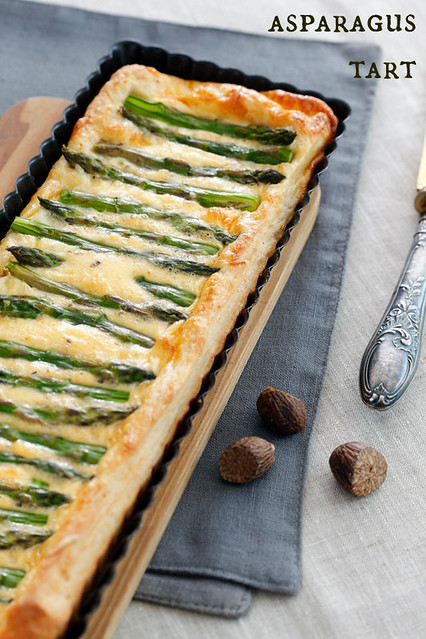
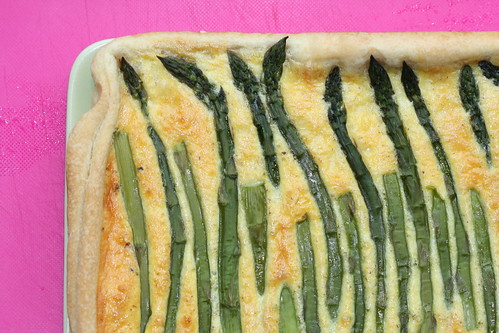
Asparagus tart. Asparagus quiche.
Originally posted in May 2011, but I'm bumping this up again, as the local asparagus season has began. The photo above was taken by Juta Kübarsepp to illustrate my column in the May 2014 issue of Kodu ja Aed magazine here in Estonia.. 

Isn't it pretty? This lovely topless tart can be served either warm (perhaps with a green side salad) or cold (cut into thin slices to accompany drinks). It's a simple tart - a puff pastry base (I made a quick rough puff pastry myself) is covered with a layer of grated cheese, followed by an egg and cream mixture, and finally topped with lightly cooked asparagus spears. You could certainly mix the cheese in to the egg and cream mixture, but I loved the visual effect of using a separate cheese layer.

Asparagus and cheese tart
(Spargli-juustupirukas)
Serves 8 to 10

Asparagus tart / Sparglipirukas

500 g puff pastry (store-bought or home-made rough puff pastry)

24 medium-sized fresh green asparagus spears
150 g Gouda or Gruyère cheese, coarsely grated
3 large eggs
200 ml fresh cream (whipping, heavy or double)
sea salt and freshly ground black pepper
freshly grated nutmeg

Snap off the hard and woody lower end of the asparagus spears (these can be used to make stock, for instance). Cook the asparagus spears in a simmering and lightly salted water for about 2 minutes. Drain, rinse quickly under cold water and drain again. Put aside.
Line a rectangular pie dish (approximately 25x35 cm) with a parchment paper. Roll out a puff pastry so it'd cover the base and come up the sides a little. Prick with a fork here and there.
Scatter the grated cheese over the base.
Whisk the eggs with cream, season with salt, pepper and grated nutmeg. Pour carefully over the cheese.
Place asparagus spears on top.
Bake in a preheated 200 C oven for about 30 minutes, until the tart is nicely golden on top and the puff pastry is cooked.

Wednesday, June 19, 2013

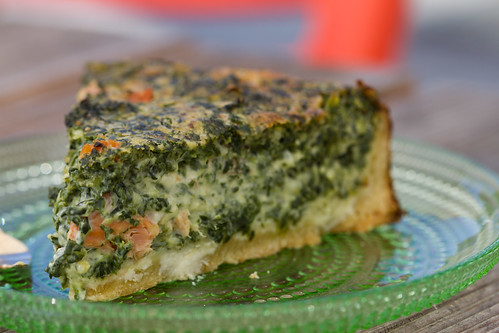
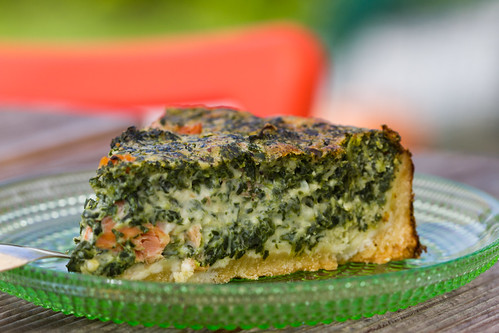
Smoked salmon and spinach quiche

Spinati-suitsulõhepirukas / Spinach and smoked salmon quiche

Some seven years ago, when my dear K. and I met for a long weekend date in Paris. One morning we had a late breakfast at Bread & Roses, a lovely deli-cafe near the Luxemburg gardens. I cannot recall exactly what else we had, but we definitely had a really lovely smoked salmon and spinach quiche. I even wrote about it back in 2006, after baking it in Edinburgh (yes, back then I was still living in the beautiful capital of Scotland, and K. and I were having a long-distance relationship. We had no idea what life had in store for us, and definitely didn't think we'd be happy parents to three little kids in 2013 :))

The quiche is still a favourite with us, always bringing back nice memories of those promising spring days in Paris. I've modified the recipe a little over the years, and here's the adapted recipe for you, my dear readers.

Smoked salmon and spinach quiche
(Spinati-suitsulõhepirukas)
Serves six

NOTE that an American cup is 240 ml, an ounce is about 28 grams and 100 grams of butter is 7 Tbsp - in case you need to convert the measurements! 

IMG_5716.jpg

All-butter crust:
180 g all-purpose flour (300 ml)
100 g cold butter, cubed
a pinch of salt
2-3 Tbsp cold water

(Or use your favourite pâte brisée/shortcrust pastry recipe; you'll need about 300 grams).

Filling:
150 g cold-smoked salmon or trout, chopped
300 to 450 g frozen chopped spinach, defrosted and squeezed dry
300 to 400 ml double cream/whipping cream/heavy cream
3 large eggs
100 g cheese, shredded
salt and freshly ground black pepper

Start by making the pie crustIf using your hands, then rub the butter into the flour (with salt added) until the mixture resembles fine breadcrumbs. If using a food processor, then place flour and salt into a food processor and pulse until combined. Add the cold butter and pulse until you have a mixture that resembles a coarse meal.

Add a spoonful or two of cold water and pulse again, until the mixture just clumps together. Mix until the the dough forms a ball. Press the dough into a greased or non-stick springform pan, 24 cm (9'') or 26 cm (10'') in diameter, going slightly higher up on the sides when using the smaller cake pan.

Place the pan into fridge or freezer for about 30 minutes.
Meanwhile, preheat the oven to 200 C (400 F). 

Bake the pie shell in the middle of the oven for about 15-20 minutes, until golden and beginning to pull away from the sides of the pan. 

For the filling, whisk together the cream, eggs, salt and pepper. Add the chopped fish, spinach and shredded cheese. Spoon the filling into the partially baked tart shell and continue baking for about 30-40 minutes, until the filling is set and golden brown. 

Cut into wedges and serve either hot, at room temperature or cold. A nice green salad on the side would be nice. 

Smoked salmon and spinach quiche. Suitsulõhe-spinatipirukas.

Monday, September 10, 2012

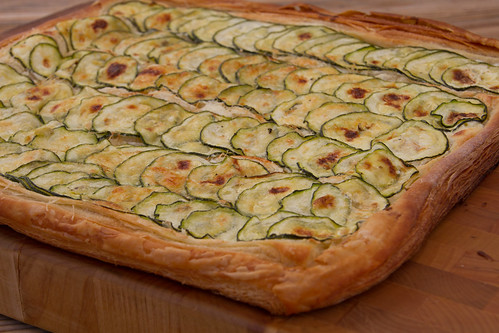
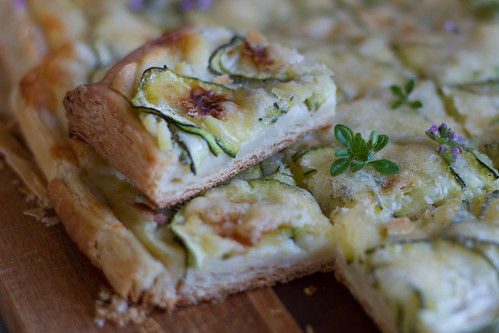
Zucchini and Parmesan Tart

Courgette and parmesan tart / Zucchini and parmesan tart / Parmesani-suvikõrvitsapirukas

What's your favourite zucchini/courgette dish this year?

I'm still harvesting a good-sized zucchini or two every few days, and here's my favourite zucchini dish of 2012 (another recent favourite is this courgette/zucchini cake with lemon frosting, but as one is sweet and the other savoury, I believe I'm allowed to have two favourites :)). I spotted this idea in the May 2009 issue of the British food magazine Olive, but there was too little cheese and too much zucchini in the original recipe, so I've been playing around with it quite a lot. The tart has been a real hit with everybody who has tried it (just look at the number of comments on my Estonian site), and I can see why - the cheese, garlic and courgettes work together immensely well.

Use a slim and crisp zucchini for this - both for the looks and the texture.

Courgette and Parmesan Tart
(Parmesani-suvikõrvitsapirukas)
Serves about 8 to 10

500 g puff pastry
ca 500 g zucchini/courgette
2 large garlic cloves
extra virgin olive oil
sea salt and freshly ground black pepper
fresh herbs of your choice (oregano, thyme - optional)
150 g cream cheese
75-100 g finely grated Parmesan cheese

Preheat the oven to 200 C/400 F. Line an oven sheet with a parchment paper. 

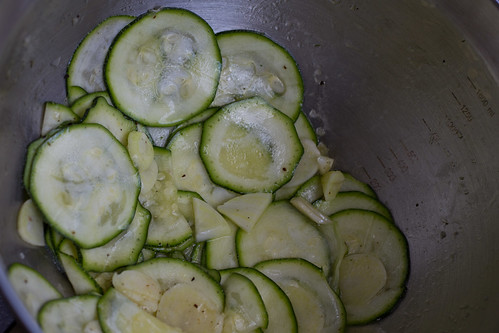
Slice the courgette thinly (I use my Benriner Japanese kitchen mandoline for this), peel the garlic cloves and slice thinly as well. Place into a bowl, season generously with salt and pepper and herbs (if using), drizzle with olive oil. Toss gently to combine and leave to macerate for 10-15 minutes.
 Parmesani-suvikõrvitsapirukas / Courgette and parmesan tart

Roll out the puff pastry. Using a sharp knife, score a border about 1-1.5 cm from the edge of the pastry. Transfer the puff pastry onto the baking shet.
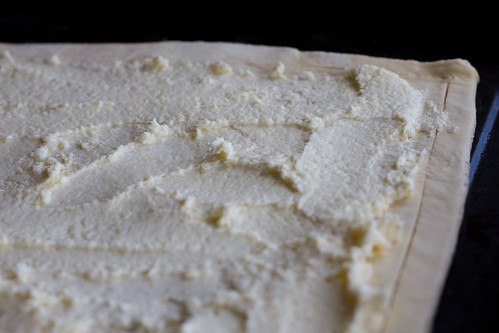
Mix the cream cheese with half of the grated Parmesan cheese, spread the cheese mixture onto the puff pastry (stay withing the cut you made).

 Parmesani-suvikõrvitsapirukas / Courgette and parmesan tart

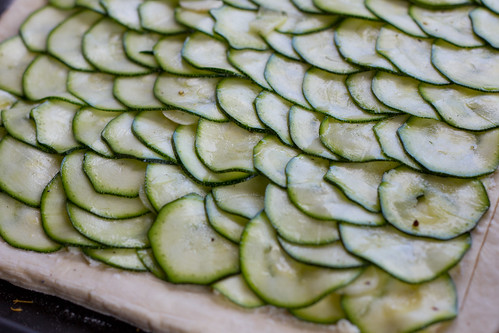
Layer the zucchini slices neatly on top of the cheese mixture, overlapping them as you go.

 Parmesani-suvikõrvitsapirukas / Courgette and parmesan tart

Bake for 15 minutes at the pre-heated oven.
Take the tart out of the oven, sprinkle the rest of the Parmesan cheese on top, and return to the oven. Bake for another 15 minutes or until the tart is lovely golden brown on top.

Cool a little and cut into small squares. 


 Parmesani-suvikõrvitsapirukas / Courgette and parmesan tart

Saturday, May 21, 2011

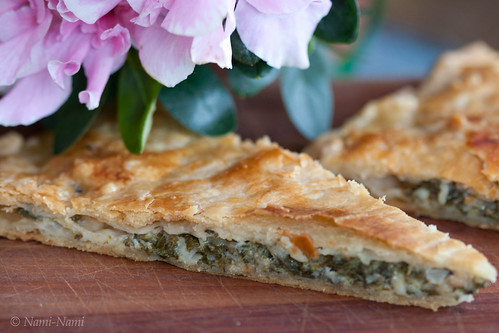
Gardener's revenge: ground-elder and cottage cheese pie

Ground-elder pie / Naadipirukas

Originally posted here.

A well-known (and much-hated) garden pest, ground-elder (Aegopodium podagraria, also known as bishop's weed and goutweed in English, naat in Estonian) has a long history of being used for medicinal purposes. However, it was also cultivated as a food crop in the Middle Ages, especially in Russia (and in Siberia in particular - the Russian Saint Seraphim of Sarov is said to have survived three years on eating mainly ground-elder while on self-exposed exile in a deep forest), Scandinavia, in Central Europe. Old Finno-Ugric peoples were keen consumers of ground-elder, too. According to some sources, old traders wrapped their vegetables into ground-elder leaves to keep them fresh looking and smelling - the leaves are high in essential oils and helped to keep the other produce fresh and aromatic, too. Young and tender ground-elder leaves can be added to soups, omelettes and stews. Blanched leaves can be mixed with cottage cheese and curd cheese. The leaves are high on Vitamin E, as well as vitamin C, they're rich in antioxidants, minerals, flavonoids and fibre. Dishes containing ground-elder are easily digestible, and have cleansing properties - so they're good for that spring-time detoxing :)

Ground-elder / Naat

Make sure to use only very young ground-elder/goutweed leaves (like those on the photo above) - the big ones tend to be too bitter and rough. Pamela Michael, a well-known "herbal cook" and author of Edible wild plants and herbs, writes that "those of us who suffer from the weed in our gardens, should rejoice in the knowledge that we can eat the pest" :)

Intrigued? You can also use young ground-elder leaves to make delicious spring-time vanilla-scented muffins.

Ground-elder and cottage cheese pie
(Kevadine naadipirukas)
Serves 8 to 10

Ground-elder pie / Naadipirukas

Pastry:
200 g butter
200 g sour cream
350 g all-purpose flour
a pinch of salt

Filling:
100 to 200 g young ground-elder leaves
1 Tbsp oil
one large onion (about 100 g)
300 to 400 g cottage cheese, drained
1 egg
1 tsp dried oregano
sea salt and freshly ground black pepper

Make the pastry: melt butter over moderate heat. Take the saucepan off the heat, stir in sour cream, flour and salt. Stir until well combined, then place into the fridge for about 30 minutes to rest.

Make the filling: wash the goutweed leaves carefully, drain lightly. Place onto a dry hot skillet and heat until wilted. Then rinse quickly under cold running water to stop the leaves from cooking further. Press to dry the leaves thoroughly, then chop roughly.
Heat oil on a heavy frying pan, add onion and sauté gently for about 10 minutes, until the onion softens. Add the chopped ground-elder leaves, cottage cheese, oregano, salt and pepper. Give it a stir, then add most of the egg and stir again.

Take the pastry out of the fridge, divide into two. On a flour-dusted table, roll out one of the pastry pieces into a large circle (approximately 40 cm in diameter or whatever the size that fits your oven sheet). Transfer onto a lined oven sheet, spoon the filling on top. Roll out the other pastry and cover. Press the edges tightly together, prick the top with a fork here and there.

Brush with an eggwash. Bake in a preheated 200 C oven for about 25-30 minutes, until the pie is lovely golden brown on top.

Thursday, May 05, 2011

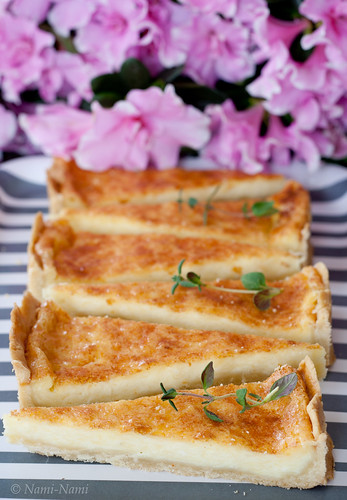
Västerbottenspaj aka Swedish Västerbotten Cheese Tart

Västerbotten cheese pie / Västerbottenspaj / Västerbottenpaj / Västerbotteni juustu pirukas

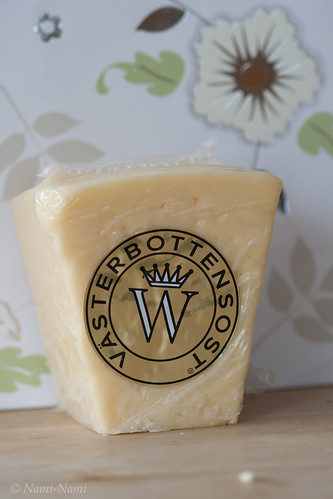
Västerbotten is an excellent hard cow's milk cheese from Sweden that reminds me (and many others) of a good youngish Parmiggiano Reggiano, but it's somewhat sweeter. Sadly it's not available in Estonia, but we've got good friends in Sweden who bring us a chunk every time they're popping over to Estonia. It is produced in the far North of Sweden, and the recipe and process has remained pretty much the same for the last 150 years or so. The Swedes love it, and it's considered the Emperor of Swedish cheeses (hence the crown on the packaging? See below ;))

You can read more about this cheese here (includes a link to the US supplier), here (Anne's Food), here and here (Wiki).

Although it's an excellent cheese for the cheese board, it's also a great cooking cheese. So far I've tried honeyed Västerbotten cheese spread, which was unusual but delicious (sweet and creamy). I got another half-a-kilo chunk of Västerbotten for my birthday (thank you, Annika & Markus!!!), and wanted to try the classic Västerbotten cheese tart. It's so simple - a plain shortcrust base, topped with a mixture of eggs, cream/milk and cheese. There are hundreds of similar recipes in the Internet, here's the way I made it.

You can serve it either hot or cold, accompanied with a nice sauce or perhaps a green salad. When cold, the tart can be cut into very thin and elegant slices that would be great as an appetizer.

Västerbottenspaj or Västerbotten cheese tart
(Västerbotteni juustu pirukas)
Serves 6

Västerbottensost / Västerbotten cheese / Västerbotteni juust

Pastry:
200 g plain flour
pinch of salt
100 g cold butter, cubed
1 egg

Cheese filling:
3 eggs
200 ml fresh cream (single, whipping, double or even half-and-half)
200 g Västerbottens cheese, coarsely grated
salt and freshly ground black pepper

Make the pastry first. Combine flour and salt in a bowl of your food processor, then add the cold butter and process until you've got coarse crumbs. Now add the egg and process again, until the dough comes together.
Flatten the dough into a disc and wrap in clingfilm. Place into the fridge for at least 30 minutes, preferably an hour.
Roll the pastry on a lightly floured surface into a circle large enough to fill a 26 cm springform or tart tin. Transfer the dough into the tin, pressing it gently to the edge and up along the sides. Blind bake in a 200 C oven for about 15 minutes. Remove from the oven.
For the filling, whisk the eggs and cream until combined, then season with salt and pepper. Fold in the grated cheese. Pour over the partially baked pastry base.
Return into the oven and bake for another 25-30 minutes, until the filling is set and the tart is golden (do not brown).

Tuesday, April 26, 2011

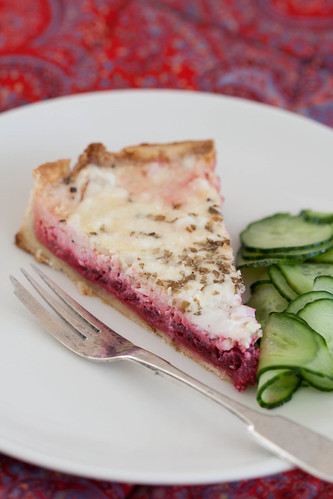
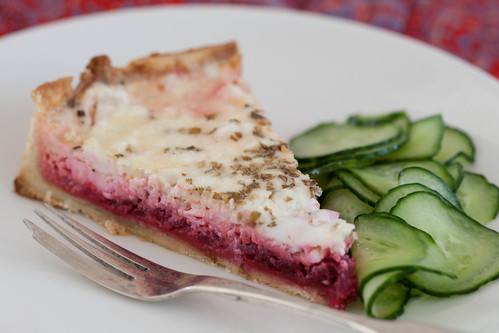
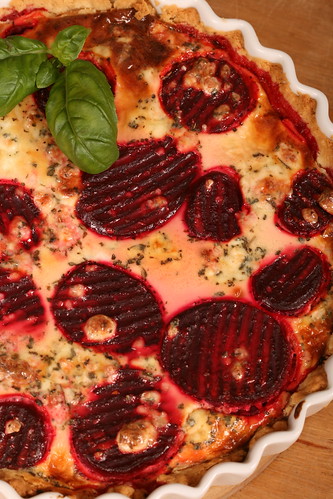
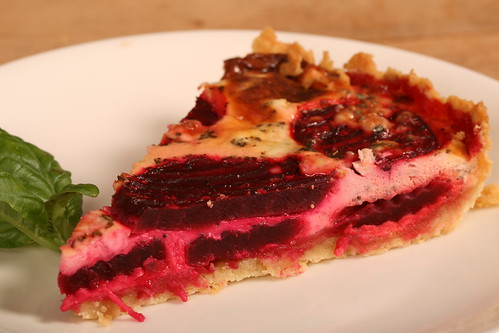
Beetroot and feta tart recipe

Beetroot & Feta Quiche / Peedi-fetajuustupirukas

Cooksister's Jeanne is hosting this month's Monthly Mingle, and she chose topless tarts as the theme. She's one cheeky foodblogger, you know :) As my little family has been growing, I've been very bad in taking part various foodblogging events, but this theme really speaks to me and hence this post. I'm contributing this lovely beet and feta tart for the occasion. I know, I know - it wasn't so long ago that I blogged about beetroot tart. But March's beetroot tart was this lovely quiche with blue cheese and pickled beets. This time it's all about feta cheese and roasted beets!

I realise it's a risky choice for this month's mingle, as the hostess isn't so fond of beets. Hopefully she'll still accept my entry and give it the consideration it deserves :D

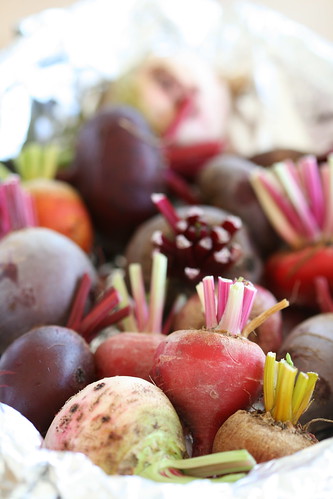
Here's a reminder from last summer - beets from our own garden:

Our beets / Meie oma aia peedid

Aren't they cute? I think they are ;)

Beetroot and feta tart
(Peedi-fetapirukas)
Inspired by Molly @ Orangette
Serves 6

Beetroot & Feta Quiche / Peedi-fetajuustupirukasA

Pastry:
180 g all purpose flour (300 ml)
0.5 tsp salt
0.5 tsp caster sugar
100 g cold butter, cut into cubes
cold water

Topping:
300 g boiled or roasted beets
200 g feta cheese
2 eggs
150 ml milk or single cream
fresh or dried oregano or dill
freshly ground black pepper

Make the pastry first. Combine flour, salt, sugar in a bowl of your food processor, then add the cold butter and process until you've got coarse crumbs. Now add a tablespoonful or two of cold water, until the dough comes together.
Flatten the dough into a disc and wrap in clingfilm. Place into the fridge for at least 30 minutes, preferably an hour.
Roll the pastry on a lightly floured surface into a circle large enough to fill a 24 cm springform tin. Transfer the dough into the tin, pressing it gently to the edge and up along the sides. Blind bake in a 200 C oven for about 15 minutes. Remove from the oven.
Great the beetroot coarsely, spread over the partly baked base.
Crumble the feta cheese over the beetroot.
Whisk the eggs with milk or cream, season with salt and dill or oregano. Pour over the tart.
Bake in a 180 C oven for about 35-40 minutes, until the egg is set.

Thursday, March 24, 2011

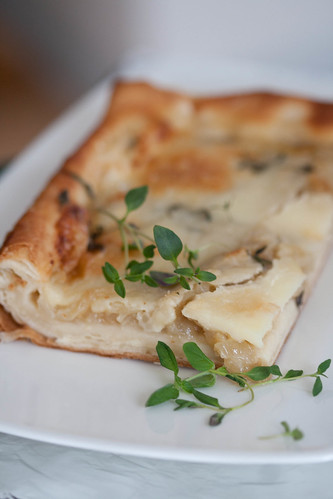
Taleggio cheese and onion tart

Taleggio and onion tart / Taleggio juustuga sibulapirukas

Are you familiar with the Italian Taleggio cheese? Originally made in and named for Val Taleggio near the Swiss-Italian border, this soft cow's milk cheese has been described as

'a  mild stinky cheese, with a whiff of steamed broccoli, almonds and humid cellars' :D

There's a detailed blog post about Taleggio written by David Clark here. It's a beautifully melting cheese that's especially wonderful in various pies and tarts and quiches. I've used it quite often in my cooking, though never blogged about it before (however, there's a recipe for wild mushroom and Taleggio pie in my first cookbook). There are quite a few foodbloggers who have written about it, so you should not have any troubles finding recipes if you're interested (do try Anne's risotto with Taleggio, it's delicious!)

The recipe below is inspired by the British author Nigel Slater, but I've modified the quantities.

Taleggio and onion tart
(Sibulapirukas Taleggio juustuga)
Serves six

6 medium sized onions (or 2 huge salad onions)
50 g butter
500 g (yeasted) puff pastry
200 g Taleggion cheese
handful of fresh thyme

Peel the onions and cut into thin slices. Melt butter in a heavy saucepan, add onions and sauté over low heat for about half an hour, until onions are soft and silky and sticky.
Roll out the puff pastry to fit a small deep baking sheet (mine was 25x34 cm). Using a sharp knife, make an insertion about 2 cm from the edge of the pastry.
Spread the soft and sticky onions over the pastry, leaving the edges clean. Use the onion-flavour pan liquid to brush the pastry edges.
Cut the cheese into slices, dot over the onion filling. Sprinkle some thyme leaves on top.
Bake in a pre-heated 220 C oven for 15-20 minutes, until the pastry is risen and golden, and the onions are nicely golden brown.

Sunday, March 13, 2011

Pickled beets and blue cheese quiche

Beetroot quiche with blue cheese / Peedi-sinihallitusjuustupirukas

Have you got a glass of pickled beets lurking in the back of your fridge? If yes, then you could use them for making this colourful and lovely quiche. The otherwise sweet beets have quite a piquant flavour when pickled, and that works well with the saltiness of the blue cheese. I used Valio AURA, one of my favourite blue cheese (made in Finland), but it will work with any other crumbly blue cheese, too..

Beetroot quiche with blue cheese
(Pirukas marineeritud peedi ja sinihallitusjuustuga)
Serves six to eight
Adapted from Valio, Finland

Beetroot quiche with blue cheese / Peedi-sinihallitusjuustupirukas

Pie crust:
100 g butter, at room temperature
150 g all-purpose flour (one cup)
a pinch of salt
2 Tbsp cold water

Filling:
250 g pickled beets, drained and sliced
200 ml single cream
2 eggs
0.25 tsp freshly ground black pepper
1 tsp dried basil or 1 Tbsp fresh basil, chopped
150 g blue cheese (Valio Aura)

Mix butter, salt and flour, then add the water and mix until a dough ball forms. Press onto a 24 cm pie dish, and place into the fridge to rest. (If you wish, blind bake for 10 minutes at 200 c/400 F).
Mix all the filling ingredients, pour onto the (pre-baked) pie shell.
Bake at 200 C/400 F for about 30 minutes, until the filling is set and the top is golden.

Monday, August 23, 2010

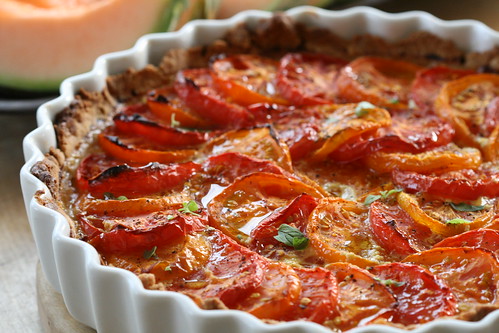
French tomato tart with a lot of mustard

French tomato and mustard tart / Prantsuse sinepine tomatipirukas

I guess you gathered from yesterday's tomato posting that we're swamped with tomatoes this year. That means lots of tomato dishes - like this flavorsome tomato salad, for instance. Here's another flavoursome tomato dish - a mustardy French tomato tart that's excellent with some peppery green salad leaves. Choose tomato variety with few seeds, as then you don't have to deseed or drain them first and save some valuable time for yourself.

French tomato tart
(Sinepine tomatipirukas)
Serves six to eight

Crust:
200 g plain flour
pinch of salt
100 g butter
1 egg

Topping:
3 Tbsp sour cream, creme fraiche or double cream
3 Tbsp Dijon mustard
5 to 6 medium sized tomatoes
sea salt flakes and freshly ground black pepper
fresh thyme or oregano
extra virgin olive oil, to drizzle

First make the tart crust. Mix flour, salt and cold cubed butter in the food processor until crumbly, then add the egg and give it a few turns. Press into a dough ball with your hands, then use your fingers to line a 26 cm pie dish with the dough. Pierce the bottom with a fork in a couple of places, then place into the fridge for half and hour.
Bake the cool crust in a preheated 200 C oven for about 15 minutes (you can also blind-bake, but I didn't bother with that).
Combine mustard and cream, then spread onto the base of the pre-baked pie crust.
Cut the tomatoes, crosswise, into 5 mm slices, layer nicely onto the mustard layer. Season with salt and pepper.
Bake in the pre-heated 200 C oven for about 40 minutes, until tomatoes are nicely roasted and coloured.
Drizzle with some olive oil, sprinkle fresh thyme or oregano leaves on top and serve either hot or cold.

Thursday, November 26, 2009

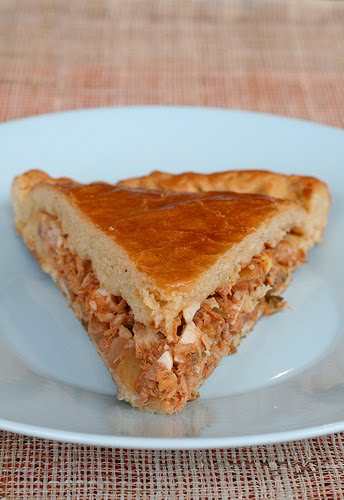
Empanada Gallega de Atun


Ever since I enjoyed my first tuna-filled Galician turnover, empanada gallega, on a hillside picnic about an hour's drive from Madrid last Spring - in a lovely company of Ximena and her hubby J - I've been wanting to make these at home. I have been waiting for Ximena's special recipe to appear on Lobstersquad (soon!), but meanwhile I came up with this version of the famous Spanish pastry. I must admit I was thoroughly satisfied with the result - and I hope that my Spanish friends approve.

Basically, it's a yeast pastry (tinged slightly red with the help of the very special and wonderful smoked Spanish paprika powder, Pimentón de la Vera) that's encasing a moist and flavoursome tuna, egg and tomato filling. Although we had small turnovers on that memorable hillside picnic - empanadillas gallegas - then it's more traditional to make one large pie that's cut into wedges.

Empanada Gallega de Atun or Galician Tuna Pie
(Galiitsia tuunikalapirukas)
Serves six to eight


Yeast pastry:
500 g plain flour
300 ml warm water (42 C)
100 g olive oil
1 sachet of active dry yeast
1 tsp smoked mild Spanish paprika (Pimentón de la Vera, dulce)
1 tsp salt

Filling:
2 cans of tuna chunks in brine (a 200 g), drained and flaked
3 Tbsp olive oil
2 large onions, chopped
1 green bell pepper, chopped
200 g chopped tomatoes (half a regular can)
2 garlic cloves, chopped
2 hard-boiled eggs, peeled and chopped
a handful of chopped fresh parsley
salt, black pepper and smoked paprika powder, to taste

For brushing:
egg

First, prepare the yeast dough. Mix flour, active dry yeast, paprika powder and salt in the mixing bowl. Stir in the water and oil and mix and knead until a uniform ball forms. (I use my KA mixer for this). Cover with clingfilm or a clean kitchen towel and leave to rise in a warm place for an hour.
For the filling, you start with sofrito. Heat olive oil on a sauté pan, add onion and bell pepper and sauté for a few minutes. Add garlic, sauté for another few minutes. Then add the tomatoes, season with salt and pepper. Simmer on a low heat for about 10 minutes, until the vegetables are soft and the sauce has thickened a little.
Season with smoked paprika powder, salt and pepper to taste. Stir in drained and flaked tuna, chopped hard-boiled eggs and parsley.
Divide the yeast pastry into two more or less equal pieces. Dust your worktop with some flour and using the rolling pin, roll one piece into a large circle, about 5 mm thick. Transfer onto a baking sheet lined with parchment paper.
Spread the tuna, egg and tomato filling on top, leaving about 2 cm edge.
Roll out the other half of the pastry, place that over the filling. Crimp the edges together (see below).
Using a sharp small knife, cut couple of "breathing holes" on top of the pastry.
Brush with a whisked egg.
Bake in the middle of pre-heated 200 C oven for about 30 minutes, until the empanada is lovely golden brown on top.
Remove from the oven and leave to cool a little before cutting into wedges and serving.

Saturday, August 15, 2009

Carrot and Chantarelle Quiche

Carrot and chantarelle quiche / Porgandi-kukeseenepirukas

Decisions, decisions.

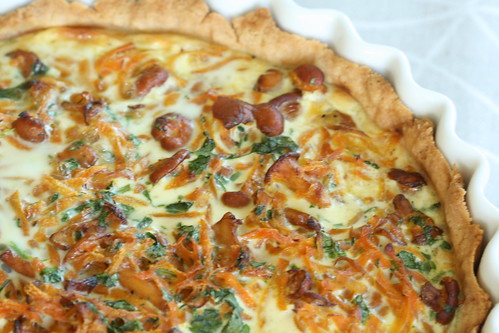
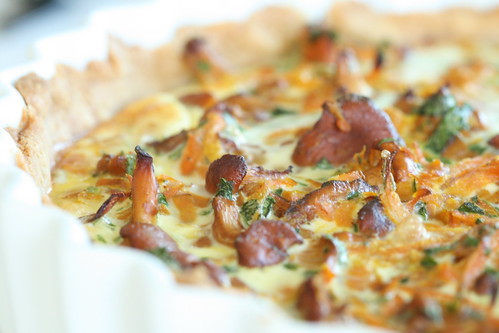
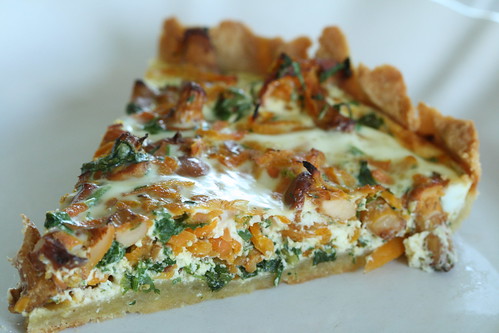
A week or two ago I was staring at a pile of yellow chantarelle mushrooms and a bunch of young orange carrots in my fridge, trying to decide which one should become the centrepiece of our dinner table. Earthy wild mushrooms or succulent sweet carrots? Which one to take, and which one to leave? I couldn't choose (which one would you have chosen?), and combined them both in a quiche instead. The resulting carrot and chantarelle quiche could be my favourite wild mushroom tart of all times.

Here's the recipe. Do try it, if you have a chance.

Carrot and Chantarelle Quiche
(Porgandi-kukeseenepirukas)
Serves 6 to 8

Carrot and chantarelle quiche / Porgandi-kukeseenepirukas

Pastry:
175 g plain/all-purpose flour
0.25 tsp salt
100 g cold butter, cut into cubes
1 egg

Filling:
200 g carrots
300 g fresh chantarelle mushrooms
1 Tbsp butter
about 100 ml /half a cup/ of finely chopped fresh parsley
2 large eggs
200 ml single cream
salt
freshly ground black pepper

Combine flour and salt in a food processor. Add butter and pulse 8-10 times, until mixture is crumbly. Add the egg, pulse again until the mixture begins to come together. Press the mixture into a dough ball, flatten it into a disk. Using your fingers, press the dough to the bottom and sides of a 24 cm pie dish (alternatively, roll out on a lightly floured surface and line the pie form with the pastry.
Place to rest in the fridge for 30 minutes.
Pierce the pastry base with fork, then blind bake in a pre-heated 200 C oven for 10-15 minutes, until the base looks dry.

To make the filling, grate the carrots coarsely. Rinse the mushrooms quickly, if necessary, and drain very thoroughly. If the mushrooms are large, then cut them into smaller pieces.
Heat butter on a saucepan, add mushrooms and carrots. Season with a bit of salt and then sauté on a low heat for 5-7 minutes, until the carrots begin to soften. Remove the pan from the heat. Stir in the parsley.
Whisk eggs with cream, season with a bit of salt and with some black pepper.

Scatter the mushroom and carrot mixture on the pre-baked pastry case, then pour over the egg and cream mixture.
Cook for another 25-30 minutes, until the filling is set and the pie is light golden brown on top.

Carrot and chantarelle quiche / Porgandi-kukeseenepirukas

Friday, July 17, 2009

Smoked Bacon, Onion and Cheese Tart with Cherry Tomatoes


While we're still eating lots of strawberries (yes, the season is still going strong here), then here's something savoury for a change. I flipped through the latest issue of the British BBC Good Food magazine in a café few days ago, and this recipe for Smokey Cheese and Onion Tart caught my eye. I used puff pastry instead of shortcrust, and slightly modified the process and ingredient proportions, and made this for dinner on Wednesday. We liked it a lot.

As with most puff pastry tarts, this is best when still warm or lukewarm.

Smoky Bacon, Onion and Cheese Tart with Cherry Tomatoes
(Sibula-juustu-peekonipirukas)
Serves 6 to 8


500 g puff pastry
100 g smoked bacon
4 to 5 medium-sized yellow onions
200 ml whipping cream
1 large egg
200 g grated cheese
200 g cherry tomatoes, halved
freshly ground black pepper

Roll the puff pastry into a rectangle, place on a baking sheet covered with parchment paper. Using a small sharp knife, score a 1 cm border around the edge of the pastry.
Cut the smoked bacon into small cubes. Peel and halve the onions, then cut into thin half-slices.
Heat a heavy frying pan over medium heat, add bacon and onions and sauté for about 10 minutes, stirring every now and then, until bacon is browned and onions softened. Remove from the heat, and cool slightly.
In a medium bowl, whisk egg and cream, then fold in the grated cheese and fried onions and bacon. Spread the mixture over the puff pastry, staying within the scored line.
Scatter the cherry tomatoes on top, season with freshly ground black pepper.
Bake in the middle of a preheated 225 C / 450 F oven for about 20-25 minutes, until the puff pastry edge has risen and the filling is a lovely golden shade.

Friday, August 08, 2008

Tomato and Goat Cheese Tart with Thyme Recipe


I'm not even trying to pretend that this is my recipe. It's Delia's, of course. I've only very, very slightly played around with the amounts and place my tomatoes differently on the pie - just because I think it looks nicer my way :) In any case, it's a beautiful recipe for showcasing all those lovely, ripe, juicy local tomatoes that abound at the moment. Highly recommended!

Roasted Tomato and Goat's Cheese Tart with Thyme
(Tomati-kitsejuustupirukas)
Serves six to eight

500 grams puff pastry, rolled
150 g soft and creamy goat cheese
4 tsp fresh thyme leaves
2 fresh garlic cloves, minced
500 g ripe plum tomatoes
extra virgin olive oil
freshly ground black pepper
Maldon sea salt

Roll out the puff pastry to 30x40 cm rectangle and place on a slightly oiled baking sheet. Carefully score a line about 1 cm from the edge along the pastry, but do not cut through! This will help the filling to stay inside the pastry and the edges to puff up nicely.

Mix the goat cheese, minced garlic, thyme leaves, salt and pepper in a small bowl. Spread the mixture evenly on the puff pastry sheet (remaining inside the scored line).

Cut the tomatoes into 3-5 mm slices and place nicely next to each other on top of the goat cheese. Sprinkle with sea salt and black pepper and drizzle some olive oil on top.

Bake at a pre-heated 180 Centigrade oven for 45-50 minutes, until the pasty is golden and tomatoes have dried up a little.

Before serving, scatter some more thyme leaves on top. Cut into squares and serve.

Thursday, October 04, 2007

It's Your Call: A Blue Cheese and Pear Tart


I really wanted to save this post for Christmas, as it'd be perfect for the festive season, but wasn't able to. You see, some of you saw the photos in my Flickr stream, and started asking for it, persistently. Being a kind person as I am, I decided that it'd be unfair to let you wait for another 3 months before sharing the recipe..

Few years ago an Estonian cookery programme Kaunimaks köögis (channel TV3) featured a recipe for a pear and blue cheese tart. I hadn't seen the programme, but a friend of mine did, liked what see saw, tried the tart at home and sent me the recipe. I waited a few years until I had some lovely pears, excellent blue cheese, and some good puff pastry in hand. After couple of inevitable adaptations (puff pastry for shortcrust one, 'slashed' pears* for cubed ones, almonds for hazelnuts etc) I came up with this version and made this early last month. And, oh my, it was absolutely delicious, and versatile. It's a wonderful mixture of subtle sweet and savoury flavours that would be just as perfect as a starter before a fancy main course, or as a dessert after one. It would be an excellent accompaniment to a glass or two of white wine (forget about cheese & grapes!), or a cup of coffee or tea. It's your call where and when to serve it. Just excellent. And furthermore - due to the mix of spices in the filling, it would be perfect, absolutely perfect, for the forthcoming Christmas season. I will be definitely making it again.

I used the very excellent Finnish blue cheese - Valio Aura Gold - that has been ripened for 12 weeks. It's strong, but rounded and yet mellow. If that's not available to you, then try some mellow blue cheese instead. Think Gorgonzola or Danish Blue rather than Stilton or Roquefort here..

Blue Cheese and Pear Tart
Serves 6-8


250 grams puff (Danish) pastry
4 large pears, peeled, halved and cored
50 grams slices almonds
100 grams Aura Gold blue cheese, cut into small chunks
300 ml single cream
2 free-range eggs**
1 tsp of gingerbread seasoning***

Roll out the puff pastry into a circle and line a 22-25 cm pie dish with it. Cover with a parchment paper and ceramic baking beans, and blind-bake at 200C for 15 minutes.
Cut the pear halves cross-wise almost through, place nicely on a pre-baked crust.
Place cheese chunks between the pear slices. Tuck almond slices between the pear slices.
Whisk the cream, eggs and spices together, pour over the pears and cheese.
Bake at 180-200C for another 25 minutes, until the egg mixture has set and the pears are cooked.
Cool before serving.


Tuck in and enjoy!!!

* I first saw slashed/sliced pears in a tart on the display shelf of Cafe Peterson here in Tallinn, and thought that'd be much nicer than cubing the pears.
** The eggs are from these happy chicken, which explains the bright yellow colour of the filling.
*** Estonian gingerbread seasoning contains cinnamon, ginger, cardamom, nutmeg and cloves. Feel free to use mixed spice (coriander, cinnamon, cloves, allspice, nutmeg, ginger) or pumpkin spice (cinnamon, ginger, allspice, nutmeg) instead. Or, if you prefer, just take a pinch of this and a pinch of that :)

This recipe was also included in my second cookbook, Jõulud kodus ("Christmas at Home"), published in Estonian in November 2011.

Tuesday, September 25, 2007

What a difference a spice makes: Feta, Spinach and Onion Quiche with Nutmeg

Yes, I'm amazed what a difference a spice makes. Of course I knew that dusting some cinnamon on my apple pie or cumin on my carrot mash makes a huge difference. Yet it still took me by surprise when I took the usual ingredients - spinach and feta cheese and a good puff pastry (as I often do for my spanakopita) - but instead of dried Greek oregano used some freshly grated nutmeg, and got something utterly, totally different. Yes, still a delicious feta and spinach pie, but with a very distinct and different character. I made this just days after the Cheesy Feta & Spinach Pie, and not once did I think that one is too similar to the other..

Go on, try it yourself!

Feta, Spinach and Onion Quiche with Nutmeg
(Feta-spinatipirukas muskaadiga)
Serves 8
Adapted from a recipe on the Finnish Pirkka site


300 grams puff pastry*
150 grams spinach, leaves only
200 grams finely chopped onions
2 Tbsp oil
200 grams feta cheese, cubed
200 ml single cream
3 medium eggs
a pinch of salt
0.25 tsp coarsely ground black pepper
a quarter of a nutmeg, freshly grated (or a very, very generous pinch)

Roll puff pastry into 4-5 mm thickness and line a pie dish with it (you can use a round, 23 cm pie dish, or a square dish). Put aside.
Wash the spinach, do not shake too dry, put onto a hot frying pan and heat, until spinach has wilted. Refresh quickly under cold running water, then drain thoroughly and chop spinach roughly.
Heat the oil on a heavy frying pan and saute onions on a gentle heat until softened. Do not brown!
Spread spinach on the puff pastry, then scatter fried onions and feta cubes on top.
Whisk eggs with single cream, season with salt**, pepper and nutmeg, pour the mixture over the quiche.
Bake at 200 C for about 45 minutes, until the egg mixture has set and puff pastry is lovely golden shade.
Cool a little and serve as a light meal.

* I use the leavened one with yeast, as it gives a lighter and puffier texture, but plain puff pastry would work, too.
** The amount of salt depends on the saltiness of the feta you're using, so be careful here.

Wednesday, September 12, 2007

A Cheesy Feta & Spinach Pie

Feta cheese and spinach are a match made in heaven. I'm yet to get tired of this combination, and I hope that neither have you, as I've got two feta & spinach pie recipes in store for you (that's in addition to my Spanakopita á la Pille that I wrote about almost two years ago). They're all very different, so I hope you won't be too bored, and will stick around :)

The first recipe is for a cheesy (no, not in that sense!) tart, adapted from a Finnish Apu-magazine, where a recipe for juustoinen pinaattipiiras was published on 20 July 2001. It's rather rich and cheese-laden, so not a pie for those trying to lose a dress size. I found that this tasted even better on the following day, so I've added it to my savoury pies and tarts folder with a note 'best made day before' - quite useful for picnics, that is...

A cheesy feta & spinach pie
(Juustune spinati-fetapirukas)
Serves 6-8


Cheesy crust:
100 grams butter
50 grams grated cheese (Cheddar is good)
115 grams plain flour (about 200 ml)
2-3 Tbsp cold water

Spinach & feta filling:
250 grams fresh spinach
200 grams feta cheese
100 grams grated cheese (Cheddar is good)
200 ml single cream
3 eggs

First prepare the pastry: mix flour, butter and cheese with a knife until crumbly, then add the water and bring the pastry together. Press into a pie dish and put into a fridge for about 30 minutes to rest.
Meanwhile, blanch the spinach leaves in boiling water, then quickly cool under a running cold water, drain and squeeze dry. Cut coarsely, then mix with the other filling ingredients.
Blind-bake (see photo here) for 10 minutes in 200 C, until the crust is slightly golden.
Pour the filling into the pre-baked cheesy pastry shell and bake for another 20-25 minutes in the middle of the oven, until the filling is set and the top of the pie is lovely golden shade.
Cool a little, then serve with a green salad.

Wednesday, July 25, 2007

Small beetroot & blue cheese tartlets

Me and my never-ending supply of beetroot recipes, eh? Here's an incredibly simple recipe that I made on Monday night, when a computer guy came to fix some issues with our wireless rooter. These were perfect, as he could munch on those while fiddling with the router - they're just a mouthful or two each, you see. I'll be making them again for a movie night with girls on Thursday..

It's best to use those oblong red beets for this recipe, as they slice into even and beautiful thin slices. To bring out the natural earthy sweetness of beetroots, wrap them in foil and roast them rather than boil them. Assembling and baking the tartlets takes just under half an hour, as long as you remember to roast the beets in advance.

I'm using one of my favourite blue cheeses here, Finnish Valio Aura, which is a strong-flavoured blue-veined cow's milk cheese that has been aged for 6 months.

Beetroot & blue cheese tartlets
(Väikesed peedi-sinihallitusjuustu pirukad)
Yields about 20 small tartlets


300 grams ready-made yeasted puff pastry (i.e. Danish pastry)
1 to 2 medium red beets, oblong type
100 grams Valio Aura or other strong-flavoured blue cheese
fresh thyme
egg, for brushing

Wash the beets and wrap in foil. Roast in a pre-heated 200 C oven for about an hour, checking for doneness by piercing a beetroot with a small knife. Cool, unwrap and peel (using your fingers, not a knife). Slice thinly.
Roll the Danish pastry into a rectangle, leaving it about 4-5 mm thick. Cut into small 5 cm/2 inch squares, then press a light circle inside the square (do not press too hard; I used a small shot glass - see photo here).
Place a thin beetroot slice inside each circle, top with a chunk of blue cheese and garnish with thyme leaves. Brush pastry edges with whisked egg.
Place the tartlets on a lined baking sheet and bake in a pre-heated 200-210 C oven for about 10-15 minutes, until the pastry has risen and turned golden brown.
Cool and serve.

BLAST FROM THE PAST
A year ago I wrote about smoked salmon & spinach quiche that was inspired by my date with K. in Paris earlier last year. Two years ago I mused about the green vegetables I bought at Edinburgh Farmers Market - rather appropriately, as K. and I picked up a lot of wonderful fruit, berries and vegetables at Tallinn Central Market today.

Saturday, July 14, 2007

A Beetroot & Potato Pie


UPDATE 22.8.2007
One of my Estonian readers tried this pie and really liked it. You can see her photo here.

*****

I posted the above teaser picture yesterday and asked you to guess what it was. Well, I'm sorry to tell that none of the seven readers who left their guess in the comments got it right. It's not a cherry pie, nor raspberry pie and it's definitely not a rhubarb pie (we don't really eat rhubarb after St John's night over here). And there's no meringue involved either.

It wasn't even a sweet pie, but a savoury one. But even if I had told you that, I doubt that you had guessed the ingredients - it's a beetroot & potato pie :)

And what a brilliant pie it was. Apart from being tasty (though you do need to like beetroot to like a beetroot pie, of course), it also looked beautiful, and my whole extended family wholeheartedly approved. The recipe is very slightly adapted from the Finnish Herkkutori site and the recipe below will yield 6 generous slices. If you don't feel like making a pie, yet want something with lovely beets and new potatoes, then check out Alanna's recipe for Scalloped Potatoes with Beetroots.

Beetroot & Potato Pie
(Uhke peedipirukas)


For the pastry*:
50 grams soft butter, at room temperature
250 grams plain flour
2 tsp baking powder
100 ml milk

Filling:
4 small beets
4 medium potatoes
3 eggs
150 ml sour cream or creme fraiche
150 ml milk
1.5 tsp salt
1 tsp black pepper

For brushing:
a small egg

First, prepare the pastry. Mix flour with baking powder and knead it into the soft butter, adding milk bit by bit (you may need a spoonful more or less, so don't rush). Press the pastry into a ball, wrap in plastic and put into the fridge for 30 minutes.

For the filling, boil beets and potatoes (separately) until almost done (for small beets, this would probably mean about 20-25 minutes). Drain and cool and peel. (You can obviously also use left-over boiled beets and potatoes). Cut into thin slices (about 3-4 mm thick).

Mix eggs, sour cream and milk in a bowl, season with salt and pepper. Put aside.

Divide the pastry into two pieces (about 1/3 and 2/3). Roll the larger piece of pastry into a thin disc to cover the bottom and sides of a 25 cm high springform non-stick pie dish. Press firmly onto the sides.

Now layer the potatoes and beets into the pastry shell, pour over the egg and cream mixture.

Roll the smaller pastry piece into a disc large enough to cover the pie, place over the filling and press edges firmly together.

Brush with an egg, pierce couple of holes into the lid and place into the lower shelf of a pre-heated 190-200 C oven. Bake for 35-40 minutes, until the pie is lovely golden brown.

Let it cool a little, then remove the springform dish.


Serve with a herby yogurt or sour cream sauce. The pie is excellent when still warm, but can also be taken along to a picnic on the following day, as it doesn't loose any of the flavour when cold (and if you compare the second and third photo, then you can see that the beetroot 'leaks' into the potato layers overnight).

* I reckon you could also use the pastry I used for making hortapita or the Greek pie with wild greens to make this beetroot & potato pie.

BLAST FROM THE PAST
Two years ago I posted a recipe for Paul Hollywood's mint and halloumi bread. Although I think Mr Hollywood got some of the quantities wrong (20 grams of dried mint is A LOT!!!), the bread itself is fabulous and definitely worth trying.

Sunday, June 03, 2007

It's a wild thing: hortapita or a Greek pie with wild greens


On a gorgeous Sunday in early May K. and I walked along the paths of my - sorry, our - childhood summers. Literally. And during that walk, we packed a small linen bag with young ground elder leaves. You see, ever since buying the book on the culinary use of wild herbs & weeds few months ago, I've been discovering new edible wild plants galore. Eating dandelion greens is almost conservative now. I've turned dandelion blossoms into dark and sticky syrup, thrown milk thistle leaves into my salads, and yes, eaten enough wild garlic leaves to provide me with vitamins for months, and yes, even made a pie out of ground-elder. I can see that not everybody gets excited about stuff like that - even my 87-year old grandmother was a bit suspicious of me collecting these weeds for human consumption. But luckily K. is very supportive, and doesn't mind being fed one 'interesting' dish after another.

Ground-elder (Aegopodium podagraria, also known as bishop's weed and goutweed in English, naat in Estonian) has a long history of being used for medicinal purposes, but it was also cultivated as a food crop in the Middle Ages, especially in Russia (and in Siberia in particular - the Russian Saint Seraphim of Sarov is said to have survived three years on eating mainly ground-elder while on self-exposed exile in a deep forest), Scandinavia, in Central Europe. Old Finno-Ugric peoples were keen consumers of ground elder, too. According to some sources, old traders wrapped their vegetables into ground elder leaves to keep them fresh looking and smelling - the leaves are high in essential oils and helped to keep the other produce fresh and aromatic, too. Young and tender ground-elder leaves can be added to soups, omelettes and stews. Blanched leaves can be mixed with cottage cheese and curd cheese. The leaves are high on Vitamin E, as well as vitamin C, they're rich in antioxidants, minerals, flavonoids and fibre. Dishes containing ground elder are easily digestible, and have cleansing properties - so they're good for that spring-time detoxing :)


A hortapita in Portaria, June 2006

I decided to make hortapita with my ground elder leaves. The wise Greek village women, you see, have been using wild greens - horta - for culinary purposes forever. I enjoyed hortapita in a shady cafe in Portaria (see the photo above) during my 2006 trip to Greece. Its slightly more elegant and modern version - spanakopita - is one of my favourite pies. Using my ground elder bounty for a Greek hortapita seemed like the most logical thing to do. The Greek villagers would use lots of other wild and bitter leaves for making hortopita (and other dishes too, obviously, like salads etc). Amaranth (vlita in Greek, one of the most popular horta's - rebashein), sow thistle (tsochos / piimaohakas), stinging nettles (tsouknithes / kõrvenõges), mallow (molocha / kassinaeris), dandelion, purslane ( glistrida or andrakles / portulak), wild carrots, as well as more familiar chicory, sorrel, mustard greens, rocket, endives and others. Ground elder makes as good a pie filling as any of the others mentioned - just a little bit bitter, gutsy and earthy.

The pastry recipe is from my friend Virve, who uses it to make a fabulously easy apple pie. It's the easiest pastry to work with and it tastes wonderful - it's easy, soft and pliable dough that procudes a flaky and wonderful pastry. The filling is inspired by my spanakopita recipe.

Hortapita or a Greek-style pie with wild greens
(Naadipirukas)
Serves 8


Pastry:
200 grams butter
200 grams sour cream
350 grams plain flour
a pinch of salt

Filling:
3 Tbsp oil
200 grams young ground-elder leaves
100 grams onion, finely chopped
200 grams cottage cheese or feta cheese
1 egg
1 Tbsp dried oregano
salt and coarsely ground black pepper

First, prepare the pastry. Melt the butter on a medium heat, take off the heat and cool a little. Mix in sour cream, flour and salt. Knead until the pastry comes together - it'll be very soft and pliable, like plastiline. Wrap into cling film and put into the fridge for up to 30 minutes (leave it for much longer, and you'll have hard time rolling it!)
Meanwhile, prepare the filling. Wash the wild greens, dry thoroughly. Heat a non-stick frying pan and 'cook' the leaves until they 'wilt'. Then quickly rinse them under cold running water to stop them from cooking further. Press until dry, and chop the cooked leaves coarsely.
Heat the non-stick frying pan again, this time with oil on it. Add the onion and cook on a low heat for about 10 minutes, until onion starts to soften. Take off the heat.
Now add the other ingredients, mix thoroughly.
Roll the relaxed dough to a large rectangle about 4-5 mm thick, cut into 2 more or less equally sized rectangles. Place the smaller one on a medium-sized oven tray, spread the filling on top, and cover with the larger dough sheet. Pinch the edges firmly together, pierce with a fork couple of times and brush with whisked egg.
Bake at 200C for 25-30 minutes, until golden brown. Cool a little and cut into squares.
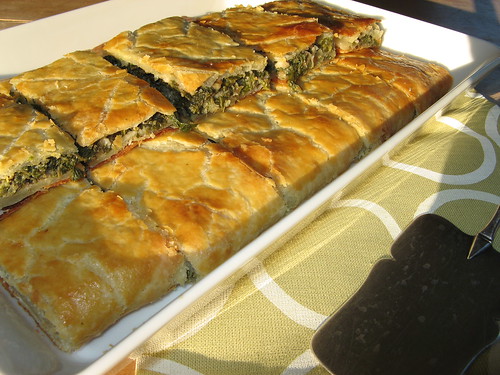
Hortopita / Naadipirukas

Wednesday, March 21, 2007

On neighbourly relations, and a feta and red onion tart

I've never met Rosmariini (= Rosemary = she) & Pippurimylly (= Pepper Mill = he), the couple behind the Finnish-language Pastanjauhantaa blog, but I think we'd like each other, if we did. We've got a pretty similar taste in food, you see, and keep recreating recipes from one another's blogs. Pippurimylly was inspired by my posts for the slowly braised Dutch beef dish, draadjesvlees (see here) ; the small feta and spinach omelettes (see here); and most recently my savoury blue cheese and beetroot muffins (see here). And vice versa - it works the other way around, too. I've knicked many recipe ideas from the neighbouring Finns (for example, roasted asparagus with Parmesan and numerous other weekday dinners that I haven't blogged about) . But that's what good neighbours are for, isn't it??

In late February Rosmariini wrote about a feta and red onion quiche that I simply had to make, and last night I did, with some small adaptations. I now have two favourite red onion pies - the feta and red onion tart here, and the Upside-down Red Onion Pie by Nigella. The original recipe uses a simple shortcrust pastry. I've recently found a pretty decent local puff pastry that I've been using (f. ex. for my salmon kulebyaka), so I opted for that, but feel free to use your favourite pâte brisée recipe (or use Pierre Hermé’s Perfect Tart Dough that Chubby Hubby praises).

Peeling onions for this tart is the most difficult task, which is to say that it's supereasy and very flavoursome - the salty feta cheese and sweet honey and earthy oregano melding wonderfully together. Feta cheese and the abundant use of dried oregano gives this tart a very Greek feel, which suits me just well, as I love Hellenic food.

Thanks again, Rosmariini, for the inspiration!!

Feta and red onion tart
Serves 6


500 grams puff pastry

500 grams smaller red onions (peeled weight, that's about 650 grams unpeeled)
2 Tbsp olive oil (from the canned feta)
1 tsp dried oregano
1 Tbsp honey
salt and freshly ground black pepper
300 grams feta cubes in olive oil
2 eggs
200 ml single cream

fresh parsley to garnish

Peel the onions, cut into half and then into thin slices.
Drain some of the oil from feta cheese onto the heavy-bottomed frying pan. Heat up and add the onions. Fry gently on a moderate heat for about 10 minutes, stirring regularly, until the onion has softened. Add oregano and honey, stir to combine. Season with salt and pepper.
Roll the puff pastry into a square (approx. 23 x 30 cm). Place in a tart tin, so the pastry goes slightly up the edges (you need raised edges to keep the filling inside).
Spread the fried and honeyed onions over the puff pastry, scatter feta cubes on top.
Whisk the eggs with the cream, pour over the filling.
Bake at 200C for about 25 minutes, until the eggy filling has set and the pastry is golden brown.

Transfer to a serving dish, scatter with lots of fresh parsley and serve.