Monday, February 11, 2013

Estonian recipes: yellow split pea soup with smoked pork (hernesupp suitsulihaga)

Originally posted in February 2012, slightly edited.
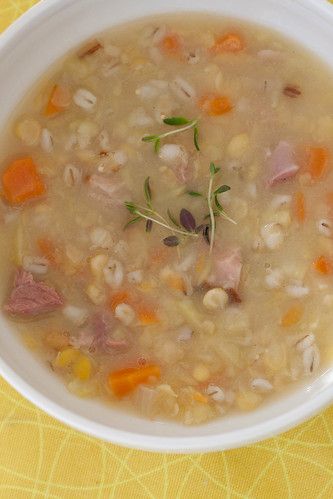
Estonian split pea soup with smoked ham / Hernesupp

It's Shrove Tuesday tomorrow, and before feasting on delicious Lenten buns (I've blogged about the classic ones, chocolate ones and luscious raspberry and marzipan ones), Estonians eat split pea soup. Thick, hearty, well-flavoured (smoked pork!) and textured (peas + pearl barley) - all the elements of a substantial and delicious winter soup are present. Here's a recipe that I've been using for years to make a big (I mean it!) pot of delicious soup.

It's a fusion recipe, of a kind. You see - apparently in the Southern Estonia, they used to put barley in the split pea soup; in the North, they replaced the pearl barley with cubed carrots and potatoes. I use them all, so it's a meet-me-in-the-middle soup :)

Note that the soup reheats very well. As it thickens when cooling, you may need to add some water when reheating it, and adjusting the seasoning again, if necessary. 

Estonian Yellow Split Pea Soup with Smoked Pork
(Hernesupp suitsulihaga)
Serves eight to ten
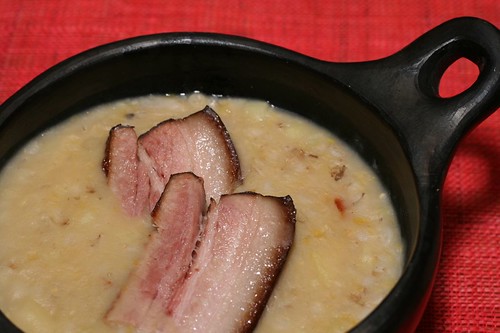
Split pea soup with smoked pork rib / Hernesupp suitsuribiga

200 g yellow split peas
150 g pearl barley
3 litres of water
about 1 kg of smoked pork - rib, cheek or hock
1 large onion
2 to 3 large carrots
2 large potatoes
salt to taste
2 to 3 tsp sharp mustard (or to taste)
fresh herbs (parsley, celery, dill, thyme, savory)

ON THE PREVIOUS NIGHT OR IN THE MORNING:
Pick through the peas and pearl barley to remove any grit. Place into a bowl, pour over enough cold water to cover by couple of centimetres and leave to soak. (This reduces the cooking time considerably).

ON THE DAY:
Place the smoked pork into a large bowl (definitely larger than 5 litres!). Add the 3 litres of water and bring slowly into a boil. Remove any froth and scum that appears on the surface.
Rinse the soaked barley and peas, drain and add to the saucepan. Bring to a boil again, then reduce heat, cover with a lid and simmer gently for about an hour.
Meanwhile, peel and chop (or grate coarsely) the onion, carrots and potatoes. If you wish, you can sauté the onion and carrots in some oil - this enhances the flavour.
Add the vegetables to the soup and continue simmering for about half an hour, until the meat and vegetables are fully cooked.
Take the pork out of the soup, remove the meat from the bones and chop finely. Return the chopped meat into the saucepan.
Season the soup with mustard and salt, add some herbs of your choice and serve.

Friday, February 08, 2013

Braised rabbit with mustard (lapin à la moutarde)

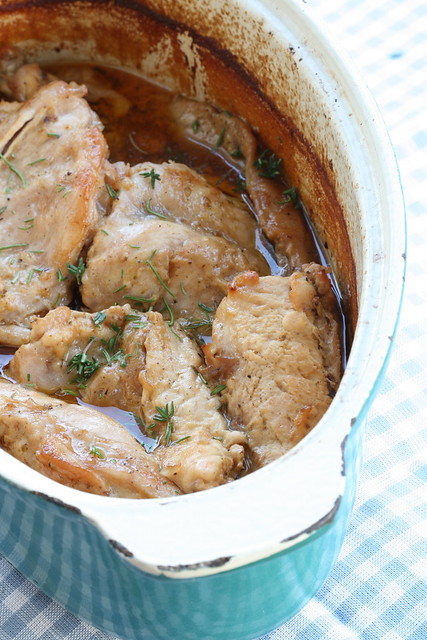
Sinepine küülik / Mustard and rabbit stew
Photo by Juta Kübarsepp for the November 2012 issue of Kodu ja Aed magazine.

It's snowing outside, and once again I'm craving something belly- and heart-warming. This braised rabbit with mustard sauce (lapin à la moutarde) hits the spot. Rabbit has become more easily available here in Estonia for an average shopper (read: you can get it vacuum-packed in your local supermarket), and this rabbit stew with a creamy mustard sauce is an excellent way of cooking rabbit.

The recipe is French-inspired and adapted from Anthony Demetre, the chef patron at the London restaurants Arbutus, Wild Honey and Les Deux Salons; more specifically, from his book Today's special: A new take on bistro food - Recipes from Arbutus and Wild Honey. Demetre uses rabbit legs, but for a home cook, using a whole rabbit makes much more sense - and is much more economical, of course.

It's my favourite way of cooking and serving rabbit - I included the recipe in my first cookbook, as well as in the November 2012 issue of Kodu ja Aed magazine. You can braise this one on the stovepot or bake in the oven - the choice is yours.

Braised rabbit with mustard
(Sinepine küülikuhautis)
Serves four to six
Mustard Rabbit / Küülik sinepikastmes

1 rabbit
sea salt and freshly ground black pepper

75 g butter

75 ml white wine vinegar (5 Tbsp)
3 Tbsp good Dijon mustard
500 ml (2 cups) hot chicken stock
200 ml double or whipping or heavy cream
1 Tbsp dried oregano
1 tsp smoked paprika powder (pimentón de la Vera)
1 tsp finely chopped fresh rosemary
5 garlic cloves
2 bay leaves

If braising the rabbit in the oven, then pre-heat the oven to 200 C/400 F.

Cut the rabbit into serving pieces (here's a photo of me tackling another rabbit, I usually end up with two shoulders, two legs, two belly flap pieces, 2 saddles; I throw the rib cage into the stew as well to give extra flavour, but I don't eat it; here's Hank Shaw's very detailed step-by-step guide, which I find a wee bit over-complicated, but perhaps the rabbits here and there are somewhat different :); and finally, here's Saveur's guide).

Season the meat with salt and pepper.

Take a heavy saucepan or Dutch oven or casserole dish. Melt the butter, then brown the meat pieces on all sides (you'll need to do that in 2-3 instalments probably). Remove the browned pieces and put aside.

Pour the wine vinegar into the saucepan, bring to the boil and reduce by half. Add the rest of the ingredients, bring into the boil again. Season to taste with salt and pepper, then return the browned rabbit pieces into the saucepan again.

Once again, bring into the boil, cover tightly with the lid and transfer into the pre-heated oven. Cook for about 1,5 hours, until the meat falls off the bone.

(If you opt for stove-top braising, then simmer over moderately low heat, covered, until the meat falls off the bone).

Serve with seasonal vegetables.

Similar recipes:
Hank Shaw's rabbit in mustard sauce @ Simply Recipes
Raymond Blanc's braised rabbit with mustard @ BBC Food
Rabbit cooked with Dijon mustard @ Saveur
Rabbit with mustard @ Gourmet Traveller WINE
Mustard rabbit @ The Evening Hérault
Rabbit in mustard sauce @ French cooking for Dummies
Rabbit in mustard cream @ Lindaraxa

Sunday, February 03, 2013

Tuna and egg sandwich cake (Smörgåstårta aka võileivatort)

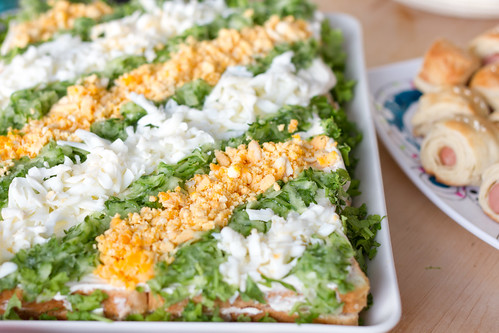
Sandwich cakes / Kaks võileivatorti

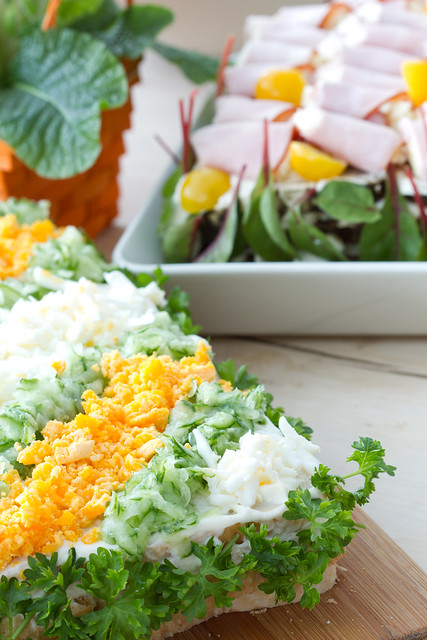
Although it's Sweden that is most famous for its sandwich cake - smörgåstårta - sandwich cakes aka  võileivatordid have been popular in Estonia for a few decades now. We celebrated our older kids birthday parties last weekend - our daughter turned 4 and our son 2 in January, and I made three sandwich cakes for the occasion. One with ham and egg filling, using dark rye bread and decorated with small cheese-filled ham rolls. The other was with tuna and egg filling, using light wholegrain bread and garnished with strips of cucumber and egg.

Here's the recipe for the latter. It's incredibly easy to make, and tastes like one big nice tuna sandwich. As with all sandwich cakes, it's best made a day before, but garnished just before serving. I've made it with dark rye bread previously, but prefer making it with sliced wholegrain bread these days.

You're welcome to follow my Sandwich cake Pinterest board (there are some great ideas for decorating sandwich cakes) or check out the relevant topic on my Estonian site (võileivatordid ja nende kaunistamine).

Tuna and Egg Sandwich Cake
(Maitsev ja mahlane tuunikalatort)
Serves 12 to 18
Original idea: Pereköök, November 2000 (adapted over the years)

Tuna sandwich cake / Tuunikalatort / Tuunikala-võileivatort
24 square slices of (wholemeal) toast bread

Filling:
2 canned tuna chunks in brine or oil, drained
1 medium-sized leek, white and pale green parts only
2 hard-boiled eggs
200 g good-quality mayonnaise (I use Jaani)
150 g sour cream, smetana or creme fraiche
sea salt and freshly ground black pepper

To cover:
about 150 g mayonnaise or a mix of mayonnaise and sour cream

To decorate:
2 hard-boiled eggs
1 green cucumber
salad leaves or finely chopped fresh parsley

Cut the leek half lengthwise, rinse, if necessary, to get rid of any dirt. Cut into thin slices. Crush the tuna with a fork, chop the egg finely or use the coarse grater. Mix the eggs, leeks and tuna.
Add the mayonnaise and sour cream, season with salt and pepper to taste. You're aiming for a well-seasoned and moist sandwich filling here - add more sour cream or mayonnaise, if your filling seems to dry.

(You can remove the crusts from your bread slices for a neater finish. I almost never do.)

Place 6 bread slices on your serving tray, neatly next to each other. Spoon half of the tuna and egg filling on top. Then cover with another 6 bread slices, the rest of the tuna and egg filling and the final six bread slices.

That's how easy it is :)

Now cover the sandwich cake with cling film and place into the fridge for at least 4 hours, preferably overnight.

When ready to serve, spread some mayonnaise on top and on the sides of the cake. Cover the sides with finely chopped parsley or some salad leaves.

For the topping, I prefer thin strips of coarsely grated cucumbers, egg whites and egg yolks, but it's really up to you.