Wednesday, February 27, 2013

Grilled mackerel with potato and chorizo hash

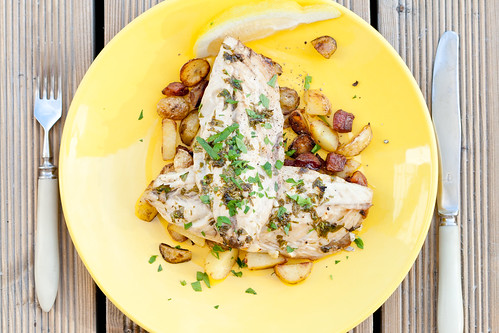
Grilled mackerel with potato and chorizo hash / Grillitud makrell chorizo-kartuipadjal

Doesn't this look like something wonderfully light and spring-like? We've had couple of beautifully sunny days here in Estonia recently and I do believe now that this looooong and greyish winter will end, eventually.

Here's a simple lunch or dinner idea, using new potatoes, cooking chorizo (you can choose a spicy or milder one, it's up to you) and fresh mackerel. Flavoursome and filling!

Grilled mackerel with potato and chorizo hash
(Grillitud makrell chorizo-kartulipadjal)
Adapted from DeliciousMagazine.co.uk
Serves 4

500 g new potatoes, skin on
2 whole mackerels, filleted into 4 either by you or your fishmonger
2 Tbsp olive oil
juice of 1 lemon
1 garlic clove, crushed
a small bunch of flat-leaf parsley, roughly chopped
100-150 g cooking chorizo, cut into smaller chunks
salt and black pepper

Wash the potatoes thoroughly, then parboil in salted water until just tender. Drain and cool slightly.

Put the fish fillets into a shallow dish. Mix together the olive oil, lemon juice, crushed garlic, chopped parsley. Pour over the fish, then season generously with salt and pepper.
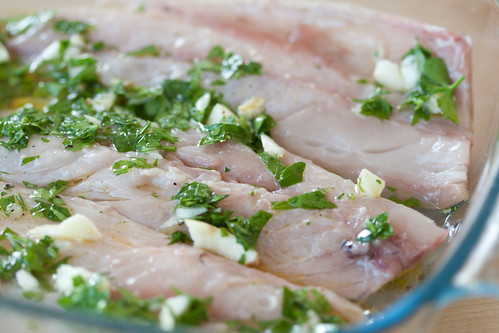
Grilled mackerel with potato and chorizo hash / Grillitud makrell chorizo-kartuipadjal

Peel the cooled potatoes, chop into smaller pieces.

Pre-heat the grill to high.

Prepare the potato and chorizo hash. Heat a large frying pan and cook the chopped chorizo over a high heat for about 2 minutes or until the oil starts to run. Add the chopped potatoes and cook for another 8-10 minutes, stirring every now and then, until the chorizo and potatoes are golden and crisp.

When the potatoes and chorizo are cooking, lift the mackerel fillets from the marinade. Place onto a grill rack and grill for 7-8 minutes, until the skin is golden and the flesh is cooked through.

To serve, spoon the potato and chorizo onto warmed plates, place the fish fillets on top, drizzle with some herb oil and serve immediately.
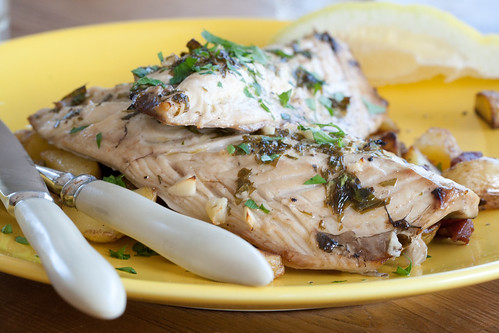
Grilled mackerel with potato and chorizo hash / Grillitud makrell chorizo-kartuipadjal

Tuesday, February 19, 2013

Fried fish in marinade (Baltic herring recipe)

Marineeritud praetud räimed / Fried Baltic herrings in marinade

Time for another Estonian recipe here on Nami-Nami. My mum celebrated her birthday last weekend, and this - "marineeritud praetud räimed" aka "praetud räimed marinaadis" - was one of the dishes I brought along to her party. You see, both my grandmothers - one 91, the other 92 years old - are staying with my parents these days. The other day my mum was complaining that her mum and her mother-in-law (that's my two grandmothers then) had been asking for fried Baltic herring for a while now and my mum hasn't had a chance to go to the market in search of fresh fish. As we have an excellent fishmonger - Pepe Kala - at our weekly farmer's market in Viimsi, I decided to make my mum's life easier and cooked a batch to take along.

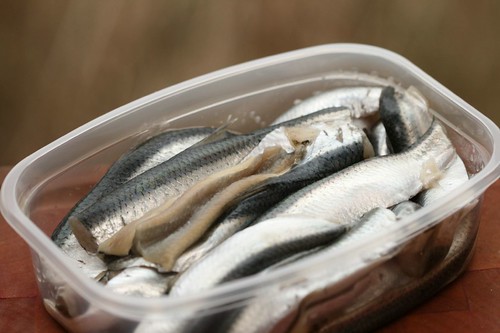
 Baltic herring fillets / Räimefileed


In Estonia this dish is made with Baltic Herrings (Clupea harengus membras, above), a subspecies of the Atlantic herring (Clupea harengus). Baltic herring is smaller and less fatty than the Atlantic herring, and they're also much smaller - up to 18 cm long compared to the Atlantic herring's 40-45 cm. Baltic herring - räim - is considered the "national fish" of Estonia. It's known as silakka in Finnish, strömming in Swedish, hareng de la Baltique in French. True (Nordic) fish aficionados claim the taste of Baltic herring to be superior to the taste of much more well-known sardines. :)

 If you cannot get hold of the Baltic herring, you could try sardines instead - apparently the marinade works well with fried sardines, too.


Fried Baltic Herring in Marinade
(Praetud räimed marinaadis)
Serves 8

 Marineeritud praetud räimed / Fried Baltic herrings in marinade
600 g Baltic herring fillets (or about 1 kg fresh fish)

2 large eggs
4 Tbsp milk

200 ml all-purpose flour or rye flour

oil for frying

Marinade:
1 l water (4 cups)
2 carrots
2 onions
10 black peppercorns
5 allspice berries
2 bay leaves
2 Tbsp 30% vinegar
1.5 Tbsp salt
2 Tbsp caster sugar

Fry the fish. Whisk the eggs with milk, dip fish fillets into the mixture, flesh side down. Press both sides of the fish into the flour, shaking off any extra flour.

Heat a tablespoon or so of oil in a heavy frying pan until hot. Place the breaded fish fillets, flesh sides down, onto the pan and fry for a 2-3 minutes, until dark golden brown. Flip gently over and fry the skin side until golden brown. Transfer the cooked fish fillets into a large bowl.

Make the marinade. Peel and thinly slice the carrots and onion (I used my trusty Benriner mandoline slicer). Place the vegetables, peppercorns and allspice berries, bay leaves, salt and sugar into a medium-sized saucepan. Add the water and bring into a boil. Reduce heat and simmer until the carrots are al dente or still have some bite to them. Taste for seasoning - add more salt or sugar, if necessary. The marinade should be quite salty and sugary to have enough potency to flavour the fried fish fillets.

Now add the vinegar* and remove the pan from the heat. Again - you want the marinade to be vinegary to flavour the fish, but not so much that the resulting dish would be too vinegary. Let the marinade cool for a 10-15 minutes, then slowly pour the whole thing (including the carrots, onions and the seasoning) over the fried fish.

Cool completely, then cover and transfer into the fridge for at least 8-10 hours or overnight.

 Marineeritud praetud räimed / Fried Baltic herrings in marinade

Enjoy on a slice of good dark rye bread or alongside boiled potatoes.

These keep in a fridge for a week or so.

* A note on vinegar - we use the 30% proof vinegar to make this dish in Estonia. Use whatever neutral-tasting vinegar you have, adjusting the amount and aiming for the slightly vinegary marinade.

Tuesday, February 12, 2013

Lenten buns aka semlor aka vastlakuklid 2013

Vastlakuklid 2013 / Lenten buns 2013

It's Shrove Tuesday or Fat Tuesday today, which means pancake feasts in many places across the world. In Estonia and other Nordic countries, however, this means eating lenten buns (semla, vastlakukkel) instead. I baked a batch of these wonderful buns, filling them with whipped sweet cream this year. No marzipan, no jam.

You'll find all my Lenten recipes here., including recipes for barley and bacon porridge and split pea soup with smoked pork.