Showing posts sorted by relevance for query rugelach. Sort by date Show all posts

Thursday, October 02, 2008

Rugelach, rugelach, rugelach


Few weeks ago a friend of mine from Toronto, Melissa, came to visit me. Melissa and I both did our postgraduate degrees in Edinburgh in year 2000, after which she left first to her native South Africa and then moved to Toronto to do her doctorate. She had promised to visit me on several occasions since she left Scotland, and we even managed to meet up at a conference in London at one point. Now, finally, she - and her beautiful 9-month old daughter Natali - came to Estonia for a brief, 8-day visit.

And this gave me an opportunity to try some Jewish recipes I had been wanting to try for a while. You see, Melissa is Jewish, who keeps kosher. And she's vegetarian. In this Land of Pork Chops Served with Cheese Sauce, it was easiest for us to eat at home. And one night, I baked us a batch of Rugelach. Rugelach - when said with a low, husky voice, and repeatedly, sounds sweet and funny (at least little Natali seemed to think so!), like something out a fairy tale, so I was thrilled to be finally making them.

And they sure were moreish - sweet, flakey, fragrant, and very, very tasty. I adapted a recipe from Clarissa Hyman's book The Jewish Kitchen: Recipes and Stories from Around the World. Note these are not parve/pareve or 'neutral', as they contain cream cheese, so don't serve them after a meat meal, if you're trying to keep kosher.

Hazelnut Rugelach
(Rugelach)
Makes 32 small pastries

For the pastry:
200 g butter, softened
200 g full-fat Philadelphia cream cheese, softened
2 tsp caster sugar
200 g all-purpose/plain flour, sifted
a pinch of salt

For the filling:
100 g finely ground hazelnuts or walnuts
50 g soft brown sugar
5 Tbsp unsweetened cocoa powder
2 tsp cinnamon

For brushing:
25 g butter, melted

For glazing:
1 egg white, beaten with a little water

Cream the warm butter and cream cheese until well blender. Beat in the sugar, then stir in the flour and salt. Mix until the dough begins to hold together, press into a ball, wrap in clingfilm and chill overnight in the fridge.

Combine the ground nuts, brown sugar, cocoa powder and cinnamon.

Divide the dough ball into two and return the other half into the fridge. Roll out the pastry on a slightly floured surface into a thin circle about 25 cm /10 inches in diametre. Using a sharp knife or a pizza-wheel, cut into 16 equal wedges.

Brush the surface of the wedges with melted butter, then sprinkle half of the nut and cocoa mixture on top, spreading evenly as you go. Using your hand or a rolling pin, press the filling tightly down into the dough (there seems to be a lot of filling, but it'll make the pastries only nicer!).

Carefully roll up each wedge tightly, starting from the wider, outside end. You'll end up with 16 mini croissants. Brush with egg white wash.

Cover a baking tray with parchment paper and bake at the middle of a preheated 180 C/350 F oven for 20-30 minutes, until the rugelach are golden brown.

Leave to cool slightly, then transfer to a wire rack.

Repeat with the second half of the pastry - even straight away or on the following day.

Wednesday, December 16, 2009

Holiday baking: Rugelach with prune filling


It's been a over a year since I made some delicious rugelach-cookies with hazelnut filling. After seeing a very talented young American pastry chef, Heidi Park (now based here in Tallinn), sharing her recipe for rugelach-cookies in a local food magazine, I felt the urge to make these again. I used my old recipe, and adapted the filling from Martha Stewart's recipe for Prune Rugelach.

Very pleased with the final result, so sharing it with my dear readers :)

Rugelach with Prune Filling
(Rugelach-küpsised ploomitäidisega)
Makes 32 small pastries

For the pastry:
200 g butter, softened
200 g full-fat Philadelphia cream cheese, softened
2 tsp caster sugar
200 g all-purpose/plain flour, sifted
a pinch of salt

For the filling:
200 g dried plums/prunes
100 ml brandy or cognac

Breadcrumb mixture:
4 Tbsp breadcrumbs
4 Tbsp caster sugar
0.5 tsp cinnamon

For glazing:
1 egg white, beaten with a little water

On the night before:
Pour brandy over the prunes and let soak for up to 24 hours.

Cream the warm butter and cream cheese until well blender. Beat in the sugar, then stir in the flour and salt. Mix until the dough begins to hold together, press into a ball, wrap in clingfilm and chill overnight in the fridge.

On the day of baking:
Combine the breadcrumbs, sugar and cinnamon.

Puree the prunes with the brandy until smooth.

Divide the dough ball into two and return the other half into the fridge. Roll out the pastry on a slightly floured surface into a thin circle about 25 cm /10 inches in diametre. Using a sharp knife or a pizza-wheel, cut into 16 equal wedges.

Brush the surface of the wedges with half of the prune puree, then sprinkle half of the breadcrumb mixture on top, spreading evenly as you go. Using your hand or a rolling pin, press the filling tightly down into the dough (there seems to be a lot of filling, but it'll make the pastries only nicer!).

Carefully roll up each wedge tightly, starting from the wider, outside end. You'll end up with 16 mini croissants. Brush with egg white wash.

Cover a baking tray with parchment paper and bake at the middle of a preheated 180 C/350 F oven for 20-30 minutes, until the rugelach are golden brown.

Leave to cool slightly, then transfer to a wire rack.

Repeat with the second half of the pastry - even straight away or on the following day.

Wednesday, July 04, 2012

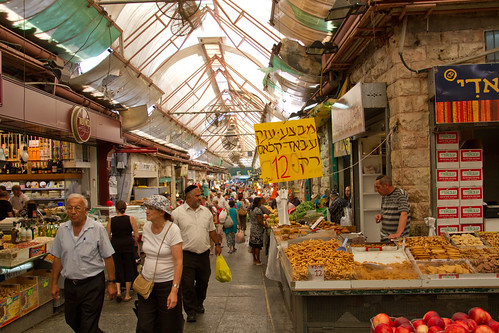
The obligatory market post: Mahane-Yehuda market in Jerusalem

Mahane-Yehuda market, Jerusalem, Israel
Which food lover doesn't like visiting a proper food market when travelling? I believe there's none. Here are some of my photos from the visit to the main market in Jerusalem exactly one week ago.

Also known as Machne Yehuda or simply the Shuk, Mahane-Yehuda market is one of the symbols of Jerusalem, the capital of Israel (and one of the non-religious kind). The market dates back to the Ottoman period (the first stalls began their trade at the end of the 19th century), and has seen several redesigns and developments during the last 100+ years. Today the market covers a rather large plot of land, and hosts stalls that offer everything from flowers to household goods to art to food. We, the foodbloggers, were obviously focusing on the numerous market streets specialising in food (that'd be Eitz HaChaim street, Machane Yehuda street, HaTapuach street, Eliyahu Banai street, HaShaked street). Our tour guide Zvi took as to several of his favourite food spots at the market. 

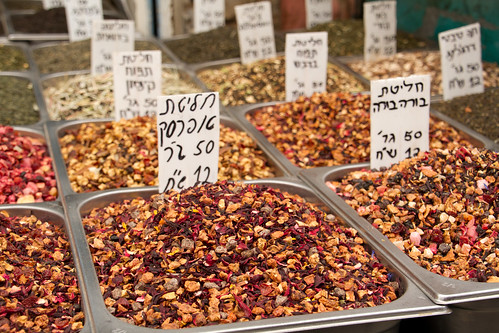
Beautifully fragrant fruit teas:
Mahane-Yehuda market, Jerusalem, Israel

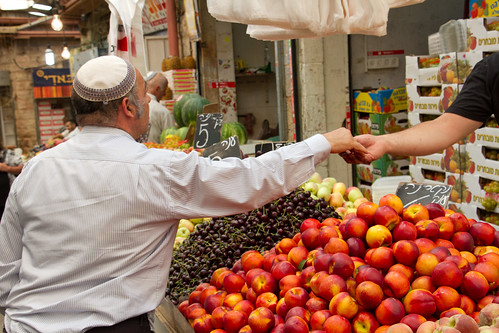
A fruit vendor. Cherries, peaches, plums - all were in season right now:
Mahane-Yehuda market, Jerusalem, Israel

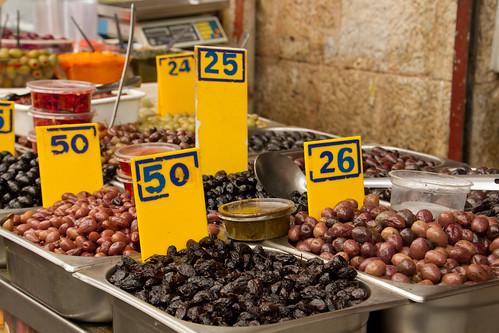
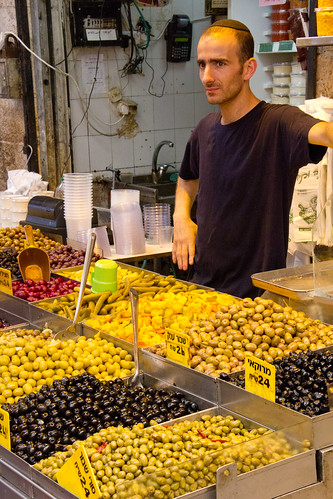
A great range of olives was sold at the market. Many indigenous olive varieties are grown in Israel (f. ex. Souri, Barnea, Nabali (Balladi)), as well as internationally known Manzanilla, Kalamata, Picual, Novo, Leccino, Fishulin.
Mahane-Yehuda market, Jerusalem, Israel

This cheeky vendor offered everyone a taste of some rather fierce yellow pickled chillies. Luckily I was warned before I went for it :)
Mahane-Yehuda market, Jerusalem, Israel

Baked goods:
Mahane-Yehuda market, Jerusalem, Israel

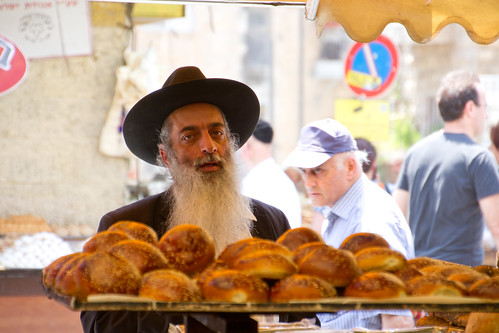
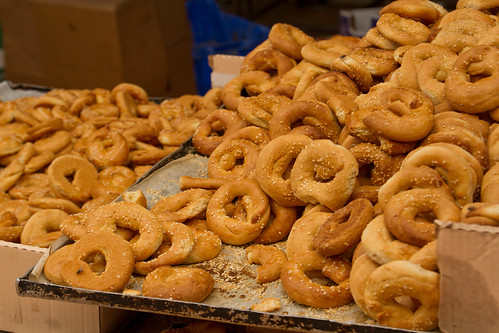
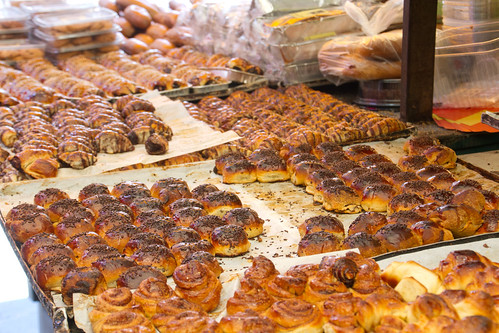
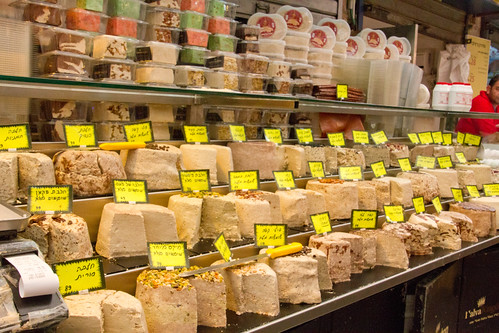
A great selection of fresh pastries. See the rugelach on the back (you'll find my two rugelach recipes when clicking on the link)?
Mahane-Yehuda market, Jerusalem, Israel

Halva Kingdom had couple of stalls at the market. Halva Kingdom has been making and selling home-made halva in Jerusalem since 1947, and opened a stall at the Mahane-Yehuda market back in 1986. They sell over 100 different halva flavours and types (we had a chance to nibble a mocca-flavoured one, which was lovely). Their halva is made using sesame seeds from Ethiopia at a factory in Mishor Edomim industrial settlement. The sesame seeds are ground in a millstone and then mixed with sugar until a sweet and thick paste is formed:
Halva Kingdom @ Mahane-Yehuda market, Jerusalem, Israel

Israeli climate is perfect for growing figs. Again, several varieties are grown across the country, the one on the photo should be honey-sweet and pale pink Byadi. I had a chance to eat them later during the week again (and that's where I was told the variety of figs), and they're extremely soft and luscious and sweet.
Mahane-Yehuda market, Jerusalem, Israel - the fig variety is Byadi, I believe

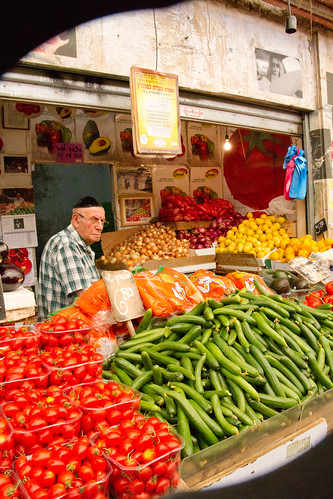
A fresh vegetable stall:
Mahane-Yehuda market, Jerusalem, Israel

I was bemused by the cucumbers at the market. They look exactly like mini versions of our "regular" cucumbers - shiny, long, smooth and slim, just much smaller. Our "small" cucumbers that we eat a lot during the summer - 10-12 cm in length, crunchy and crisp as they are - are prickly and chunky, like you can see on the third photo in this old post of mine. Mahane-Yehuda market, Jerusalem, Israel

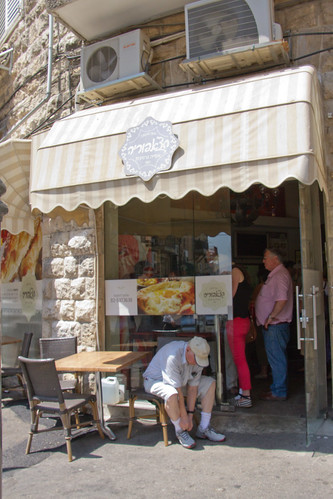
Getting hungry was inevitable with all that fresh and delicious-looking food all around us, so Zvi led us to the Iraqi market (built in 1931) and more specifically, to a wonderful Georgian café Hatchapuria (5 HaShikma St, established in 2009):
Mahane-Yehuda market, Jerusalem, Israel

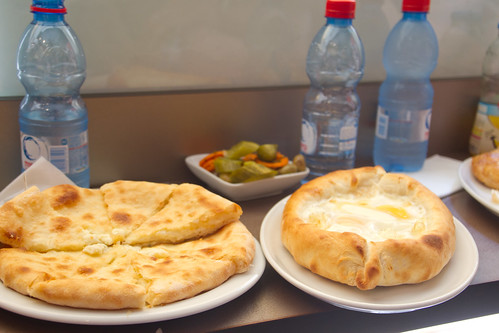
The shopkeeper Tango Shavit (pictured left) treated us to three different types of Georgian cheese bread - hatchapuri (the traditional bread with cheese in the middle), acharuli (the boat-shaped open-top bread filled with cheese and topped with an uncooked egg that you mix yourself with into the very hot cheese filling) and magaruli (a simple hatchapuri that's topped with cheese and baked until crisp), as well as some Georgian pickles and the popular sweetmeat - walnuts dipped into thickened grape syrup and hanged to dry (churchkhela, pictured on the left).

Khatchapuri @ Mahane-Yehuda market, Jerusalem, Israel

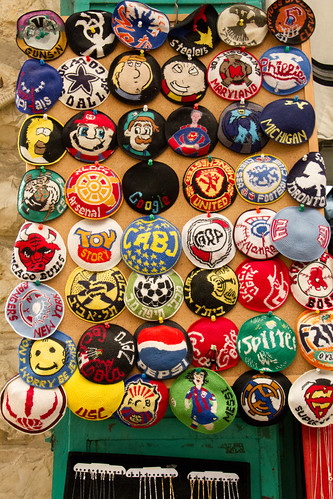
Some funny crocheted kippah/kipa skullcaps were also available at the market: Mahane-Yehuda market, Jerusalem, Israel

Similar posts:
FoodBridge on Mahane-Yehuda market and our tour of Jerusalem (an Israeli foodblog written by US-born Sarah)
The Kitchn on Mahane-Yehuda market (post by Cambria Bold)
Other posts about my trip to Israel.

If you're visiting the market and want some guidance, then this English-language website dedicated to the market might be a good place to start.

Disclaimer: I spent six days in Israel in late June/early July as a guest of a non-profit social start-up Kinetis, more specifically their Vibe Israel programme. This particular trip hosted five international food bloggers and writers, introducing them to the multifaceted and pluralist Israeli culture and cuisine.