Showing posts sorted by date for query barley. Sort by relevance Show all posts
Thursday, November 06, 2014
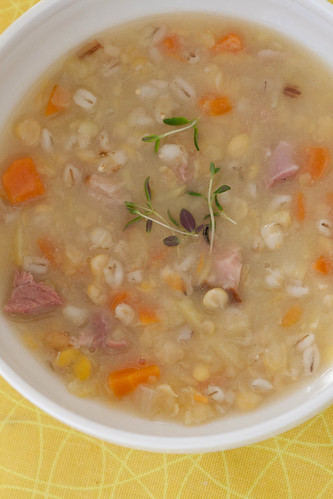
Estonian lamb soup with cabbage
Time for soup! Earlier this year I came across a recipe for Islandic lamb and cabbage soup in the blogosphere. Lovely soup and justifiably popular - and almost identical to the Estonian way of making lamb and cabbage soup. Not surprising, giving the fact that both Iceland and Estonia are "up North" and the range of vegetables traditionally available is pretty similar.
It's a simple and rustic soup, as many Estonian soups are. Hope it'll become as well and widely known as the Icelandic one ;)
Note that it's even better on the next day, so feel free to make it a day or two in advance.
Lamb soup with cabbage
(Kapsasupp lambalihaga)
Serves 6 or more as a main dish
500-750 g of lamb on the bone (shank, neck, ribs)
2 l (8 cups) water
salt and black pepper
1 medium head of cabbage
2 medium sized onions, chopped
a handful of pearl barley, soaked (optional)
3-4 carrots, sliced
5-6 potatoes, cut into chunks
fresh dill, finely chopped
Place the meat into a large saucepan, pour in enough cold water to cover. Bring into a rolling boil, let boil for a few minutes. Then drain the whole lot over a colander. Rinse the saucepan thoroughly, return to the hob.
Rinse the meat under a cold running water to remove any impurities. Return to the saucepan. Add 2 litres of water and bring slowly into a boil.
Add the peppercorns and a generous pinch of salt. Bring into a boil, then reduce heat and simmer on a low heat for about 1,5-2 hours, until the meat is really tender and easily falls off the bones. (Skim off any fat or scum that appears at the top of the soup with a slotted spoon). Remove the meat from the soup, put aside.
Now add the onions and shredded cabbage into the pot, and simmer for about 30 minutes (if using pearl barley, then add it alongside onions and cabbage). Add carrots and cook for 15 minutes. Add potatoes and simmer until carrots and potatoes are cooked.
While the vegetables are cooking, remove the meat from the bones and cut the lamb into small pieces. Return the meat into the broth and re-heat thoroughly. Season to taste, sprinkle with dill and serve.
Similar recipes:
Icelandic lamb soup @ TastyTrix
Icelandic lamb soup @ Diary of a Tomato
Irish lamb stew with a twist @ Simply Recipes
Scotch broth @ Milk and Mode
Lambalihasupp aedviljadega @ KÖÖK (recipe in Estonian)
Friday, October 24, 2014
Home-made granola recipe
This was originally posed in January 2009. I'm reposting this with new photos.
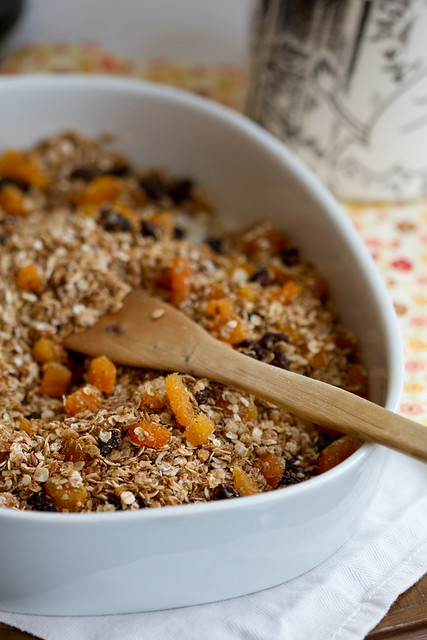
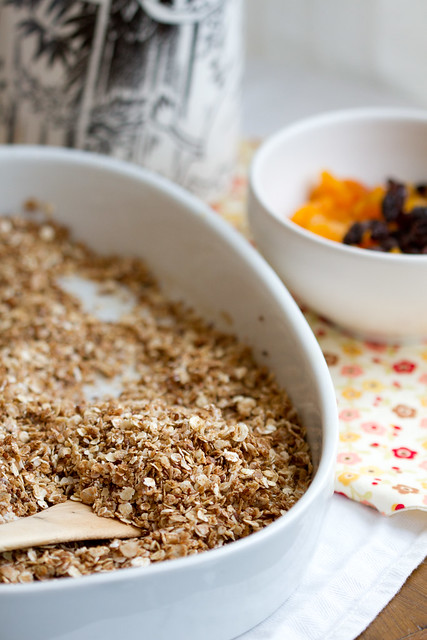
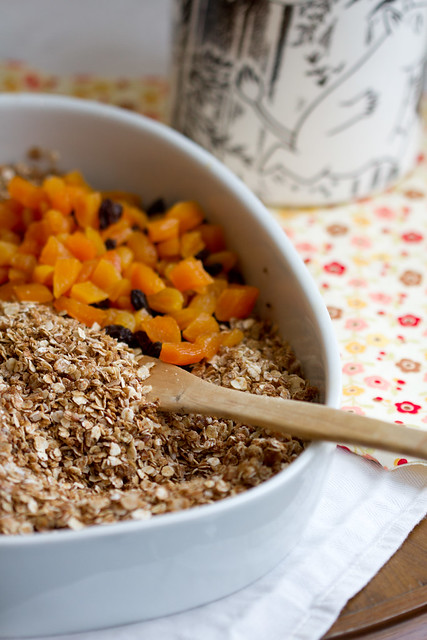
I'm not sure why it took me so long to make my own granola to sprinkle on yogurt for breakfast, considering how incredibly easy it is! The recipe below is a mixture of various ideas, and it's pretty simple. I'm especially fond of the addition of malt extract* that I got from Moosewood granola recipe included in the Moosewood Restaurant New Classics - it adds a lovely, well, malted flavour to the end product. I've used a mixture of chopped apricots, seedless raisins and dried cranberries to 'buff up' my granola, but the choice of dried fruit is obviously yours.
What do you do? Make your own granola/müsli or buy from a shop? If you buy, then what's your favourite brand/type? Just curious :)
Home-Made Granola
(Kodune krõbe müsli)
Makes enough for 2 persons for a week

100 g old-fashioned rolled oats (about 1 cup)
3 Tbsp dark muscovado sugar
5 Tbsp unsweetened coconut flakes
1 Tbsp flax seeds/linseeds
1 tsp cinnamon
3 Tbsp neutral-flavoured oil
2 Tbsp water
1 Tbsp malt extract
To 'top up':
half a cup or so chopped dried apricots or prunes or dried cranberries or seedless raisins
Mix the oats, sugar, coconut flakes, linseed and cinnamon in a bowl. Stir in molasses extract, oil and water, stir to combine.
Line a small baking tray with a parchment paper and spread the granola mixture on top.
Bake in a pre-heated 200 C/400 F oven for 15 minutes, stirring once or twice while baking, until the granola is golden and very aromatic (it will crispen up after you take it out of the oven).
Take out of the oven and cool completely, then stir in the chopped dried fruit.
Keep in a closed jar and serve with your breakfast yogurt or milk.
* Moosewood recipe uses "barley malt syrup or unsulphured molasses", explaining that "Barley malt is a liquid made from fermented barley and often used in baking bread. We use it here for sweetness and moisture. If unavailable, any unsulphured molasses except blackstrap will work fine". I used a local product which is meant for brewing your own beer at home, but is also widely used for baking bread at home.
Sunday, July 06, 2014
Festival food: Estonian Song and Dance Celebration 2014

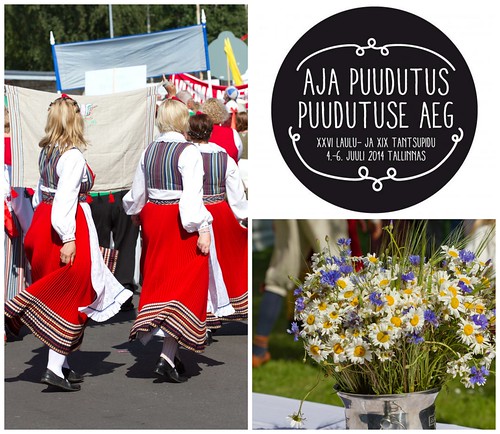
This is a very special weekend for Estonia - our 26th Song Celebration and 19th Dance Celebration takes place. You'll get all the necessary information on this website, I'll focus on food here ;)
It's a huge festival - with about 100 000 people gathered at the Song Festival Square, among them over 20 000 singers! You can imagine the amount of food you need to feed all those people during the weekend :)
Festival food isn't usually known for its gastronomic finesse and wonderful flavour, but the food I saw yesterday at the Tallinna Lauluväljak (Song Festival Square) was pretty interesting. Here's a short overview for you, should you head to the celebrations today.
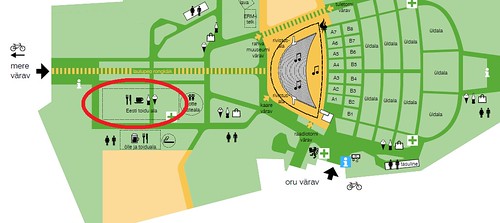
The main eating area is marked with the red circle on the map below. "Merevärav" marks the "sea entrance" on Pirita road, so in case you're hungry, you should head to the right after entering the Song Festival grounds:
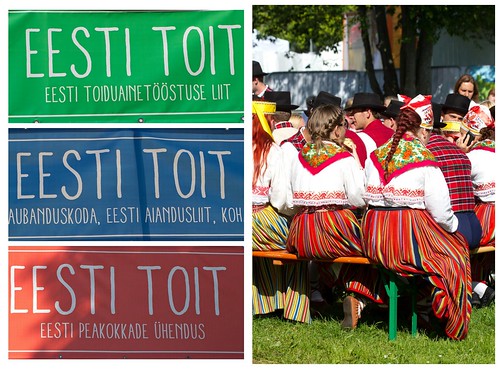
It's also where the EESTI TOIDU VÄLJAK aka Estonian Food Court is located. This consists of three large tents, marked by coloured signs. The Green sign marks the tent that represents the Estonian Food Industry Association. The tent with a Blue sign hosts the local small producers, Estonian Horticultural Association and the Estonian Chamber of Agriculture and Commerce. The Red signs marks the Estonian Chefs Association.

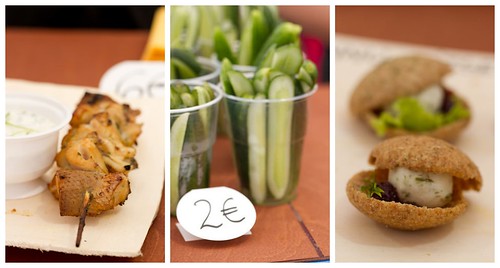
Let start with the "Blue" tent (well, the tent is white, the sign is blue :)), hosting the small/artisanal/local producers. You could feast on "haugišašlõkk" (pike shashlik, type of white fish), "soolakurgid" or fresh salted cucumbers, or small goat cheese and rye crisp "burgers":
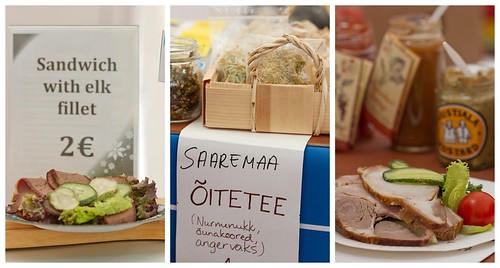
Saaremaa is the biggest island in Estonia and they're increasingly becoming big players on the culinary scene as well. What about sandwich with elk fillets, a floral tea mixture (primrose, apple and meadowsweet), or smoked pork and rye sandwich?
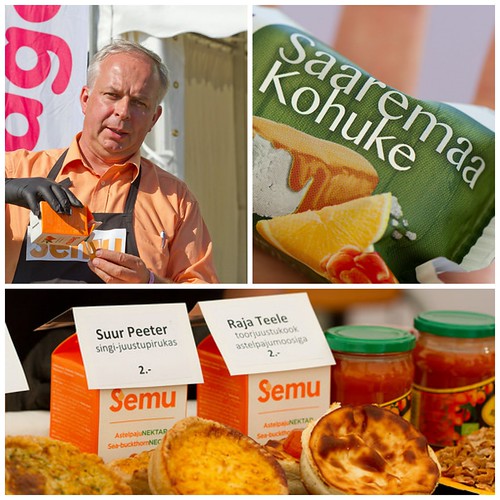
The "Green" tent hosted several big food producers, including Saaremaa Delifood that introduced their new "kohuke" (curd cheese bar, top right) with cloudberries and lemon as well as Semu with their really nice sea-buckthorn drinks.
Finally, the "Red" tent, hosting the representatives of Estonian Chefs Association. There were three catering companies present, Tervise Catering, Event Catering and House Gourmet. Some of the festival food items were flatfish terrine with roasted vegetables (lestavorm röstköögiviljadega); pulled lamb with wild-garlic pearl barley (rebitud lammas karulaugu-odrakruubiga); hot smoked perch with tomato-cucumber salad (suitsuahven tomati-kurgisalatiga):

Pike fishcakes with curd cheese and cucumber dressing (haugikoogid kohupiima-kurgikastmega, below left). You could also a buy a selection of six dishes for 6 Euros (below right):

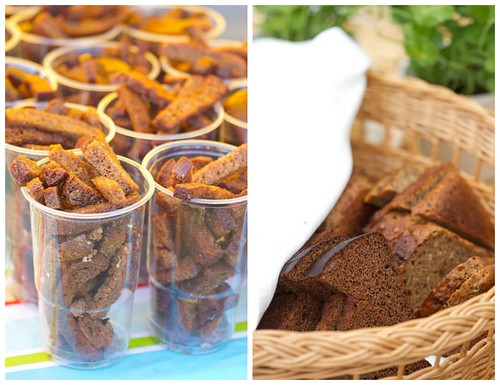
This being Estonia, black rye bread was served everywhere - either fresh (below right) or as garlic bread (below left; yes, that's what you'd get if you ask for garlic bread (küüslauguleib) in a pub in Estonia).

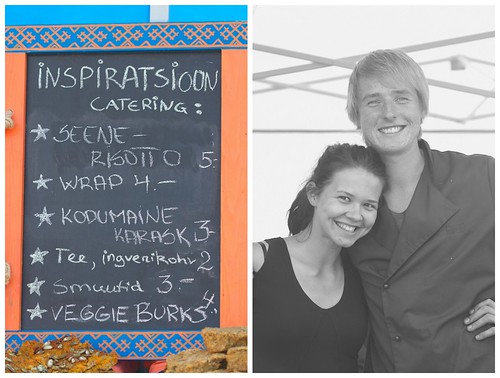
There's food outside the Estonian Food Court as well. I spotted these happy people from soon-to-be-opened Inspiratsioon Catering, serving vegetarian, vegan and gluten-free food:

I didn't have a chance to look into the big "beer and food" area, where many food stalls were located, but overall I can say the food was pretty decent for a festival food :)
What type of food did you have last time at a music festival?
Sunday, January 26, 2014
Sauerkraut with pork and barley (Mulgi kapsad)

Mulgi kapsad aka mulgikapsad is a traditional dish from Southern Estonia, consisting of pork, sauerkraut and barley (either pearl barley or barley groats). It doesn't sound much - but it's another one of those dishes that tastes much more and better that you'd imagine when looking at the (short and rather bland) list of ingredients. It's also cheap, filling and substantial, a perfect winter dish, which deserves attention outside Estonia as well. Hence this blog post.
You'll need fresh sauerkraut for this dish. When I say "fresh sauerkraut", I mean the uncooked, fermented and unpasteurized sauerkraut. Look for "barrel cured" sauerkraut, not the "wine cured", and find it either in Eastern European stores or in your local health food store. Or ferment your own! :)
* PS This dish is wheat-free. If you want a gluten-free version, then feel free to use porridge/pudding/risotto rice instead of barley.
Sauerkraut with pork and barley
(Mulgikapsad)
Serves 6 to 8
1 kg fresh sauerkraut
0,5-1 kg fatty pork (belly or Boston butt/shoulder)
200 g pearl barley, rinsed and drained
about 500 ml (2 cups) water
salt, to taste
sugar, to taste (optional)
Cut the meat into bite-sized pieces.
Spread the sauerkraut at the bottom of the pot, then top with meat cubes, and scatter barley on top:

Now sprinkle with salt (about half a teaspoon should be enough in most cases) and pour over enough water to barely cover the ingredients. Cover with the lid, bring into a boil. Reduce heat and simmer gently for about 2-3 hours, until the food is done. NO NEED TO STIR IT, though you may want to peek under the lid couple of times and add a little water, if it seems too dry. (You can also cook it in the moderate oven, if you prefer).
This is how it'll look like when done - the pearl barley has swollen and the meat is tender:
It's only now that you're supposed to give it a good stir, so the sauerkraut, barley and pork would be nicely and evenly distributed:
Taste for seasoning - if you need, add a bit more salt. Some people add a bit of sugar as well, but I don't - it all depends on the flavour of your sauerkraut. Mulgi kapsad is not supposed to be sweet-and-sour, but you may need some sugar to balance the acidity, if your cabbage is very sour.
Serve with boiled potatoes, with a good dollop of nice thick sour cream on the side, if you wish.

Other bloggers writing about mulgikapsad:
Kiilike köögis (recipe in Estonian)
kokkama.blogspot.com (recipe in Estonian)
The Kitchen Mouse (recipe in English)
Estonian Cooking and Eating (recipe in English; some helpful comments there)
Emmanuel Wille (recipe in Estonia; slightly fancier "restaurant-style" version)
Talerka (recipe in Russian)
Suhkrusai (recipe in Estonian)
Ave köök (recipe in Estonian)
Sille toidublog (recipe in Estonian, she uses turkey)
Minu kodunurk (recipe in Estonian)
Silgud ritta (recipe in Estonian)
Igapäevane kokakunst (recipe in Estonian)
Tuesday, February 12, 2013
Lenten buns aka semlor aka vastlakuklid 2013

It's Shrove Tuesday or Fat Tuesday today, which means pancake feasts in many places across the world. In Estonia and other Nordic countries, however, this means eating lenten buns (semla, vastlakukkel) instead. I baked a batch of these wonderful buns, filling them with whipped sweet cream this year. No marzipan, no jam.
You'll find all my Lenten recipes here., including recipes for barley and bacon porridge and split pea soup with smoked pork.
Monday, February 11, 2013
Estonian recipes: yellow split pea soup with smoked pork (hernesupp suitsulihaga)
Originally posted in February 2012, slightly edited.

It's Shrove Tuesday tomorrow, and before feasting on delicious Lenten buns (I've blogged about the classic ones, chocolate ones and luscious raspberry and marzipan ones), Estonians eat split pea soup. Thick, hearty, well-flavoured (smoked pork!) and textured (peas + pearl barley) - all the elements of a substantial and delicious winter soup are present. Here's a recipe that I've been using for years to make a big (I mean it!) pot of delicious soup.
It's a fusion recipe, of a kind. You see - apparently in the Southern Estonia, they used to put barley in the split pea soup; in the North, they replaced the pearl barley with cubed carrots and potatoes. I use them all, so it's a meet-me-in-the-middle soup :)
Note that the soup reheats very well. As it thickens when cooling, you may need to add some water when reheating it, and adjusting the seasoning again, if necessary.
Estonian Yellow Split Pea Soup with Smoked Pork
(Hernesupp suitsulihaga)
Serves eight to ten

200 g yellow split peas
150 g pearl barley
3 litres of water
about 1 kg of smoked pork - rib, cheek or hock
1 large onion
2 to 3 large carrots
2 large potatoes
salt to taste
2 to 3 tsp sharp mustard (or to taste)
fresh herbs (parsley, celery, dill, thyme, savory)
ON THE PREVIOUS NIGHT OR IN THE MORNING:
Pick through the peas and pearl barley to remove any grit. Place into a bowl, pour over enough cold water to cover by couple of centimetres and leave to soak. (This reduces the cooking time considerably).
ON THE DAY:
Place the smoked pork into a large bowl (definitely larger than 5 litres!). Add the 3 litres of water and bring slowly into a boil. Remove any froth and scum that appears on the surface.
Rinse the soaked barley and peas, drain and add to the saucepan. Bring to a boil again, then reduce heat, cover with a lid and simmer gently for about an hour.
Meanwhile, peel and chop (or grate coarsely) the onion, carrots and potatoes. If you wish, you can sauté the onion and carrots in some oil - this enhances the flavour.
Add the vegetables to the soup and continue simmering for about half an hour, until the meat and vegetables are fully cooked.
Take the pork out of the soup, remove the meat from the bones and chop finely. Return the chopped meat into the saucepan.
Season the soup with mustard and salt, add some herbs of your choice and serve.
Thursday, August 30, 2012
Average Betty makes traditional Estonian barley bread
Remember my recent post about a quirky American foodblogger, Sara o'Donnell aka Average Betty, visiting Estonia? Well, she's now back home, and going through all the lovely recipes served at our party and mentioned in my post (or at least that's what I'd love to think :)). She has also posted her first Estonian recipe video on her very popular YouTube channel, where she makes and bakes the delicious and simple Estonian barley bread, odrajahukarask.
Here's the link to Average Betty's YouTube recipe video* - do check it out, it's very informative and entertaining at the same time.
Sara uses a recipe from Marika Blossfeldt's excellent book Essential Nourishment: Recipes from My Estonian Farm. and the bread on Sara's photo (on the left) and on the video looks just perfect.
Here are links to some other blog posts written by Sara about her trip to Estonia:
Estonian epicures and how to choose wine infographic (August 3)
My day with chef Dimitri Demjanov (August 20)
Traditional Estonian barley bread recipe (August 29)
Leib: Estonian for Bread (August 30)
* Note that while the soda bread/barley bread Average Betty is making is traditionally Estonian, the music at the beginning and at the end of the video is definitely not. Sara was here during the Old Town Festival, and wandering around our beautiful Town Hall Square while some Russian babushkas were on the stage, singing :)
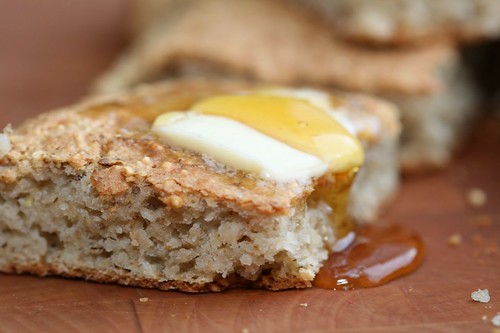
Once you've tried Sara's/Marika's recipe for the traditional soda bread, remember that you'll find two more recipes for the Estonian barley bread/soda bread here on Nami-Nami.
Estonian soda bread/barley bread with kefir or cultured buttermilk:
Estonian barley bread with ricotta:

Feel free to browse all the Estonian recipes here on Nami-Nami.
Here's the link to Average Betty's YouTube recipe video* - do check it out, it's very informative and entertaining at the same time.
Sara uses a recipe from Marika Blossfeldt's excellent book Essential Nourishment: Recipes from My Estonian Farm. and the bread on Sara's photo (on the left) and on the video looks just perfect.
Here are links to some other blog posts written by Sara about her trip to Estonia:
Estonian epicures and how to choose wine infographic (August 3)
My day with chef Dimitri Demjanov (August 20)
Traditional Estonian barley bread recipe (August 29)
Leib: Estonian for Bread (August 30)
* Note that while the soda bread/barley bread Average Betty is making is traditionally Estonian, the music at the beginning and at the end of the video is definitely not. Sara was here during the Old Town Festival, and wandering around our beautiful Town Hall Square while some Russian babushkas were on the stage, singing :)
Once you've tried Sara's/Marika's recipe for the traditional soda bread, remember that you'll find two more recipes for the Estonian barley bread/soda bread here on Nami-Nami.
Estonian soda bread/barley bread with kefir or cultured buttermilk:

Estonian barley bread with ricotta:

Feel free to browse all the Estonian recipes here on Nami-Nami.
Monday, July 30, 2012
Average Betty was here!
Are you familiar with the American food blog called Average Betty? It's written by a lovely 30-something LA-based woman called Sara O'Donnell, who is even more known for her witty and catchy recipe channel Average Betty on YouTube.
She was visiting Estonia last week and I had the chance to meet her and throw a party for her and her husband. It was supposed to be a garden party (my dear K. even managed to excuse himself from my aunt's husband's 65th birthday party as he had to mow the lawn and make sure the garden looks all nice and pretty when Sara and the guests arrive ;)), but alas, the weather wasn't on our side. Luckily we managed to fit all the 18 adults and numerous kids into our house as well.
While I regularly entertain rather big groups of people at our home, I decided to play it safe this time and organise a potluck party instead, asking each local guest to contribute a dish. We did agree beforehand that the dish has to be pretty Estonian and more or less summery, and we ended up with a rather lovely spread, if I may say so myself. I think Sara and Lee agree, and I saw them at least tasting each of the numerous dishes - quite an achievement considering that they came to the party straight from the meeting with a famous local chef Dmitri Demjanov, which included a full meal at one of his restaurants.
Sara and me checking out some of the delectable dishes available.
I had invited a group of local food bloggers to the party, as well as my favourite pastry chef and good friend Heidi Park (who just happens to be an American based in Tallinn) and another good Estonian friend who currently resides in Washington DC (but is visiting home for a few weeks). The local bloggers were a mix of good foodblogging friends and some rising local foodblogging stars, and based on the quality of the dishes they brought along, I just might invite them over again soon ;)
Here's the bi-lingual menu (ignore the bottom part of the blackboard. I told you the house was full of kids ;))

On the photo below you see a beetroot salad (thank you, Mann!), a salt pork and onion flatbread, specialty on our largest island, Saaremaa (baked by Kirsike). Fried Baltic herring and a sour cream dip was brought along by Vernanda, the barley soda bread by Tuuli (I've blogged about this delicious Estonian bread here). You can get a glimpse of various local charcuterie on the left and of local artisanal cheese at the bottom. Finally, there's a selection beautiful tomatoes from our greenhouse (various cherry tomatoes - mainly Suncherry and Sungold varieties - are in a beautiful white bowl designed by a young Israeli Tal Zur of Studio Trixie), large tomatoes are next to chopped green Siberian chives, all from our garden as well:

Here's Sara taking photos of our cute tomatoes (she's a foodblogger, after all):
See that pale blue enamel pot just behind the charcuterie selection on the photo below? The pot contains a huge pile of delicious breaded and fried turkey steaks in marinade. These were made and brought along by Ragne, and it's a lighter version of this popular Estonian pork dish.
Marinated saffron milkcaps, courtesy of my K's mum:
I baked one of my favourite chantarelle quiches, flavoured with tarragon and paprika (recipe in Estonian):
Other savoury dishes included a wonderful Estonian rye bread and herby home cheese (Tuuli) and a layered smoked ham, egg and cucumber salad (Kätrin).
Sara looks happy with a glass of Estonian bubbly (see note at the end of the post), and our son is helping himself to some of the dishes:
We obviously also had quite a few sweet dishes, though in the midst of the hustle and bustle we forgot to photograph them all :) Heidi, the Tallinn-based American pastry chef, brought along a passionfruit cheesecake - a perfect balance of acidic fruit and sweet cheesecake. Kirsike made a batch of toffee-covered kama cereal balls (Estonian recipe here), and my friend Liis brought along a proper Estonian kringel (baked by her sweet diplomat husband Kristjan, who couldn't make it to the party himself), and Kätrin made a küpsisetort, a layered Estonian cookie cake (I've posted a recipe for my favourite version here).
Kaare, who drove to the party all the way from Tartu, brought along a very popular curd cheese cake - a shortcrust base, with a raisin and curd cheese topping:

Oh, and there was also a bowl of wonderful sweet-yet-tart yellow gooseberries that Triin brought along from Tartu.
Finally, I'd love to say a huge thank you to our drinks sponsors. Coffee was provided by Nami-Nami's long-time supporter Meira, who's also representing Segafredo Zanetti coffees in Estonia. Meira kindly gave us a Segafredo capsule coffee machine for the party (a huge thank you also to our barista Natalie :))
A le Coq sent us a selection of juices (plum nectar, banana-pear nectar and orange juice) and their Organic Beer (the first locally produced organic beer in Estonia)! By the way, the banana-pear nectar has two of Nami-Nami's recipes printed on each carton :):
There was another first-and-only at the party. We enjoyed chilled FEST - the first Estonian sparkling fruit wine, made from local apples. This semisweet apple wine is definitely very squaffable, if you ask me :) A huge thank goes to the producer, Põltsamaa FELIX. Another local drink company - Värska Vesi - had just re-introduced their mineral waters and still and sparkling drinking waters in beautiful glass bottles, and they kindly sent us a box of each.

All in all, I hope that Sara and her husband had great time in Estonia and that we managed to make them feel very welcome here.
While I regularly entertain rather big groups of people at our home, I decided to play it safe this time and organise a potluck party instead, asking each local guest to contribute a dish. We did agree beforehand that the dish has to be pretty Estonian and more or less summery, and we ended up with a rather lovely spread, if I may say so myself. I think Sara and Lee agree, and I saw them at least tasting each of the numerous dishes - quite an achievement considering that they came to the party straight from the meeting with a famous local chef Dmitri Demjanov, which included a full meal at one of his restaurants.
Sara and me checking out some of the delectable dishes available.
I had invited a group of local food bloggers to the party, as well as my favourite pastry chef and good friend Heidi Park (who just happens to be an American based in Tallinn) and another good Estonian friend who currently resides in Washington DC (but is visiting home for a few weeks). The local bloggers were a mix of good foodblogging friends and some rising local foodblogging stars, and based on the quality of the dishes they brought along, I just might invite them over again soon ;)
Here's the bi-lingual menu (ignore the bottom part of the blackboard. I told you the house was full of kids ;))

On the photo below you see a beetroot salad (thank you, Mann!), a salt pork and onion flatbread, specialty on our largest island, Saaremaa (baked by Kirsike). Fried Baltic herring and a sour cream dip was brought along by Vernanda, the barley soda bread by Tuuli (I've blogged about this delicious Estonian bread here). You can get a glimpse of various local charcuterie on the left and of local artisanal cheese at the bottom. Finally, there's a selection beautiful tomatoes from our greenhouse (various cherry tomatoes - mainly Suncherry and Sungold varieties - are in a beautiful white bowl designed by a young Israeli Tal Zur of Studio Trixie), large tomatoes are next to chopped green Siberian chives, all from our garden as well:

Here's Sara taking photos of our cute tomatoes (she's a foodblogger, after all):

See that pale blue enamel pot just behind the charcuterie selection on the photo below? The pot contains a huge pile of delicious breaded and fried turkey steaks in marinade. These were made and brought along by Ragne, and it's a lighter version of this popular Estonian pork dish.
Marinated saffron milkcaps, courtesy of my K's mum:

I baked one of my favourite chantarelle quiches, flavoured with tarragon and paprika (recipe in Estonian):
Other savoury dishes included a wonderful Estonian rye bread and herby home cheese (Tuuli) and a layered smoked ham, egg and cucumber salad (Kätrin).
Sara looks happy with a glass of Estonian bubbly (see note at the end of the post), and our son is helping himself to some of the dishes:
We obviously also had quite a few sweet dishes, though in the midst of the hustle and bustle we forgot to photograph them all :) Heidi, the Tallinn-based American pastry chef, brought along a passionfruit cheesecake - a perfect balance of acidic fruit and sweet cheesecake. Kirsike made a batch of toffee-covered kama cereal balls (Estonian recipe here), and my friend Liis brought along a proper Estonian kringel (baked by her sweet diplomat husband Kristjan, who couldn't make it to the party himself), and Kätrin made a küpsisetort, a layered Estonian cookie cake (I've posted a recipe for my favourite version here).
Kaare, who drove to the party all the way from Tartu, brought along a very popular curd cheese cake - a shortcrust base, with a raisin and curd cheese topping:

Oh, and there was also a bowl of wonderful sweet-yet-tart yellow gooseberries that Triin brought along from Tartu.
Finally, I'd love to say a huge thank you to our drinks sponsors. Coffee was provided by Nami-Nami's long-time supporter Meira, who's also representing Segafredo Zanetti coffees in Estonia. Meira kindly gave us a Segafredo capsule coffee machine for the party (a huge thank you also to our barista Natalie :))
A le Coq sent us a selection of juices (plum nectar, banana-pear nectar and orange juice) and their Organic Beer (the first locally produced organic beer in Estonia)! By the way, the banana-pear nectar has two of Nami-Nami's recipes printed on each carton :):
There was another first-and-only at the party. We enjoyed chilled FEST - the first Estonian sparkling fruit wine, made from local apples. This semisweet apple wine is definitely very squaffable, if you ask me :) A huge thank goes to the producer, Põltsamaa FELIX. Another local drink company - Värska Vesi - had just re-introduced their mineral waters and still and sparkling drinking waters in beautiful glass bottles, and they kindly sent us a box of each.

All in all, I hope that Sara and her husband had great time in Estonia and that we managed to make them feel very welcome here.
Tuesday, February 21, 2012
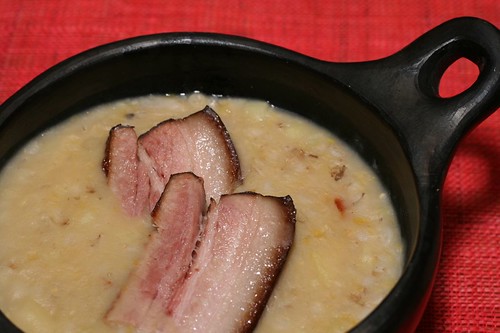
Estonian recipes: Barley with Smoked Pork (vastlapuder)

February 2012
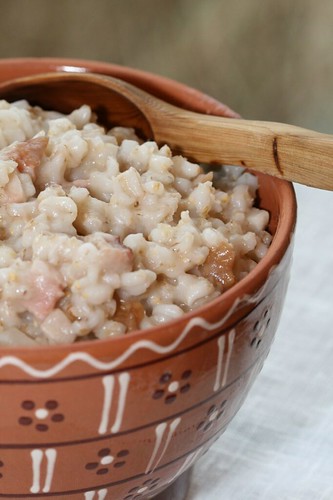
It's Shrove Tuesday today, and I'm sharing a traditional Estonian Shrove Tuesday recipe with you. You'll need exactly three ingredients - pearl barley, smoked pork and water (and some salt to taste, if necessary). Cheap, simple, filling, flavoursome, and surprisingly delicious :)
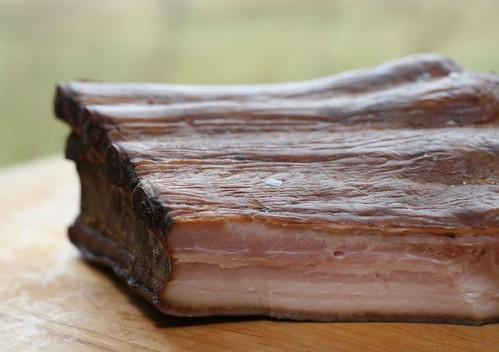
You'll need a good chunk of smoked pork - ribs are perfect, though I've often used a fattier smoked cheek. This particular piece of meat is called maasuitsuribi (country-smoked ribs) in Estonian:

Note that this porridge reheats rather well - just slowly warm it until piping hot on your frying pan. I like to serve this with some sour cream.
Barley Porridge with Smoked Pork
(Vastlapuder)
Serves four to six

200 g smoked pork (rib, cheek or thickly cut bacon)
175 g pearl barley, rinsed and drained
1 l boiling water
salt, to taste
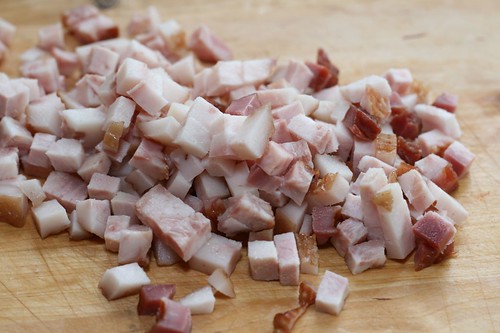
Cut the smoked pork into dice:

Fry the pork cubes in a heavy saucepan over moderately high heat, until browned and slightly crispened. (Drain off the excess oil, if necessary - various cuts of pork are rather different. Leave about a tablespoon or two of pork fat).
Add the pearl barley and sauté for about a minute, stirring.
Add the boiling water. Reduce heat, cover the pan with a lid. Simmer on a low heat for about an hour, stirring couple of times, until the barley is just ever so lightly al dente (you don't want it to go too mushy).
Taste for seasoning, add some salt, if necessary.

February 2008
MORE DELICIOUS SHROVE TUESDAY RECIPES @ NAMI-NAMI:
Yellow split pea soup with smoked pork
Traditional lenten buns
Lenten buns with raspberries and marzipan
Chocolate-y lenten buns
Wednesday, November 09, 2011
Things to do with (Estonian) black pudding aka verikäkk
Someone left a comment on my blog this morning:
Just brought back home from Estonia some Verikäkk and still wondering what to do exactly with it :D Aitäh also from Spain for your blog ;)
I thought I'll help Enlil out and share some of the recipe ideas and photos with him :)
Verikäkk is basically a dense black pudding (also known as blood pudding or blood dumpling). It's a mixture of (usually pig's) blood, flour (rye, barley or wheat), fried onions, lard/bacon and seasonings. Here in Estonia it's sold widely, and it comes in large dumplings, weighing about 450 grams. Traditionally it was made in late Autumn/for Christmas, but is now available throughout the year. I personally don't think of verikäkk as a Christmas product at all (as opposed to verivorst or black sausages), and happily buy it all year round.
Here are some of the ways of consuming black pudding.
Fried black pudding with sour cream:

1 black pudding
lard, butter or oil for frying
250 g sour cream
Cut into thick (about 1 cm) slices, fry in butter until browned and crisp on both sides. Pour the sour cream on top at the end and heat gently. Serve at once.
Pickled pumpkin salad and lingonberry or cranberry jam/sauce work well as condiments.
Fried black pudding:

1 black pudding
lard, butter or oil for frying
Cut into thick (about 1 cm) slices, fry in butter until browned and crisp on both sides. Serve with a dollop of sour cream and/or lingonberry jam. (If you forgot to buy that in Estonia, then head to your nearest IKEA food isle).
Fried black pudding crisps:

I've already blogged about this, see recipe here.
MÕNED EESTIKEELSED VIITED:
Ülle tore ood verikäkile
UMA MEKK video verikäki tegemisest
Subscribe to:
Posts (Atom)