Showing posts sorted by relevance for query kefir. Sort by date Show all posts

Friday, June 20, 2008

Cold Kefir Soup for Hot Summer Days


I start with an apology. I cannot remember where I got this recipe from. But it was in my old recipe card box, and the only note was 'Uzbek recipe?' (refering to Uzbekistan, the country in Central Asia; well, actually it said 'usbeki retsept?' on my recipe card, but you know what I mean). I don't know about that - apart from the Cayenne pepper, it sounds very Estonian to me. And on a hot summer day last week, I made this soup - it took me 5 minutes in total, and I fell in love with it all over again.

If you live in the US, you'll find kefir in Whole Foods and international food stores. Lifeway Foods does a decent one. Here's what they've got to say about kefir:

A creamy probiotic dairy beverage similar to but distinct from yogurt. Lifeway believes it offers the largest selection of kefir in the world. Low-fat or non-fat pasteurized milk is the basic ingredient in kefir. Its effervescent quality stems from the kefir culture, which contains ten active "friendly" microorganisms, compared to two or three in yogurt.

What I've got to say about this soup, is following: it takes 5 minutes to put together; it tastes fresh and refreshing; it's highly versatile - you can use any herbs you like or have around; it looks pretty gorgeous; it's good for you; it's very easy to digest :)

Cold Kefir Soup
(Külmsupp usbekkide moodi)
Serves 4

1 litre of plain kefir
250 ml/1 cup cold water
salt
Cayenne'i pepper
2 green 'English' cucumbers
1 bunch of crisp radishes
3 - 4 scallions/spring onions (incl. green parts)
4 Tbsp or more fresh chopped herbs - parsley, dill, coriander/cilantro

Mix kefir and cold water, then season with salt and Cayenne'i pepper to taste.
Wash and dry the cucumbers and radishes, then cut into small cubes or slices. Chop spring onions/scallions and herbs finely. Divide between four soup bowls. (Add an ice cube to each bowl, if it's really hot outside).

Pour the cold kefir mixture over, and serve the soup at once.

See also:
Ximena's El gazpacho de Escolástica, or the best gazpacho in the world
Ajoblanco: the other Spanish chilled soup

Friday, May 22, 2009

Kefir or Buttermilk Pudding with Jam

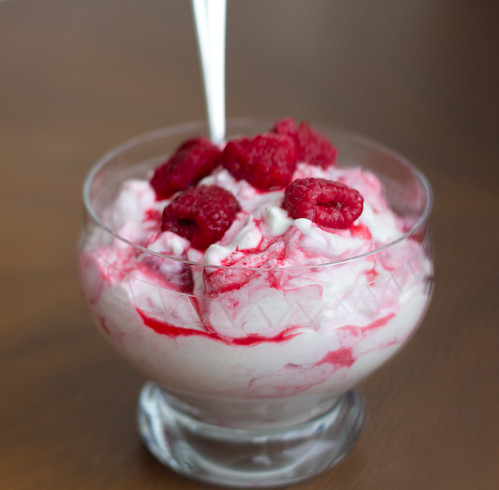
Kephir and raspberry jelly / Keefiritarretis vaarikamoosiga

Here's a delicious pudding I made last November. We use lots of dairy products in Estonia, and drink copious amounts of milk, buttermilk, kefir (and that includes adults). We also eat lots of dairy-based desserts. So it's not surprising that I think of thissimple pudding made with kefir or buttermilk as typically Estonian. For a moment I thought of blogging about it back in November - especially as I quite like the photo - but then I decided it's too humble, you see :) 

However, yesterday I saw a very similar recipe over at Elise's great Simply Recipes site - Buttermilk Pudding - so I thought I hop on the buttermilk pudding bandwagon and post my recipe as well (I actually used kefir to make this particular raspberry pudding, but buttermilk would work just as well). My version isn't as creamy and rich as the one over at Simply Recipes, but it is made with delicious (home-made) raspberry jam. Of course, you can use other type of jam, if you don't fancy the raspberry one.

Did you know that kefir is good for you? The friendly bacteria in kefir can aid in lactose digestion as a catalyst, making it more suitable than other dairy products for those who are lactose intolerant. It can also suppress an increase in blood pressure and reduce cholesterol levels.

Kefir or buttermilk pudding with raspberry jam
(Keefiritarretis maitsva moosiga)
Serves 4 to 6

500 ml (2 cups) kefir or buttermilk
300 g raspberry jam
6 gelatine leaves
4 Tbsp (1/4 cup) water, heated

Place gelatine leaves into a bowl of cold water and soak for 5 minutes. Heat the 4 Tbsp of water. Squeeze the soaked gelatine leaves lightly, then stir into and dissolve in the heated water.
Mix kefir/buttermilk and jam in a bowl. Pour in the gelatine mixture and stir thoroughly.
Divide the pudding between small dessert glasses or ramekins. 
Cover with clingfilm/plastic wrap and place into the refridgerator for at least 4 hours to set.

Thursday, July 09, 2009

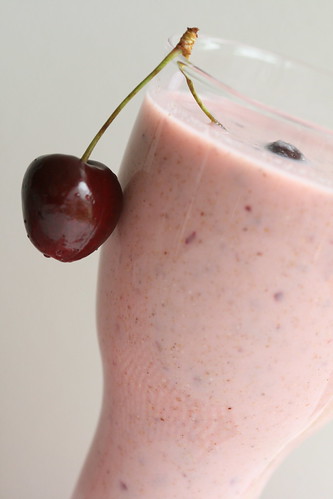
Cherry smoothie with kama and kefir

Kama smoothie / Kama-kirsikokteil e. keefirikokteil kama ja murelitega :)

Here's a quick smoothie I fixed myself yesterday. A large handful of pitted cherries, a cup of kefir*, blended with an immersion blender. I then stirred in 2 Tbsp of the famous Estonian kama mixture, and seasoned the smoothie with a spoonful of agave nectar and a squeeze of lemon. Lovely, and perfect for summer!

What's KAMA??? Read more here.


* If you live in the UK, try looking for kefir in the Polish shops. If you live in the US, you could look for Lifeway Kefir in Whole Foods, Target etc.

(Keefirikokteil kama ja kirssidega)

Sunday, July 08, 2012

Kahvliahvi Kokakool aka Kitchen Monkey's Cookery School


Here's a children's poem in Estonian, written by Heljo Mänd in 1960s, describing small elephant's Bumbu's birthday party in the jungle, where monkeys were eating wafers ("vahvel" in Estonian) and the crocodiles were eating forks ("kahvel" in Estonian). If you combine the monkeys and the forks of this poem, you'll get kahvliahvid aka kitchen/fork monkeys.

Tingel-tangel-tungel,
kära täis on džungel.
Sünnipäev on Bumbul,
elevandijumbul.


Tangel-tungel-tingel,
pidulaual kringel.
Ahvid pistsid vahvleid,
krokodillid kahvleid.


Tungel-tingel-tangel,
limonaad on kange,
jookseb mööda lonti
justkui sada tonti.


Couple of weeks ago I got a phone call from a well-known journalist and party organiser, asking to give a cookery demo to a group of kids and their parents at a small music festival in a small Estonian town of Kilingi-Nõmme.  The workshop, called Kahviahvi Kokakool ("Fork Monkey's Cooking School", or probably better translated as "Kitchen Monkeys"), was to have four cookery sessions/demonstrations, and I was asked to give one of them. I agreed - it was a chance to get out of town and listen to some nice music in fresh air before and after the cooking demo. We were discussing the possible menu options, taking into consideration what the other sessions were focusing on, and finally agreed I'd teach the kids and their parents (26 in total) how to make cold soups. Not your usual gazpacho, mind you, but a kefir and a buttermilk soup, respectively - one savoury, one sweet.

It's summer, after all! As it turned out to be a really hot on Saturday (the music festival and the culinary workshops took place on Saturday, July 7th), cold soups seemed to have been a wise choice indeed :)


My cold summer soup workshop was at 5.30 pm, third one of the afternoon:


I tied the apron strings and was ready to begin. Note the sweet monkey-fork/fork-monkey design:


The kids were all anxiously waiting and ready to start chopping:


We began with the savoury kefir soup. Basically we made this chlodnik, but adding beets/beetroots and grated horseradish was optional, and everybody added some cooked mortadella-style sausages as well, to make the soup a bit more substantial. I must admit that about 3/4th of the kids asked for both the beets and the horseradish, which made me very happy indeed :)

Small (and some slightly bigger) kitchen monkeys in action. Note the high concentration of fathers - at least four - who were accompaning their children:


My role was to make sure everyone has understood the instructions and are progressing nicely:


Cutting the sausages into small dice for the soup requires some serious focusing and concentration:
 

Me, making sure that everyone got some vitamin-rich green onions:

Here's a close-up of the cold kefir soup with scallions/green onions, finely chopped sausages, beets and cucumbers (you can only guess there's beetroot at present at this point, as the stirring of the soup was a serious and time-consuming job as well):


Once everyone had finished making and eating their cold kefir soup, it was time to start making the dessert. I had chosen the wonderfully summery Danish buttermilk and strawberry soup koldskål - you'll find the recipe here on Nami-Nami. We did use kama cereal balls instead of crushed biscuits/cookies, however.

The main component - local Estonian strawberries, which are at their peak just now:


Mint, destined as garnish of the cold buttermilk-strawberry soup (lemon balm works just as well)

 Choosing the prettiest strawberries for the buttermilk-strawberry soup:


Here's our daughter (3 y 5 m) enjoying the buttermilk-strawberry soup she made all by herself:


Thank you, Merle Liivak, Kahvliahvi Kokakool & Schilling, for inviting me! I had a lovely day indeed :)

All photos by my food-blogging friend Liina Vahter .

Monday, July 19, 2010

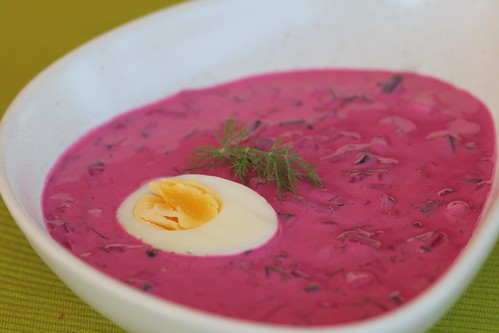
Cold Beetroot Soup (kind of Chlodnik or Холодник)

Cold Russian beet soup / Holodnik / Külm peedisupp

Although the tropical heat wave has given way to a beautiful Estonian summer (temperatures at around 25 C, with some
showers), it's still warm here in Estonia. Perfect excuse for eating lots of cold summer soups. My cold soup repertoire isn't huge, I must admit. I love Ximena's gazpacho (and will be making it again and again in a week or so, when our tomatoes are ready). I also love this simple cold kefir soup with herbs and radishes. But radishes are finished for this year, so I needed a new cold soup recipe. The recipe here is slightly adapted from this Russian foodblog, and we loved both the flavour as well as the stunning colour. Our little daughter, who's almost 1 year and 6 months now, heartily approved as well!!

I love roasting the beets, as this gives them an exceptionally sweet and earthy flavour. If you're short for time, then this works with boiled (and even ready-grated and vacuum-packed) beets as well.

Cold Beet Soup with Kefir
(Külm peedisupp)
Serves four to six

Cold Russian beet soup / Holodnik / Külm peedisupp
3 small beets, each about the size of a tennis ball
2 short green cucumbers ("Lebanese cucumbers")
handful of green onions, chopped
3-4 Tbsp finely chopped fresh dill
1 litre kefir
1 Tbsp grated horseradish
salt, to taste
freshly ground black pepper, to taste
2-4 eggs

Wash the beets, wrap in foil and roast in a 200 C oven for about 45 minutes, until cooked through (test for doneness by piercing with a sharp knife). Cool completely, then peel and grate coarsely.
Hard-boil the eggs, then cool under cold water. Peel and cut into half lengthwise.
Wash the cucumbers, cut into small dice.
Take a large bowl, throw in the grated beets. Stir in some of the kefir, then season the soup base with horseradish and some salt and pepper. Add the rest of the ingredients, except boiled eggs. Taste again for seasoning - you may want to add more salt or pepper, or perhaps even some lemon juice.
Serve very cold, topping each portion with a boiled egg half or two.

Keeps well in the fridge for a day or two.

Wednesday, December 28, 2011

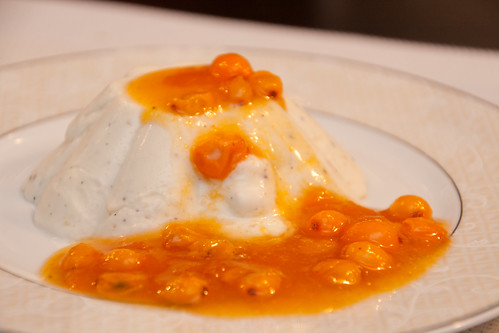
Cardamom panna cotta with apricot and sea-buckthorn sauce

Cardamom pannacotta with apricot and sea-buckthorn topping / Kardemonine pannacotta aprikoosi-astelpajukompotiga

Panna cotta is a dessert that I actually make quite often, even if I've only blogged about it once (Vanilla panna cotta with roasted rhubarb, back in June 2008). It's a good classic Italian dessert that can be served with a number of various toppings and seasoned to your liking.

Here's a rather non-Italian version that is imminently suitable for the festive season. It has a hint of spice in the form of cardamom, and it's much lighter, as some of the cream has been substituted with kefir. Sea-buckthorn berries are one of the new superfoods, and hugely popular and easily available in Estonia. A word of warning - if you taste the panna cotta mixture before you let it set, it may feel too heavy on cardamom. Don't panic, however - the sweet and sour apricot and sea-buckthorn sauce will nicely balance it out.

I like my panna cotta to be on the wobbly side, as they're supposed to be, and I often serve them in a nice glass. If you want a firmer dessert that will hold its shape even after you've turned it onto a plate, you can use some more gelatine.

Cardamom panna cotta with apricot and sea-buckthorn sauce
(Kardemonine kooretarretis aprikoosi-astelpajulisandiga)
Adapted from the Swedish COOP-website
Serves 4

3 gelatine leaves
200 ml whipping cream
2 Tbsp caster sugar
1 tsp ground cardamom
200 ml kefir

Topping:
100 ml (7 Tbsp) smooth apricot jam
100 ml (7 Tbsp) sea-buckthorn berries

Seak the gelatine leaves in cold water for 5 minutes.
Season the cream with ground cardamom, then slowly bring into a boil in a small saucepan. Cook for a few minutes, then remove from the heat and pour in the kefir. Give it a stir.
Squeeze the soaked gelatine leaves to remove excess water, then stir and melt into the cream and kefir mixture, one at a time.
Pour the mixture into individual glasses or ramekins and place into a fridge to set for at least 5 hours.
Before serving, heat the apricot jam gently in a small saucepan. Fold in the sea-buckthorn berries, heat through. Cool a little, then spoon some on top of each panna cotta.

Tuesday, March 01, 2011

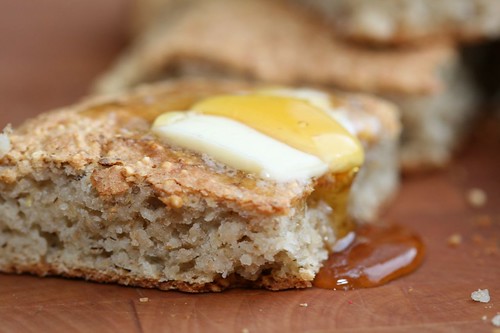
Estonian Soda Bread Recipe

Estonian Soda Bread / Odrajahu-hapupiimakarask

If you think you've already seen a recipe for Estonian soda bread here @ Nami-Nami, then you're not mistaken - I indeed blogged about it some three years ago. However, that recipe was with ricotta/curd cheese, and this one uses kefir or cultured buttermilk. There isn't such a huge taste difference - and they're both quick to make and delicious to eat. Caraway seeds are a traditional flavouring, but if you're not keen on that spice, you can leave it out.

It's best served warm - I usually devour it with some butter and honey (see photo above) or lingonberry jam.

The original recipe is from an Estonian cult baking book, Ida Savi's "Saiad, pirukad, koogid" (1989). I haven't changed it, really, as if it ain't broke, don't fix it :)

Estonian Soda Bread
(Odrajahu-hapupiimakarask)

a 23x23 cm square tin, buttered

250 ml cultured buttermilk, kefir or fermented milk (1 cup)
1 large egg
1 tsp salt
1 tsp caster sugar
2 Tbsp vegetable oil or melted butter
1 tsp caraway seeds
175 g barley flour (about 300 ml, I used wholemeal)
90 g wheat flour (150 ml)
1 tsp baking soda

Pre-heat the oven to 200 C/400 F.
Sift both flours and soda into a bowl.
Whisk the egg with salt and sugar, add the kefir, oil/melted butter, caraway seeds and the flour mix. Stir until just combined.
Pour into a buttered tin and bake in a pre-heated oven for 20-25 minutes, until the soda bread is golden brown on top.

Thursday, December 23, 2010

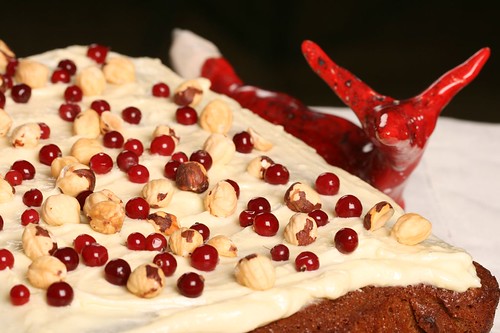
Pehme piparkook or Soft Gingerbread Cake - one of my favourite Christmas cakes

Christmas cake / Pehme piparkook

I've been making this very cake for Christmas for about 6-7 years now, and it's still one of the favourites with friends and family. I made it again for a friend's birthday party last weekend, tuning the recipe a bit - reducing the amount of sugar (you could use even less, I bet), and replacing melted butter with mild-tasting oil in the batter.

There are two things to keep in mind. First, the cake is eggless (so suitable for people with egg allergies!) and the raising agent is baking soda/bicarbonate of soda. As with other similar batters, it's important to bake the cake straight away after mixing the batter - the baking soda starts to react with acid in the batter (kefir in this case) within 15-20 minutes, and if you don't bake the cake during that time, you'll end up with a very flat christmas cake :( Secondly, you could use a much larger cake sheet, but i like this in the specified size - the cake will be about 4 cm in height, which is good for me.

Soft Gingerbread Cake with Cream Cheese Frosting
(Pehme piparkook toorjuustuglasuuriga)

Makes a large cake that'll easily feed about 20

400 g plain flour
300 g caster sugar
1 Tbsp ground cinnamon
2 tsp ground cloves
1 Tbsp baking soda
0.5 tsp salt
500 ml (2 cups) kefir or cultured buttermilk
150 g lingonberry jam (IKEA stocks some)
100 g rapeseed oil or light olive oil

Cream cheese frosting:
200 g plain cream cheese, at room temperature
50 g unsalted butter, softened
150 g icing sugar/confectioner's sugar

Decorating:
lingonberries or cranberries
hazelnuts, toasted

Preheat the oven to 200 Celsius. Line a 25x30 cm cake tin with parchment paper (or simply butter it well).

Make the cake batter first. Combine the dry ingredients in a large bowl. Combine kefir, lingonberry jam and oil in a large measuring jug. Pour the wet ingredients into the dry ingredients, stir quickly so the batter comes together. Pour into the prepared cake tin and bake for 35-40 minutes, until a toothpick comes out clean when pierced into the middle of the cake.
Let the cake cool completely (wrap in clingfilm if not decorating straight away).

For the frosting, combine the butter, cream cheese and icing sugar in a bowl - I use a wooden spoon for that, but you could also use an electric mixer. Spread the frosting over the cake.

Decorate with red berries and toasted hazelnuts or something else festive :)

Wednesday, June 03, 2009

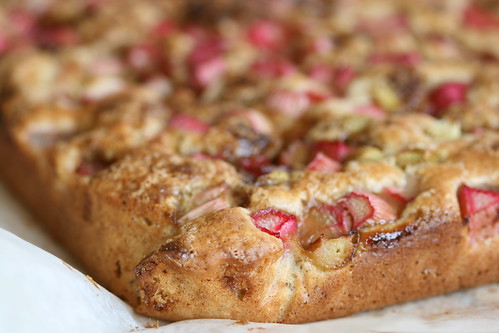
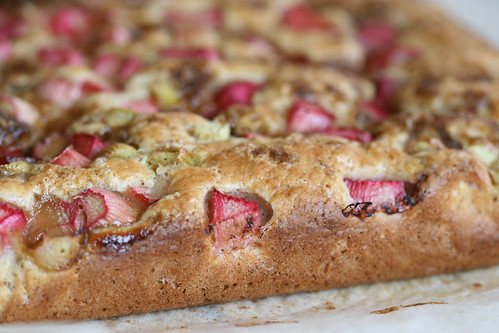
Spiced Rhubarb Cake Recipe

Rhubarb cake / Rabarberikook

I've baked probably about dozen rhubarb cakes and tarts over the last few weeks, and I still haven't had enough. Rhubarb is the first local "fruit" (I know it's actually a vegetable, but it classifies as fruit for the cooking purposes, a bit like quinoa counts as a grain, even if it is not) to arrive on the market stalls, and after a long winter season of mediocre imported fruit flown if from the other side of the world, it feels like a blessing. I'm proud to say that I managed to resist buying the imported pink forced rhubarb stalks that arrived about a fortnight earlier - and the sweeter the home-grown rhubarb tasted (if one can use that word in relation to rhubarb :))

Here's one simple tray bake recipe, made special by generous amounts of cinnamon and cardamom, and the lack of eggs. It's soft, tender and tasty. Choose the pinkest rhubarb you can find, and you're guaranteed one Pretty in Pink cake (note that I never peel my rhubarb stalks. Cannot see the point, unless they're very large and stringy, in which case it's better to avoid them anyway).

Serve with icing sugar or vanilla custard. Keeps fresh for a few days because of the buttermilk content.

Spiced Rhubarb Cake
(Kevadine rabarbri-plaadikook)

Rhubarb cake / Rabarbrikook

500 ml kefir or buttermilk (2 cups)
50 g unsalted butter, melted and cooled
200 g sugar (1 cup)
300 g plain/all-purpose flour (2 cups)
100 ml potato starch/cornflour (just under 1/2 cup)
0.5 Tbsp bicarbonate of soda
0.5 Tbsp freshly ground cardamom
0.5 Tbsp ground cinnamon

Topping:
400 g rhubarb, sliced thickly
7 Tbsp muscovado sugar

Preheat the oven to 200 C/400 F. Line and/or grease a baking tray (ca 25-30 x 34 cm)*.
Combine the kefir/buttermilk and melted butter.
Combine the flour, potato starch, sugar, bicarbonate of soda, cinnamon and cardamom. Fold in the buttermilk mixture.
Pour or spoon the batter into the baking tray, scatter rhubarb on top and sprinkle with sugar.
Place immediately into the oven (the baking soda starts reacting with the buttermilk as soon as they come into contact) and bake for 30-40 minutes, until the cake is golden brown on top.

* I cooked mine in a baking tray sized 25x34 cm, but you could easily use a large tray. Reduce the baking time accordingly.

Other rhubarb cake recipes @ Nami-Nami:
Rhubarb Sponge Cake with Almonds
My favourite rhubarb muffins
Rhubarb and coconut tart
Gluten-free Rhubarb Crumble
Creamy Rhubarb Pie

Wednesday, August 22, 2007

Estonian desserts: KAMA, the modern-traditional way


UPDATE 1.9.2007: You can read Johanna's round-up here!

My dear blog friend Johanna is hosting the latest round of Sugar High Friday, and the theme is local specialities. There are plenty of typical Estonian cakes and desserts I could write about, but considering that I have recently posted kama promotion packs* to some lovely bloggers across the world, I thought it would be appropriate to give the recipients some tips for using that funny Estonian roasted meal mixture consisting of boiled, roasted and ground peas, rye, barley and wheat. I've written thoroughly about kama here, and shared recipes for kama mousse with season's berries, and boozy kama & mascarpone truffles before. I think it's time to move on and give you the recipe for the authentic way of eating kama.

Well, semi-authentic. Adding sugar to kama is a 20th century thing. The really 'authentic' way of eating kama would be without sugar and accompanied with bread and salted sprats, or perhaps humble sandwiches. That's not how most Estonians think of kama nowadays, however, to whom kama drink as described below is more familiar and rather popular summer fare..

I understand it's tricky to replicate, as you need both a kama mixture and a fermented milk product (kefir or buttermilk or sour milk) for making this, both of which aren't so easily available. I guess thin plain drinking yogurt would work, too.

Kama, the traditional Estonian summer drink/dessert
(Kama, traditsioonilisel moel)
Serves 1


250 ml kefir, sour milk or buttermilk
2 Tbsp kama mixture
2 Tbsp sugar
a pinch of salt

Mix all ingredients, let stand in the fridge for 10 minutes, then garnish with berries (I've used Alpine strawberries from my container garden), bilberry syrup (see photo here) or go all modern with a drizzle of chocolate sauce (top).

Serve. Kama can either be eaten with a small spoon, or drunk straight from the cup. Use more or less kama mixture, depending on your preferences.

* Kama Promotion Packs consist of a 400 g packet of kama flour, a bag of kama breakfast cereal, a bar of kama 'chocolate' and a packet of kama 'Tootsie rolls'. Contact me if you're interested in trying it - I'm happy to send it to you, though I've decided to charge P&P from now on.

Friday, December 04, 2009

Caraway teacake


Adding caraway seeds to your teacake does not seem like an obvious idea, but it works. Caraway seeds are much beloved in the Northern and Eastern Europe. In Estonia we add them liberally to rye bread, to oven-baked potato wedges, into sauerkraut soups and side dishes. We usually do not add them to desserts, but there's something about the spicy earthiness of caraway seeds that complements the rich flavour of this typical Estonian teacake.

The recipe below results in a flavoursome cake with nice, dense and moist crumb. Perfect with a cup of afternoon tea..

Caraway Cake
(Köömnekeeks)
About 10 slices

180 g butter, melted and cooled
2 large eggs
170 g caster sugar (200 ml)
250 g all-purpose flour (450 ml)
1 tsp baking powder
a pinch of salt
2 Tbsp whole caraway seeds
200 ml sour milk or kefir or fermented buttermilk

Whisk the eggs and sugar until pale and thick. Stir in the kefir or fermented buttermilk.
In a medium bowl, combine flour, baking powder, salt and caraway seeds, then gently fold into the egg mixture.
Finally stir in the cooled melted butter.
Pour the batter into a lined 1-litre cake tin.
Bake in a pre-heated 180 C oven for 40-50 minutes, until the cake is golden brown and a toothpick inserted in the middle remains clean.
Cool before cutting into slices.

Friday, August 31, 2007

Emma Leppermann plums, and a good old-fashioned plum cake


For weeks, K. has been asking me to check if they already sell Emma Leppermann plums at the market. These are his favourites, and also some of the best-loved plums in Estonia - juicy, flavoursome, sweet & tangy, large and pretty, round and yellow-pink (see picture here). (The cultivar was developed by a German gardener W. Leppermann back in 1897, and he named the tree after his wife; if you read Danish, then you can read more here and here:)

Last Saturday morning we headed to the market again to stock up on various fruit and vegetables. We were due to visit my parents afterwards, and knowing that their garden has a lot to offer - my mum's got a really green thumb - I asked my mum what any good daughter would: 'Mom, we're coming over for a cup of coffee later. Have you got anything in the garden for us?' She said she's got some plums and two 'zucchinis'. I made a mental note of that (some plums, two supersized marrows), and headed to the market, where I stocked up on lots of gorgeous late summer fruit and vegetables - some pears, beets, bell peppers, leeks, onions and broad beans from the vegetable aisles, and two bottles of spicy adjika from my favourite market lady. And, rather excitedly, I spent 50 kroons (that's about £2.20 or just over $3.00) on a kilogram of K's favourite plums.

When we arrived at my parents place, I was met by a huge plum tree absolutely stuffed with ripe, juicy, delicious Emma Leppermann plums. I had never realised that she had this huge tree there (my excuse is that my parents moved into the house when I was still living in Edinburgh, and during my twice-annual visits - early summer and Christmas - aren't exactly prime plum season). My sweet mum was quite amused when I told her we had just bought those very same plums at the market. She gave us two bags, and within half an hour we had picked about 10 kilograms of the best plums on earth! That's 500 kroons worth of plums!!!

Consequently, during the last week I've eaten more plums than I can remember. I've made two different types of plum jam - one 'traditional', one with rum (yum!!). I've made a plum compote which we've eaten with whipped cream as a dessert for a few days, and neither one of us seems to be tired yet. And I baked a very simple and satisfying plum cake, which we finished between us far too quickly.

Here's the cake. The recipe is adapted from "Kirsi- ja ploomikoogid. Magustoidud" (100 Rooga, 2007), but it's pretty similar to the one my mum used to make us years ago. 'Kodune' or 'homey' is the word K. used to describe this cake. It must be a compliment of a highest sort, as he was reaching for his fourth piece when saying that..

Note the beautiful yellow shade of the cake - we're using eggs from these very happy chicken.

Plum cake
(Lihtne ploomikook)
20 pieces


500-600 grams ripe plums, washed

Dough:
2 large eggs
250 grams sugar
200 ml kefir or buttermilk or yogurt
200 ml milk
125 grams butter, melted and cooled
350 grams plain flour/all-purpose flour
3.5 tsp baking powder

Halve the plums, remove the stones and cut plums into quarters.
Whisk eggs with sugar until pale and thick. Stir in kefir/buttermilk, milk and melted butter.
Mix flour with baking powder and fold into the egg mixture.
Pour into a lined 24x32 cm baking tray*, dot with plum quarters and sprinkle with pearl sugar.
Bake at 200C for about 30 minutes, until cake is golden brown and well risen (test for doneness with a sharp knife or wooden toothpick).
Cool slightly, then cut into squares.

* Our cake was 4 cm high, and that's how we like it. You could use a large baking tray, but your cake would be thinner.

Sunday, October 14, 2012

My recipes in Home & Garden (Kodu & Aed), October 2012

Kodu & Aed, oktoober 2012 (minu esimene toimetatud köögirubriik / I'm their new food editor)

This is the cover of the October issue of one of the best-selling home magazines in Estonia, Kodu and Aed (Home and Garden) and it has my name on the cover page :)

"How come?", you wonder.

In early September I got a phone call from their editor-in-chief, Ms Veigel, asking if I'd be interested in being the editor of the food section. The phone call was totally unexpected and came out of the blue - but as I am unable to return to my academic post at the University just now, I decided to say yes. It all went very quickly then - turned out they wanted me to be in charge of the October issue already and I had about a fortnight to come up with the menu and do the photoshoot. With the help of Juta Kübarsepp, the photographer, we ended up with the following "Pille Petersoo sügismarjamenüü" aka my autumn berries menu. The concept behind the menu was that while Estonians are very good in forageing for wild forest berries (cranberries, blueberries, bilberries, cloudberries, lingonberries and such like), they often overlook the berries in our own garden. Hence I focused on black aronia aka chokeberries (a popular and very beautiful hedge plant, the berries are mainly used for making cordial), sea-buckthorn berries (the super-berry of 1990s and 2000s over here) and rowanberries (the berries of rowan or mountain ash; see also and article in The Guardian).  All three are pretty abundant, especially if you live in a small garden town or on the countryside, yet the vitamin-rich and antioxydant-rich fruit of those trees/bushes are too often left for birds to eat (while trendy urbanites spend a fortune on exotic super-berries like acai, goji, golden inca etc).

Here's the menu, photos by Juta Kübarsepp. 

Gravadlax with sea-buckthorn juice and berries: Õrnsoolatud forelli- või lõhefilee astelpajuga / Gravadlax with sea-buckthorn juice and berries

My autumn berry menu began with lightly salted salmon filet (rainbow trout would be excellent, too), that had been seasoned with salt, sugar, pepper and concentrated sea-buckthorn juice. After 24 hours in the fridge, the fish was thinly sliced and garnished with whole sea-buckthorn berries.

Beef or venison "olives" with rowanberry gravy, accompanied with carrot ragout:
Liharullid pihlakakastmega ning porgandiraguu / Beef "olives" with rowanberry gravy, carrot ragout
The sliced beef or venison is topped with sliced carrot, onion and some rowanberries, then rolled up, fried in the mixture of butter and oil, and then simmered in liquid until done.  The carrot ragout is a simple mix of sliced carrots, onions, oil, water, rosemary and seasonings. Earlier versions of both recipes have been featured here on Nami-Nami about five years ago (see here).

Black aronia smoothie and whipped semolina pudding with apples and black aronia berries:
Aroonia-õunamannavaht & arooniasmuuti / Black aronia smoothie and black aronia and apple pudding

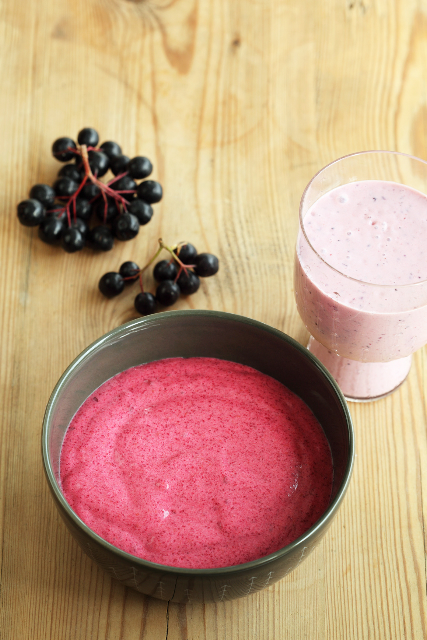
The smoothie is a mix of banana, a handful of black aronia berries, a spoonful of kama or oat bran or oats, a cup of kefir or plain yogurt, sweetened with honey or maple syrup. The whipped semolina pudding (mannavaht) is made with water, apples, black aronia berries, sugar and (wholemeal or spelt) semolina/cream of wheat.

Sea-buckthorn smoothie and sea-buckthorn kissel with crispy rye bread crumbs:
Astelpajusmuuti & kissell krõbeda rukkipuruga / Sea-buckthorn smoothie and sea-buckthorn kissel with crispy rye bread crumbs
The smoothie is a mix of banana, regular or oat milk, (frozen) sea-buckthorn berries or undiluted juice, sweetened with honey or maple syrup. The fruit soup (kissel) contains water, sugar, pureéd sea-buckthorn berries and potato starch/flour (cornflour would do), served with curd cheese mouse and garnished with crispy rye bread crumbs.

How do you like the menu? Are you familiar with any of the berries and if yes, then how do you tend to use them in the kitchen.

We shot the November issue last week and are shooting the December one in a few days, so there's a lot of cooking and writing going on at our house just now.

Monday, August 08, 2016

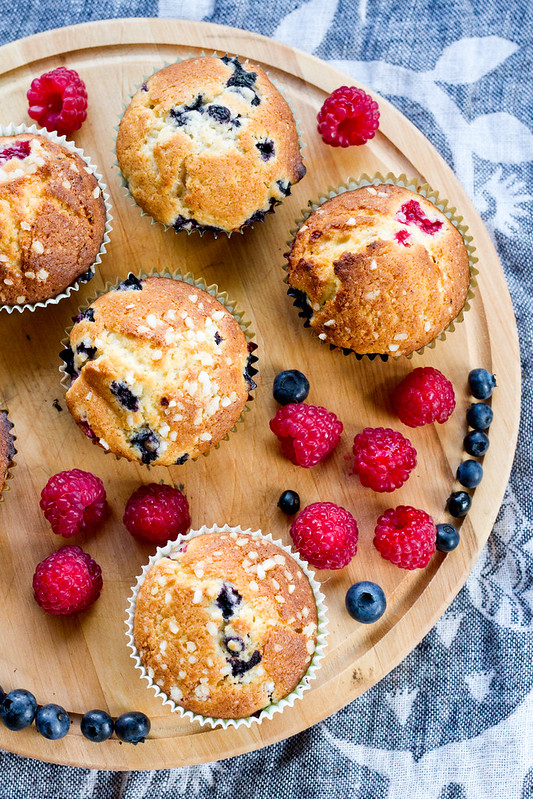
Berry muffins, fit for the Queen

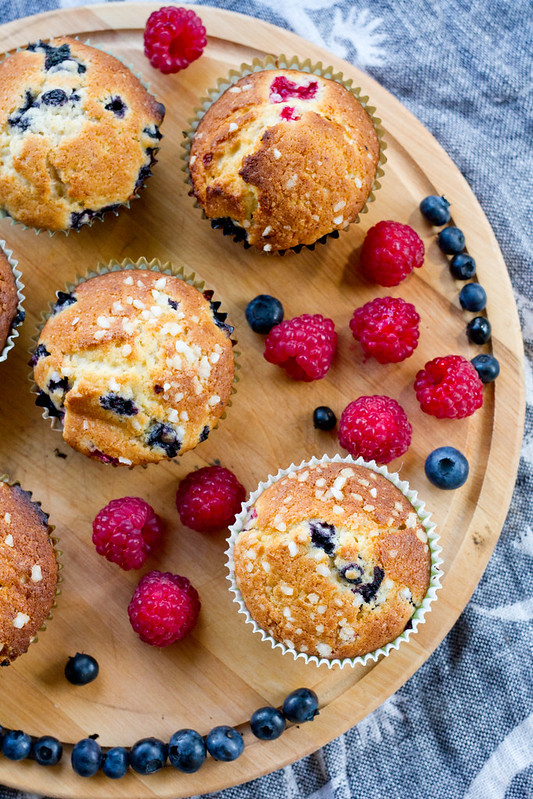
Kuningannamuffinid ehk vaarika-mustikamuffinid. Raspberry and blueberry muffins.

For some reason, our northern neighbours, the Finns, call dishes containing raspberries and blueberries (well, actually bilberries) kuningatar-this and kuningatar-that, the prefix kuningatar- meaning the queen. I'm yet to conduct research why this is so (any Finnish readers out there who know? Ritva, perhaps?), but here are some delicious summer muffins containing blueberries and raspberries - and would hence be called kuningatarmuffinsit or "queen's muffins" in Finland :)

I call them simply:

Summer Berry Muffins
(Kuningannamuffinid)
Yields 12 regular muffins

100 g butter, at room temperature
125 g caster sugar
2 tsp vanilla sugar
2 eggs (L)
50-100 ml (about 4-7 Tbsp) milk, buttermilk or kefir
120 g all-purpose flour or fine white spelt flour
60 g wholemeal flour
1.5 tsp baking powder
200 g blueberries and raspberries
pearl sugar (optional)

Cream the butter and sugars until white and soft (I use the paddle attachment of my standing mixer). Add the eggs, one at a time, and whisking thoroughly after adding each egg. Pour in the milk.

Mix the dry ingredients (flours and baking powder), fold into the egg, butter and sugar mixture.

Finally, gently fold in the berries.

Line the muffin pan with paper muffin liners, then divide the muffin mixture into the muffin cups. Sprinkle with pearl sugar, if you feel like.

Bake at pre-heated 200 C (390 F) for 15-20 minutes, until the muffins have risen and are lovely golden brown.

Let cool a little and serve.

These are best on the day they are baked. Here's a sneak peek to the inside of the muffin: my instagram muffin-pic


Kuningannamuffinid ehk vaarika-mustikamuffinid. Raspberry and blueberry muffins.

Thursday, August 30, 2012

Average Betty makes traditional Estonian barley bread

Remember my recent post about a quirky American foodblogger, Sara o'Donnell aka Average Betty, visiting Estonia? Well, she's now back home, and going through all the lovely recipes served at our party and mentioned in my post (or at least that's what I'd love to think :)). She has also posted her first Estonian recipe video on her very popular YouTube channel, where she makes and bakes the delicious and simple Estonian barley bread, odrajahukarask.
Here's the link to Average Betty's YouTube recipe video* - do check it out, it's very informative and entertaining at the same time.

Sara uses a recipe from Marika Blossfeldt's excellent book Essential Nourishment: Recipes from My Estonian Farm. and the bread on Sara's photo (on the left) and on the video looks just perfect.

Here are links to some other blog posts written  by Sara about her trip to Estonia:
Estonian epicures and how to choose wine infographic (August 3)
My day with chef Dimitri Demjanov (August 20)
Traditional Estonian barley bread recipe  (August 29)
Leib: Estonian for Bread  (August 30)

* Note that while the soda bread/barley bread Average Betty is making is traditionally Estonian, the music at the beginning and at the end of the video is definitely not. Sara was here during the Old Town Festival, and wandering around our beautiful Town Hall Square while some Russian babushkas were on the stage, singing :)

Once you've tried Sara's/Marika's recipe for the traditional soda bread, remember that you'll find two more recipes for the Estonian barley bread/soda bread here on Nami-Nami.

Estonian soda bread/barley bread with kefir or cultured buttermilk: Estonian Soda Bread / Odrajahu-hapupiimakarask

Estonian barley bread with ricotta:


Feel free to browse all the Estonian recipes here on Nami-Nami.

Friday, September 12, 2014

Whipped semolina pudding with apples and black aronia berries

Aroonia-õunamannavaht & arooniasmuuti / Black aronia smoothie and black aronia and apple pudding
Recipe by Pille @ Nami-NamiAbove photo by Juta Kübarsepp for the October 2012 issue of Kodu ja Aed ("Home and Garden", an Estonian monthly magazine. I've been their food writer since October 2012). 

Back in July 2013, The Wall Street Journal touted the slightly astringent and tart black aronia as possibly the next superberry. While WSJ listed it alongside other health-giving berries, Fox News wrote more directly: Aronia: The North American super berry with cancer-fighting properties., calling aronia the "King Kong of antioxidant berries" (other than that, it's actually a pretty good and informative article). In a word - it's a great berry that's very good to you!

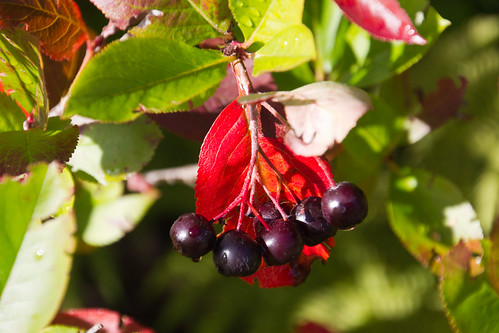
Black aronia berry has been popular here in Estonia for decades - it makes a beautiful hedge plant, especially in the autumn:

Black aronia / Must aroonia

See what I mean? The aronia plant has most beautiful dark red leaves in the autumn!

Usually the berries are used to make cordial, though they can be used in so many other ways. I often throw a handful of berries into my smoothie, and I've provided links to various recipes below. Here's a simple autumnal pudding, using apples, aronia berries and cream of wheat/semolina.

Black aronia and apple whipped semolina pudding
(Aroonia-õunavaht)
Serves 4 to 6

1 l (4 cups) water
500 ml (2 cups) of cleaned black aronia berries and apple chunks
100 g caster sugar
a pinch of salt
200 ml semolina/cream of wheat (wholewheat or spelt semolina is fine, too)

Put the aronia berries and chopped apples into a saucepan, pour over the water. Bring into a boil, then reduce heat and simmer for about 15 minutes, until the aronia berries have softened.

Take a bowl (or another saucepan) and cover with a sieve. Pour the cooked apples and black aronias - and their boiling liquid - onto the sieve and using the back of a wooden spoon, press as much of the fruit through the sieve. Season the mixture with sugar and a pinch of salt. Bring into a boil.

Pour semolina quickly into the boiling mixture, stirring vigorously to avoid any lumps. Then reduce the heat and simmer gently for 10-15 minutes, stirring every now and then, until semolina - and the pudding - thickens. Remove the pan from the heat and leave to cool for about half an hour. Whisk until fluffy and light - this is best done with an electric mixer.

Serve with milk.

More recipes using black aronia berries aka chokeberries:
Black aronia muffins @ Nami-Nami
Black aronia and kefir smoothie @ Nami-Nami
Aronia jam @ Blooms 'n' Food
6 recipes @ Deep Roots
Aronia jam @ Sto kolorow kuchni (recipe in Polish)
Black aronia soda @ ferdakost
Vispipuuro omenasta ja marja-aroniasta by Riikka @ (recipe in Finnish)
Vispipuuro marja-aroniasta @ Omenaminttu (recipe in Finnish)
Vispipuuro marja-aroniasta ja mustaherukasta by MariMaalla @ Lily (recipe in Finnish)
Aroniaglögi @ Omenaminttu (recipe in Finnish)
Aronia-omenakisselli @ Omenaminttu (recipe in Finnish)
Aronia and rye foam by Malitsu @ Mämmi

(From the recipe archives: this post was originally posted in September 2013)

Wednesday, February 19, 2014

Mascarpone and cottage cheese with raspberries

"Risifrutti" aka cottage cheese and mascarpone pudding with raspberries. Kodujuustudessert vaarikatega.

Trying to reduce the amount of carbohydrates, yet missing something sweet and luscious? Then try this low-carb, gluten-free, wheat-free mascarpone and raspberry pudding - either for breakfast, for dessert or just a quick treat between meals.  It's not dairy-free, however - there's some creamy mascarpone cheese and full-fat cottage cheese in there!

I love the dairy products we get here in Estonia. You get excellent butter, kefir, buttermilk, yoghurt, curd cheese and cottage cheese over here - though the cottage cheese we ate daily in Israel back in 2012 (pictured on the left) was even better. The curds in the Israeli cottage cheese were larger, and much softer than here in Estonia - they really did melt in your mouth!  But apart from that, you cannot fault the Estonian dairy products. We use them a lot and in various delicious ways - just browse through the Estonian recipes on my blog to see all the cakes, desserts and pastries - and even savoury dishes - requiring curd cheese (tvorog/quark/rahka) or the farmers cheese/cottage cheese.

I adopted the recipe from Madbanditten, a popular Danish LCHF-blog. Jane (the blogger) added some sweetener into the dessert as well, which I didn't have nor missed at all - mascarpone is so rich and creamy that it fully satisfies your tastebuds without any added sweetener :)

Simple mascarpone and raspberry pudding
(Kodujuustudessert)
Serves 2

100 g full-fat cottage cheese (also known as farmer's cheese)
100 g mascarpone cheese
0.5 tsp vanilla extract or powder

To serve:
raspberries

Combine cottage cheese and mascarpone in a bowl, add vanilla and mix again. Fold in some raspberries, serve at once or keep covered in the fridge until ready to eat.

Monday, July 29, 2013

Blueberry and feta salad

Mustika-fetasalat. Blueberry and feta salad.

We've had a few good sunny and warm weeks here in Estonia, with temperatures hovering above 20 C on most days (that should be around 70 F). Warmer on some days, with occasional showers. A nice summer indeed.

The weather also determines the food, of course. Ice teas, panzanella and fattoush salads, gazpacho-style and kefir-based cold soups (sweet and savoury) - all these feature heavily. Ice-cream as well, both homemade and shop-bought (Estonian major ice cream makers have come up with some nice flavours, and there's the expensive, but delicious, local organic ice cream brand now, La Muu). Various berries from the farmers market stalls and straight from the bush in our backyard.  Proper summer food :)

I love watermelon and feta salads and have shared few recipes here on my blog: watermelon and feta salad with olives, watermelon and feta salad with lime, watermelon and feta salad with roasted pepitas and balsamic glaze. Still, I was thrilled to discover an alternative fruit and feta cheese salad using blueberries instead. I spotted the recipe over @ the improvised life, and vowed to make it as soon as bilberry season begins. At the end I ended up using large blueberries instead, as I thought they'd be easier to chase with a fork and a knife on a plate than our smaller forest bilberries.

(See the end of the post for more blueberry and feta salad ideas).

Blueberry and Feta Salad with Mint
(Mustikad feta ja mündiga)
serves 1, can be easily multiplied

a large handful or two of blueberries
crumbled feta cheese
few mint leaves, chopped, if too large
sea salt flakes and freshly ground black pepper, to taste
extra virgin olive oil

Place the blueberries into a shallow plate, crumble the feta cheese on top and sprinkle with mint. Season with salt and pepper and drizzle about a teaspoonful of olive oil on top.

Serve immediately.

More blueberry and feta salad recipes:
Blueberry and feta salad with poppyseed dressing by Laura @ Real Mom Kitchen
Blueberry, cucumber and feta salad by Stacie @ One Hungry Mama
Blueberry feta salad with toasted pecans by Courtney @ The Fig Tree: Vegetarian cuisine from around the world
Blueberry, almond and feta salad @ Savvy Mom
Blueberry and grapefruit salad with mint and feta by Briat @ Thought for Food
Blueberry feta cheese salad by Alessandro @ Curative Cuisine
Watermelon, blueberry and feta salad @ Skinny Muffin
Cold pasta salad with asparagus, blueberries, feta and basil by Rowena @ She Knows
Blueberry, cucumber, feta salad by Sharib @ My Judy The Foodie
Salad with feta, blueberries and almonds by Catherine @ Albion Cooks
Blueberry and feta salad by Sues and Chels @ We are NOT Martha

Thursday, July 15, 2010

Kama, the best thing ever ...

... on a hot summer day. Here served with bilberries, wild strawberries and garden raspberries.

Kama with berries / Kama marjadega

I've written more about KAMA here. I love my kama with kefir, which should be widely available in various health food stores and Wholefood dairy aisles near you...